

145
(sample 2) [245]. The structure of 814 ([α] D –36.5°cm
2
g
−1
) was determined by
X-ray crystallographic analysis, but the Flack parameter was nearly 0.5 and thus the
absolute configuration could not be determined. The isolation of an isocomene-type
like compound 814 from a member of the genus Ligularia is quite rare [298]. Five
aromatic compounds, 924, euparin (952), 955, 957, and 961, as well as lupeol (828)
and the oleanane triterpenoid 836 were obtained from sample 3 [247].
3.20 Ligularia przewalskii (Maximowicz) Diels
A recent review of L. przewalskii appeared in 2018, discussing its chemistry and
biological activities in detail [299]. Seven samples of L. przewalskii have been
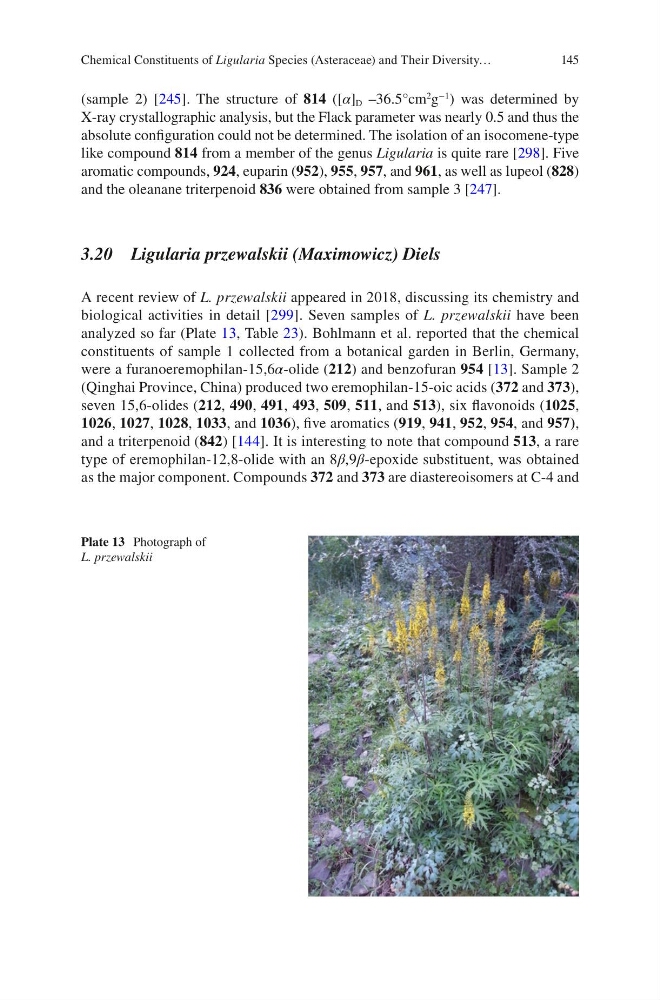
analyzed so far (Plate 13, Table 23). Bohlmann et al. reported that the chemical
constituents of sample 1 collected from a botanical garden in Berlin, Germany,
were a furanoeremophilan-15,6α-olide (212) and benzofuran 954 [13]. Sample 2
(Qinghai Province, China) produced two eremophilan-15-oic acids (372 and 373),
seven 15,6-olides (212, 490, 491, 493, 509, 511, and 513), six flavonoids (1025,
1026, 1027, 1028, 1033, and 1036), five aromatics (919, 941, 952, 954, and 957),
and a triterpenoid (842) [144]. It is interesting to note that compound 513, a rare
type of eremophilan-12,8-olide with an 8β,9β-epoxide substituent, was obtained
as the major component. Compounds 372 and 373 are diastereoisomers at C-4 and
Plate 13 Photograph of
L. przewalskii
Chemical Constituents of Ligularia Species (Asteraceae) and Their Diversity…
(sample 2) [245]. The structure of 814 ([α] D –36.5°cm
2
g
−1
) was determined by
X-ray crystallographic analysis, but the Flack parameter was nearly 0.5 and thus the
absolute configuration could not be determined. The isolation of an isocomene-type
like compound 814 from a member of the genus Ligularia is quite rare [298]. Five
aromatic compounds, 924, euparin (952), 955, 957, and 961, as well as lupeol (828)
and the oleanane triterpenoid 836 were obtained from sample 3 [247].
3.20 Ligularia przewalskii (Maximowicz) Diels
A recent review of L. przewalskii appeared in 2018, discussing its chemistry and
biological activities in detail [299]. Seven samples of L. przewalskii have been
analyzed so far (Plate 13, Table 23). Bohlmann et al. reported that the chemical
constituents of sample 1 collected from a botanical garden in Berlin, Germany,
were a furanoeremophilan-15,6α-olide (212) and benzofuran 954 [13]. Sample 2
(Qinghai Province, China) produced two eremophilan-15-oic acids (372 and 373),
seven 15,6-olides (212, 490, 491, 493, 509, 511, and 513), six flavonoids (1025,
1026, 1027, 1028, 1033, and 1036), five aromatics (919, 941, 952, 954, and 957),
and a triterpenoid (842) [144]. It is interesting to note that compound 513, a rare
type of eremophilan-12,8-olide with an 8β,9β-epoxide substituent, was obtained
as the major component. Compounds 372 and 373 are diastereoisomers at C-4 and
Plate 13 Photograph of
L. przewalskii
Chemical Constituents of Ligularia Species (Asteraceae) and Their Diversity…