

113
ligumacrophyllatin (80) was assigned as a highly oxygenated bicyclic 15,6-olide,
which is unusual, and hence its structure should be checked carefully.
A norbakkane-type ester (134), a 15,6-lactone with an isopropylidene unit (46),
and an ether-type lactone (489) were isolated from sample 3 [73]. The structure of
compound 489 was determined by X-ray crystallographic analysis. From sample 4,
three 1,10-epoxides were purified, namely, compounds 286, 294, and 295 [60]. Four
cacalol derivatives (320, 321, 331, and 337), a 10H-furanoeremophilan-1-one (186),
and an aldehyde (30) were also obtained. The structure of 295 was confirmed by
X-ray diffraction analysis, and the configurations the epoxide moieties of compounds 286 and 294 were reported to be α, while that of 295 was β. However, any
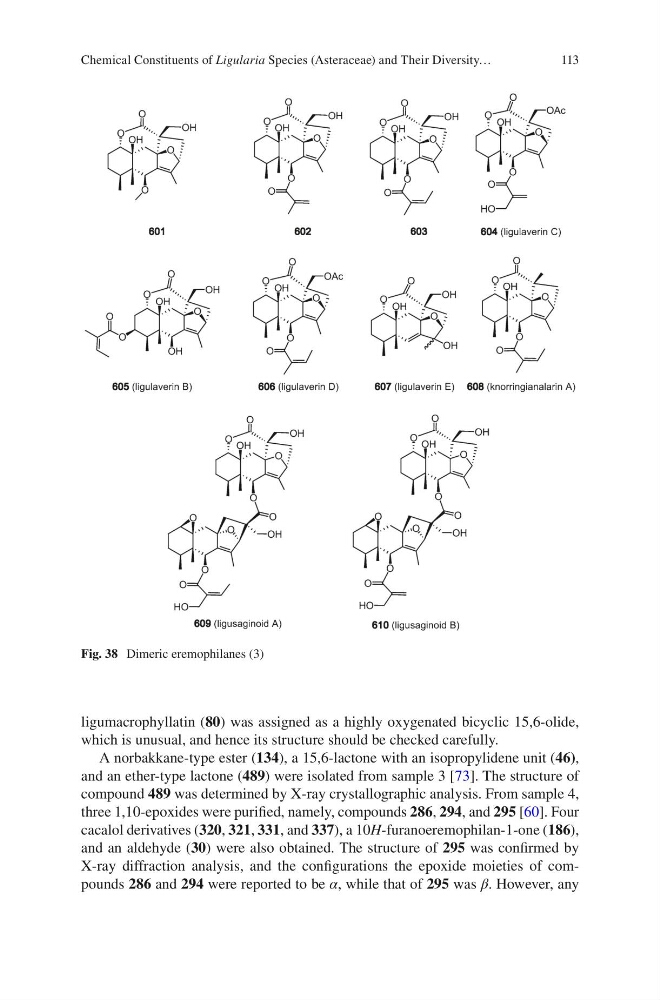
Fig. 38 Dimeric eremophilanes (3)
Chemical Constituents of Ligularia Species (Asteraceae) and Their Diversity…
ligumacrophyllatin (80) was assigned as a highly oxygenated bicyclic 15,6-olide,
which is unusual, and hence its structure should be checked carefully.
A norbakkane-type ester (134), a 15,6-lactone with an isopropylidene unit (46),
and an ether-type lactone (489) were isolated from sample 3 [73]. The structure of
compound 489 was determined by X-ray crystallographic analysis. From sample 4,
three 1,10-epoxides were purified, namely, compounds 286, 294, and 295 [60]. Four
cacalol derivatives (320, 321, 331, and 337), a 10H-furanoeremophilan-1-one (186),
and an aldehyde (30) were also obtained. The structure of 295 was confirmed by
X-ray diffraction analysis, and the configurations the epoxide moieties of compounds 286 and 294 were reported to be α, while that of 295 was β. However, any
Fig. 38 Dimeric eremophilanes (3)
Chemical Constituents of Ligularia Species (Asteraceae) and Their Diversity…