

109
of 499 was determined by X-ray diffraction analysis. From sample 5, the bislactone
498 and the epoxylactone 505 were isolated [205]. Zhang et al. reported the isolation of seven compounds from sample 6 [142]. Two 10H compounds (212 and 498),
lupeol (828), friedelin (845), epifriedelanol (844), taraxerol (851), and a monoterpene (866) were isolated. The absolute configuration of compound 866 was studied
in detail [294], but, unfortunately, the specific rotation was not described [142].
While lupeol (828) has been isolated frequently among Ligularia species, the occurrence of friedelane-type triterpenoids is quite rare.
3.12 Ligularia macrophylla (Ledebour) de Candolle
In 1979, Bohlmann and Grenz studied the chemical constituents of L. macrophylla
(sample 1, Table 15) for the first time and isolated four 10H-furanoeremophilanes
(167, 168, 200, and 212) and the 10-OH-furanoeremophilane (232), as well as two
hydrocarbons (878 and 880) [129]. Sample 2 (from Kashikar, Xinjiang Autonomous
Region of China) was shown to accumulate 2-hydroxyplatyphillide (121), a methyl
ester (37), neoadenostylone (283), an epoxide (308), ursolic acid (848), and two
rather complex compounds, ligumacrophyllatin (80) and ligumacrophyllal (158)
[67, 119]. Ligumacrophyllal (158) is a dimeric ether like secovirgaural (134), and
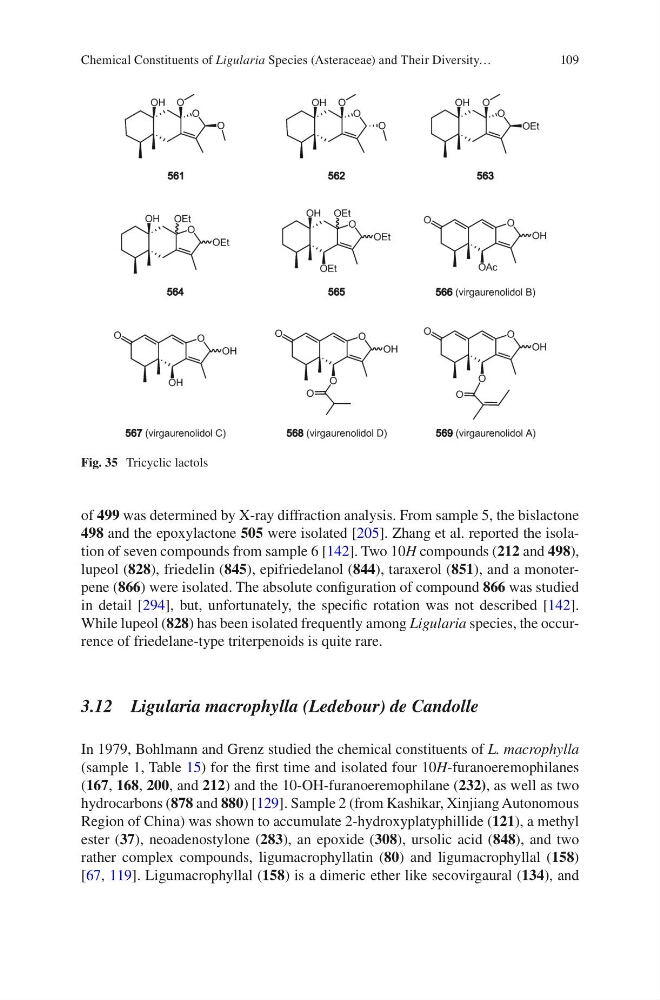
Fig. 35 Tricyclic lactols
Chemical Constituents of Ligularia Species (Asteraceae) and Their Diversity…
of 499 was determined by X-ray diffraction analysis. From sample 5, the bislactone
498 and the epoxylactone 505 were isolated [205]. Zhang et al. reported the isolation of seven compounds from sample 6 [142]. Two 10H compounds (212 and 498),
lupeol (828), friedelin (845), epifriedelanol (844), taraxerol (851), and a monoterpene (866) were isolated. The absolute configuration of compound 866 was studied
in detail [294], but, unfortunately, the specific rotation was not described [142].
While lupeol (828) has been isolated frequently among Ligularia species, the occurrence of friedelane-type triterpenoids is quite rare.
3.12 Ligularia macrophylla (Ledebour) de Candolle
In 1979, Bohlmann and Grenz studied the chemical constituents of L. macrophylla
(sample 1, Table 15) for the first time and isolated four 10H-furanoeremophilanes
(167, 168, 200, and 212) and the 10-OH-furanoeremophilane (232), as well as two
hydrocarbons (878 and 880) [129]. Sample 2 (from Kashikar, Xinjiang Autonomous
Region of China) was shown to accumulate 2-hydroxyplatyphillide (121), a methyl
ester (37), neoadenostylone (283), an epoxide (308), ursolic acid (848), and two
rather complex compounds, ligumacrophyllatin (80) and ligumacrophyllal (158)
[67, 119]. Ligumacrophyllal (158) is a dimeric ether like secovirgaural (134), and
Fig. 35 Tricyclic lactols
Chemical Constituents of Ligularia Species (Asteraceae) and Their Diversity…