

98
occurred in all of samples 2, 10, and 11 [21, 26]. Ligularol (161) was isolated from
samples 6, 7, and 11. Sample 9 produced the above-mentioned compound 199 and
a lactone derivative (491) [26]. Sample 12 elaborated a furanoeremophilane (160),
ligularol ethyl ether (163), 1α-angeloyloxyfuranoeremophilan-6β-ol (178), and an
ethyl ether 179 [21]. Compound 178 is a C-1 epimer of subspicatin B (172). The
configurations at C-11 of compounds eremofarfugins D (542) and E (543) were
deduced by the NMR chemical shift values of H-11 and H 3 -13, because no decisive
NOE observations were made in these cases. It has been determined that
15,6- lactones are formed from their 15-oic acid derivatives, with relevant chemical
evidence obtained by Bohlmann’s group and Kuroda et al. (Sect. 3.5). For this reason, the 15,6-lactones have a 6α-configuration (6β-H). Most of the L. vellerea samples produced 15-oic acids, 15,6-lactones, and ligularol (161), all of which are 10H
derivatives. Our collected samples could be grouped into two in terms of their geographical origin: the Shangri-La type (samples 2–5 and 8–11) and the Luguhu type
(samples 6, 7, and 12). The major compounds obtained proved to be 15- oxygenated
and non-oxygenated eremophilanes, respectively, and these two chemotypes were
separated clearly.
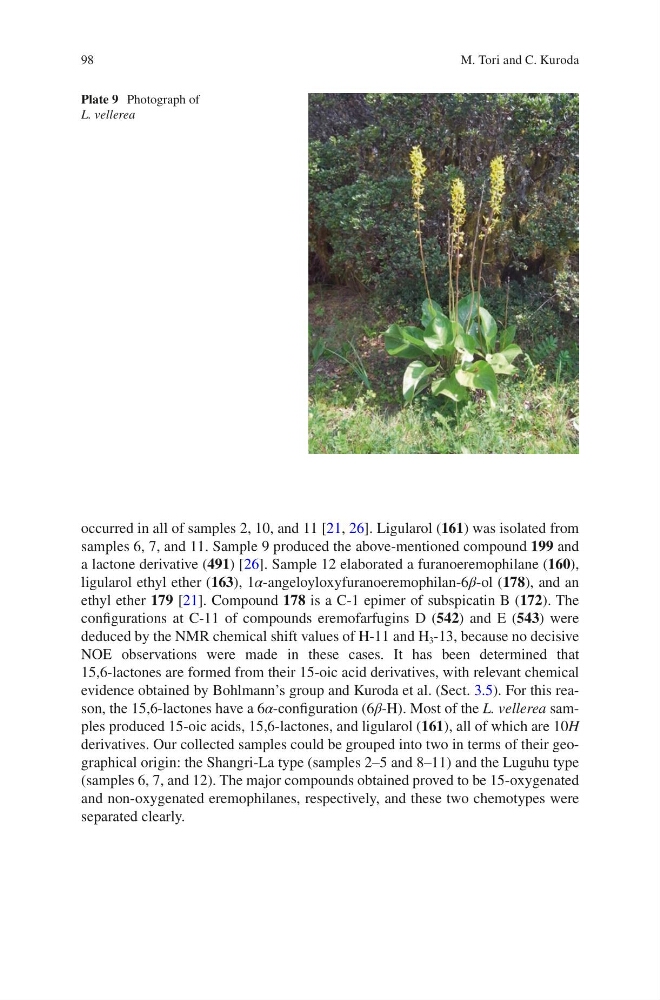
Plate 9 Photograph of
L. vellerea
M. Tori and C. Kuroda
occurred in all of samples 2, 10, and 11 [21, 26]. Ligularol (161) was isolated from
samples 6, 7, and 11. Sample 9 produced the above-mentioned compound 199 and
a lactone derivative (491) [26]. Sample 12 elaborated a furanoeremophilane (160),
ligularol ethyl ether (163), 1α-angeloyloxyfuranoeremophilan-6β-ol (178), and an
ethyl ether 179 [21]. Compound 178 is a C-1 epimer of subspicatin B (172). The
configurations at C-11 of compounds eremofarfugins D (542) and E (543) were
deduced by the NMR chemical shift values of H-11 and H 3 -13, because no decisive
NOE observations were made in these cases. It has been determined that
15,6- lactones are formed from their 15-oic acid derivatives, with relevant chemical
evidence obtained by Bohlmann’s group and Kuroda et al. (Sect. 3.5). For this reason, the 15,6-lactones have a 6α-configuration (6β-H). Most of the L. vellerea samples produced 15-oic acids, 15,6-lactones, and ligularol (161), all of which are 10H
derivatives. Our collected samples could be grouped into two in terms of their geographical origin: the Shangri-La type (samples 2–5 and 8–11) and the Luguhu type
(samples 6, 7, and 12). The major compounds obtained proved to be 15- oxygenated
and non-oxygenated eremophilanes, respectively, and these two chemotypes were
separated clearly.
Plate 9 Photograph of
L. vellerea
M. Tori and C. Kuroda