

A Model for the Assessment of the Water Footprint …
91
the average number of days of rain per year that exceeds 1 mm and 9. 1 is the average
number of storm days per year.
The terrain of the urban area, hydrologically the aquifer of Seville, locally has its
water table around 4 m deep. The water-bearing materials are calcarenites from the
Upper Miocene and different alluvial materials from the Quaternary terraces of the
Guadalquivir. This profile allows the groundwater to be fed into the ground by direct
infiltration of rainwater, since the area is classified as medium permeability by the
Spanish Geological Mining Institute (IGME), corresponding to a Quaternary detrital
basin, so the use of this data (3.3 × 10
–4 cm/s).
S1 consists of a renovation of the supply and sanitation networks where the street is
restored to its previous state, transforming the urban space into an impermeable platform that directs all rainfall and runoff to the general sanitation system together with
the water discharged from homes and businesses. As for the materials incorporated in
the work, it involves the installation of a supply network of 75 m of 250 mm diameter
ductile iron pipe together with its corresponding valves, hydrants, connections to the
network in service and replacement of the current lead home connections with others
made of polyethylene. A sewerage network of 140 m of vitrified stoneware pipe in
diameters 500 and 600 with their corresponding manholes, overhang, manholes and
scuppers. And the replacement of the affected roads to their initial state, being the
roadway a bituminous pavement and the pavements of ceramic paving stones and
prefabricated concrete kerbs.
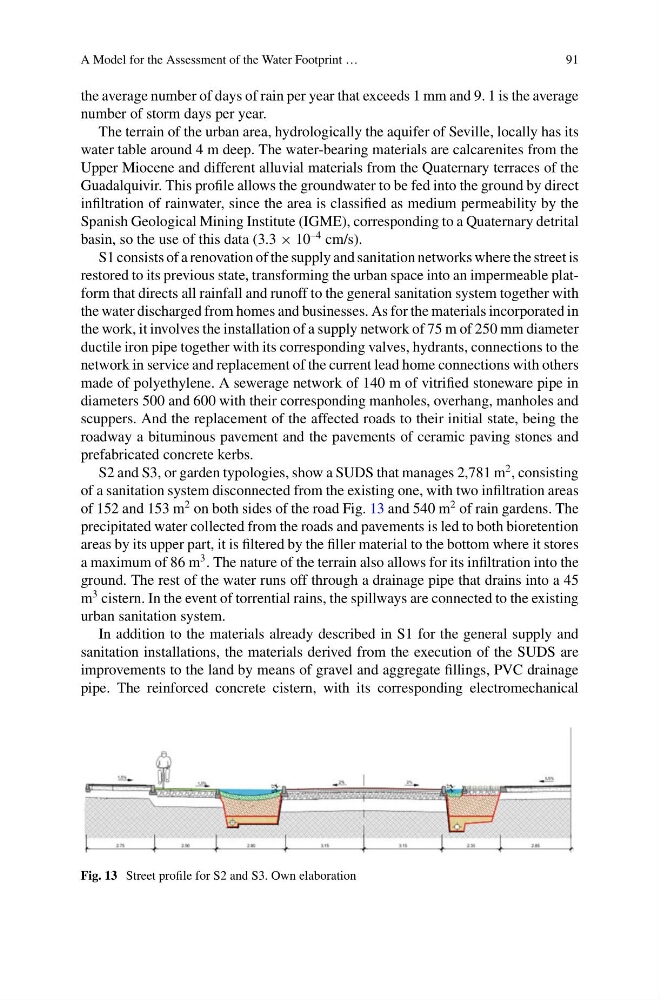
S2 and S3, or garden typologies, show a SUDS that manages 2,781 m
2 , consisting
of a sanitation system disconnected from the existing one, with two infiltration areas
of 152 and 153 m
2 on both sides of the road Fig. 13 and 540 m
2 of rain gardens. The
precipitated water collected from the roads and pavements is led to both bioretention
areas by its upper part, it is filtered by the filler material to the bottom where it stores
a maximum of 86 m
3 . The nature of the terrain also allows for its infiltration into the
ground. The rest of the water runs off through a drainage pipe that drains into a 45
m
3 cistern. In the event of torrential rains, the spillways are connected to the existing
urban sanitation system.
In addition to the materials already described in S1 for the general supply and
sanitation installations, the materials derived from the execution of the SUDS are
improvements to the land by means of gravel and aggregate fillings, PVC drainage
pipe. The reinforced concrete cistern, with its corresponding electromechanical
Fig. 13 Street profile for S2 and S3. Own elaboration
91
the average number of days of rain per year that exceeds 1 mm and 9. 1 is the average
number of storm days per year.
The terrain of the urban area, hydrologically the aquifer of Seville, locally has its
water table around 4 m deep. The water-bearing materials are calcarenites from the
Upper Miocene and different alluvial materials from the Quaternary terraces of the
Guadalquivir. This profile allows the groundwater to be fed into the ground by direct
infiltration of rainwater, since the area is classified as medium permeability by the
Spanish Geological Mining Institute (IGME), corresponding to a Quaternary detrital
basin, so the use of this data (3.3 × 10
–4 cm/s).
S1 consists of a renovation of the supply and sanitation networks where the street is
restored to its previous state, transforming the urban space into an impermeable platform that directs all rainfall and runoff to the general sanitation system together with
the water discharged from homes and businesses. As for the materials incorporated in
the work, it involves the installation of a supply network of 75 m of 250 mm diameter
ductile iron pipe together with its corresponding valves, hydrants, connections to the
network in service and replacement of the current lead home connections with others
made of polyethylene. A sewerage network of 140 m of vitrified stoneware pipe in
diameters 500 and 600 with their corresponding manholes, overhang, manholes and
scuppers. And the replacement of the affected roads to their initial state, being the
roadway a bituminous pavement and the pavements of ceramic paving stones and
prefabricated concrete kerbs.
S2 and S3, or garden typologies, show a SUDS that manages 2,781 m
2 , consisting
of a sanitation system disconnected from the existing one, with two infiltration areas
of 152 and 153 m
2 on both sides of the road Fig. 13 and 540 m
2 of rain gardens. The
precipitated water collected from the roads and pavements is led to both bioretention
areas by its upper part, it is filtered by the filler material to the bottom where it stores
a maximum of 86 m
3 . The nature of the terrain also allows for its infiltration into the
ground. The rest of the water runs off through a drainage pipe that drains into a 45
m
3 cistern. In the event of torrential rains, the spillways are connected to the existing
urban sanitation system.
In addition to the materials already described in S1 for the general supply and
sanitation installations, the materials derived from the execution of the SUDS are
improvements to the land by means of gravel and aggregate fillings, PVC drainage
pipe. The reinforced concrete cistern, with its corresponding electromechanical
Fig. 13 Street profile for S2 and S3. Own elaboration