

66
M. D. Alba-Rodríguez et al.
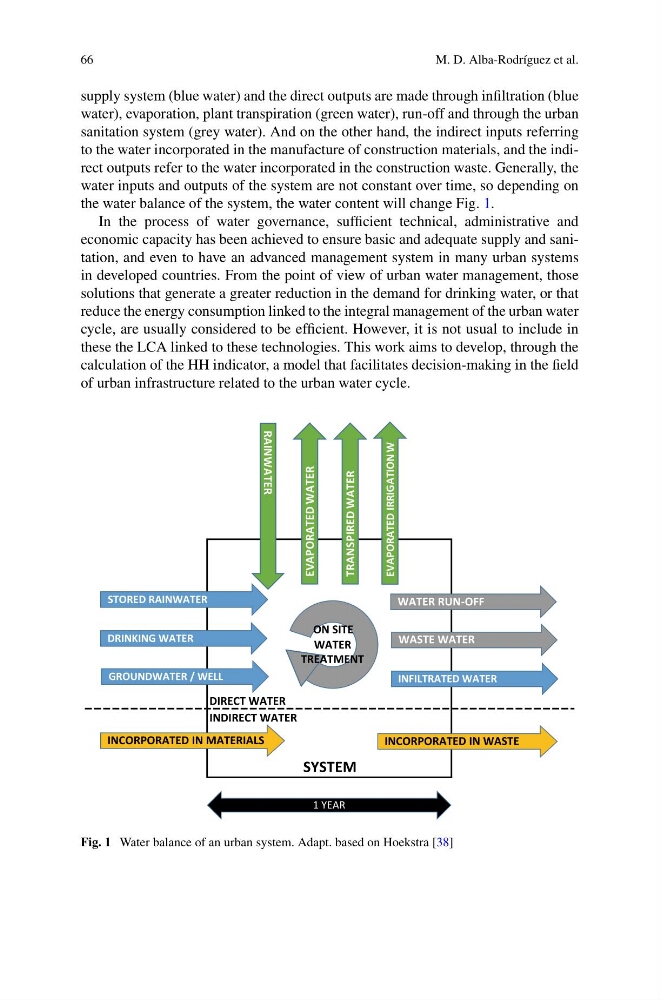
supply system (blue water) and the direct outputs are made through infiltration (blue
water), evaporation, plant transpiration (green water), run-off and through the urban
sanitation system (grey water). And on the other hand, the indirect inputs referring
to the water incorporated in the manufacture of construction materials, and the indirect outputs refer to the water incorporated in the construction waste. Generally, the
water inputs and outputs of the system are not constant over time, so depending on
the water balance of the system, the water content will change Fig. 1.
In the process of water governance, sufficient technical, administrative and
economic capacity has been achieved to ensure basic and adequate supply and sanitation, and even to have an advanced management system in many urban systems
in developed countries. From the point of view of urban water management, those
solutions that generate a greater reduction in the demand for drinking water, or that
reduce the energy consumption linked to the integral management of the urban water
cycle, are usually considered to be efficient. However, it is not usual to include in
these the LCA linked to these technologies. This work aims to develop, through the
calculation of the HH indicator, a model that facilitates decision-making in the field
of urban infrastructure related to the urban water cycle.
DIRECT WATER
INDIRECT WATER
SYSTEM
DRINKING WATER
GROUNDWATER / WELL
INCORPORATED IN MATERIALS
WASTE WATER
INCORPORATED IN WASTE
1 YEAR
WATER RUN-OFF
INFILTRATED WATER
ON SITE
WATER
TREATMENT
STORED RAINWATER
Fig. 1 Water balance of an urban system. Adapt. based on Hoekstra [38]
M. D. Alba-Rodríguez et al.
supply system (blue water) and the direct outputs are made through infiltration (blue
water), evaporation, plant transpiration (green water), run-off and through the urban
sanitation system (grey water). And on the other hand, the indirect inputs referring
to the water incorporated in the manufacture of construction materials, and the indirect outputs refer to the water incorporated in the construction waste. Generally, the
water inputs and outputs of the system are not constant over time, so depending on
the water balance of the system, the water content will change Fig. 1.
In the process of water governance, sufficient technical, administrative and
economic capacity has been achieved to ensure basic and adequate supply and sanitation, and even to have an advanced management system in many urban systems
in developed countries. From the point of view of urban water management, those
solutions that generate a greater reduction in the demand for drinking water, or that
reduce the energy consumption linked to the integral management of the urban water
cycle, are usually considered to be efficient. However, it is not usual to include in
these the LCA linked to these technologies. This work aims to develop, through the
calculation of the HH indicator, a model that facilitates decision-making in the field
of urban infrastructure related to the urban water cycle.
DIRECT WATER
INDIRECT WATER
SYSTEM
DRINKING WATER
GROUNDWATER / WELL
INCORPORATED IN MATERIALS
WASTE WATER
INCORPORATED IN WASTE
1 YEAR
WATER RUN-OFF
INFILTRATED WATER
ON SITE
WATER
TREATMENT
STORED RAINWATER
Fig. 1 Water balance of an urban system. Adapt. based on Hoekstra [38]