

52
P. S. Kumar et al.
although the yield of conventional cotton per year in India, was slightly higher than
that of the organic cotton, conventional farming produces 5.5 times the grey water
footprint produced by the organic farming. Hence, on comparing these two farming
practices, a shift towards organic farming seems to be a more sustainable option as it
drastically minimizes the grey water footprint and also produces comparable yields
of cotton. But still, the research on the effects of organic fertilizers on the water
resources is limited and should be actively pursued to shift our agricultural practices.
13 Industrial Processes
Water is one of the essential resources that is utilized in a large amount in the cotton
textile industry. Most of the water is used to rinse and wash the fabric produced
by weaving or knitting processes. Also, water is used in cooling operations in the
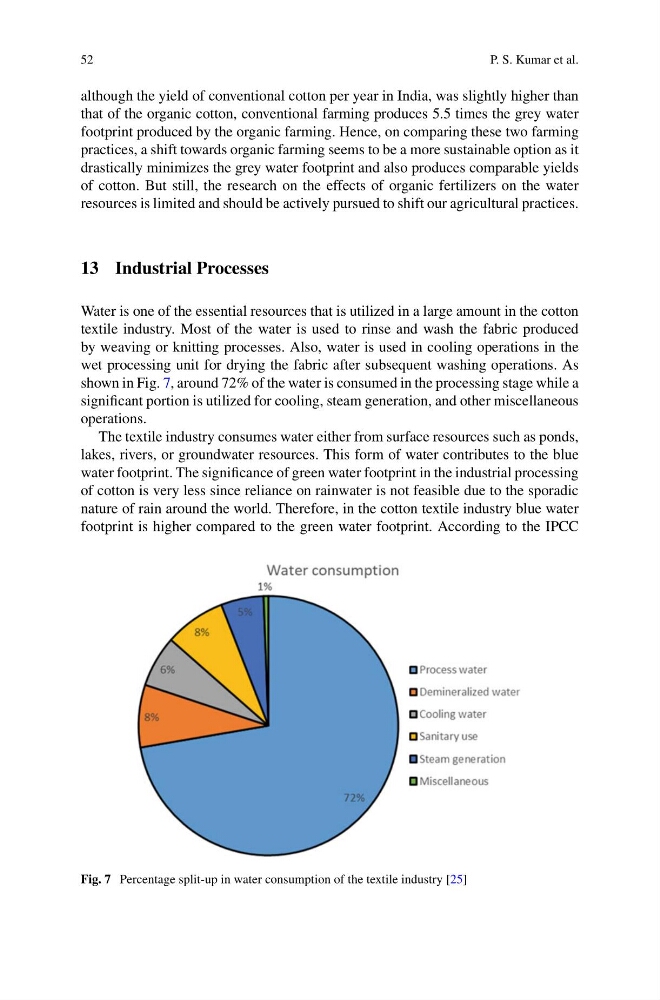
wet processing unit for drying the fabric after subsequent washing operations. As
shown in Fig. 7, around 72% of the water is consumed in the processing stage while a
significant portion is utilized for cooling, steam generation, and other miscellaneous
operations.
The textile industry consumes water either from surface resources such as ponds,
lakes, rivers, or groundwater resources. This form of water contributes to the blue
water footprint. The significance of green water footprint in the industrial processing
of cotton is very less since reliance on rainwater is not feasible due to the sporadic
nature of rain around the world. Therefore, in the cotton textile industry blue water
footprint is higher compared to the green water footprint. According to the IPCC
Fig. 7 Percentage split-up in water consumption of the textile industry [25]
P. S. Kumar et al.
although the yield of conventional cotton per year in India, was slightly higher than
that of the organic cotton, conventional farming produces 5.5 times the grey water
footprint produced by the organic farming. Hence, on comparing these two farming
practices, a shift towards organic farming seems to be a more sustainable option as it
drastically minimizes the grey water footprint and also produces comparable yields
of cotton. But still, the research on the effects of organic fertilizers on the water
resources is limited and should be actively pursued to shift our agricultural practices.
13 Industrial Processes
Water is one of the essential resources that is utilized in a large amount in the cotton
textile industry. Most of the water is used to rinse and wash the fabric produced
by weaving or knitting processes. Also, water is used in cooling operations in the
wet processing unit for drying the fabric after subsequent washing operations. As
shown in Fig. 7, around 72% of the water is consumed in the processing stage while a
significant portion is utilized for cooling, steam generation, and other miscellaneous
operations.
The textile industry consumes water either from surface resources such as ponds,
lakes, rivers, or groundwater resources. This form of water contributes to the blue
water footprint. The significance of green water footprint in the industrial processing
of cotton is very less since reliance on rainwater is not feasible due to the sporadic
nature of rain around the world. Therefore, in the cotton textile industry blue water
footprint is higher compared to the green water footprint. According to the IPCC
Fig. 7 Percentage split-up in water consumption of the textile industry [25]