

46
P. S. Kumar et al.
fabric material and remain permanent within it. These colorants diffuse into the
molecular structure of the fabric and produce color to the fabric material. The type of
interaction between the dye and the cotton fiber determines the color sustainability
of the material. There are different classes of dyes present in the world both natural
and synthetic, with over 1000 types of dyes currently used in industries. The most
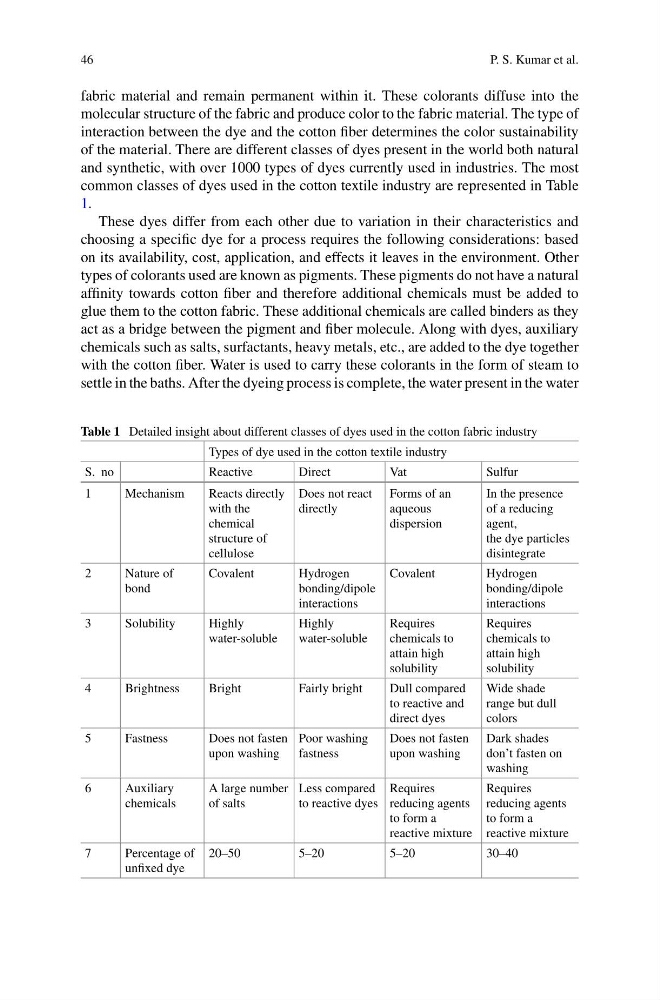
common classes of dyes used in the cotton textile industry are represented in Table
1.
These dyes differ from each other due to variation in their characteristics and
choosing a specific dye for a process requires the following considerations: based
on its availability, cost, application, and effects it leaves in the environment. Other
types of colorants used are known as pigments. These pigments do not have a natural
affinity towards cotton fiber and therefore additional chemicals must be added to
glue them to the cotton fabric. These additional chemicals are called binders as they
act as a bridge between the pigment and fiber molecule. Along with dyes, auxiliary
chemicals such as salts, surfactants, heavy metals, etc., are added to the dye together
with the cotton fiber. Water is used to carry these colorants in the form of steam to
settle in the baths. After the dyeing process is complete, the water present in the water
Table 1 Detailed insight about different classes of dyes used in the cotton fabric industry
Types of dye used in the cotton textile industry
S. no
Reactive
Direct
Vat
Sulfur
1
Mechanism
Reacts directly
with the
chemical
structure of
cellulose
Does not react
directly
Forms of an
aqueous
dispersion
In the presence
of a reducing
agent,
the dye particles
disintegrate
2
Nature of
bond
Covalent
Hydrogen
bonding/dipole
interactions
Covalent
Hydrogen
bonding/dipole
interactions
3
Solubility
Highly
water-soluble
Highly
water-soluble
Requires
chemicals to
attain high
solubility
Requires
chemicals to
attain high
solubility
4
Brightness
Bright
Fairly bright
Dull compared
to reactive and
direct dyes
Wide shade
range but dull
colors
5
Fastness
Does not fasten
upon washing
Poor washing
fastness
Does not fasten
upon washing
Dark shades
don’t fasten on
washing
6
Auxiliary
chemicals
A large number
of salts
Less compared
to reactive dyes
Requires
reducing agents
to form a
reactive mixture
Requires
reducing agents
to form a
reactive mixture
7
Percentage of
unfixed dye
20–50
5–20
5–20
30–40
P. S. Kumar et al.
fabric material and remain permanent within it. These colorants diffuse into the
molecular structure of the fabric and produce color to the fabric material. The type of
interaction between the dye and the cotton fiber determines the color sustainability
of the material. There are different classes of dyes present in the world both natural
and synthetic, with over 1000 types of dyes currently used in industries. The most
common classes of dyes used in the cotton textile industry are represented in Table
1.
These dyes differ from each other due to variation in their characteristics and
choosing a specific dye for a process requires the following considerations: based
on its availability, cost, application, and effects it leaves in the environment. Other
types of colorants used are known as pigments. These pigments do not have a natural
affinity towards cotton fiber and therefore additional chemicals must be added to
glue them to the cotton fabric. These additional chemicals are called binders as they
act as a bridge between the pigment and fiber molecule. Along with dyes, auxiliary
chemicals such as salts, surfactants, heavy metals, etc., are added to the dye together
with the cotton fiber. Water is used to carry these colorants in the form of steam to
settle in the baths. After the dyeing process is complete, the water present in the water
Table 1 Detailed insight about different classes of dyes used in the cotton fabric industry
Types of dye used in the cotton textile industry
S. no
Reactive
Direct
Vat
Sulfur
1
Mechanism
Reacts directly
with the
chemical
structure of
cellulose
Does not react
directly
Forms of an
aqueous
dispersion
In the presence
of a reducing
agent,
the dye particles
disintegrate
2
Nature of
bond
Covalent
Hydrogen
bonding/dipole
interactions
Covalent
Hydrogen
bonding/dipole
interactions
3
Solubility
Highly
water-soluble
Highly
water-soluble
Requires
chemicals to
attain high
solubility
Requires
chemicals to
attain high
solubility
4
Brightness
Bright
Fairly bright
Dull compared
to reactive and
direct dyes
Wide shade
range but dull
colors
5
Fastness
Does not fasten
upon washing
Poor washing
fastness
Does not fasten
upon washing
Dark shades
don’t fasten on
washing
6
Auxiliary
chemicals
A large number
of salts
Less compared
to reactive dyes
Requires
reducing agents
to form a
reactive mixture
Requires
reducing agents
to form a
reactive mixture
7
Percentage of
unfixed dye
20–50
5–20
5–20
30–40