

42
P. S. Kumar et al.
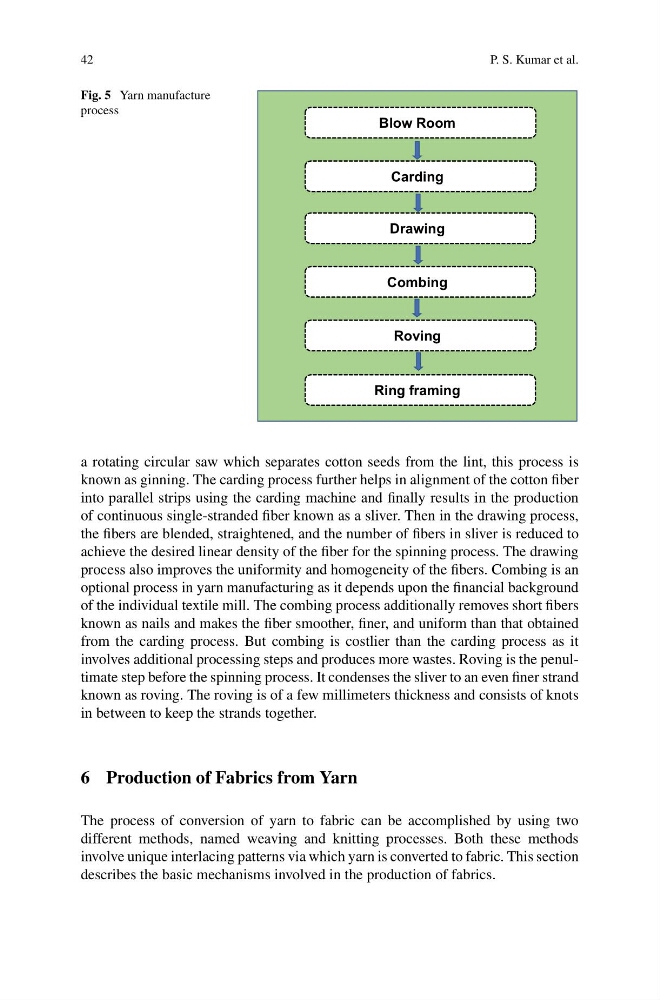
Fig. 5 Yarn manufacture
process
Blow Room
Carding
Drawing
Combing
Roving
Ring framing
a rotating circular saw which separates cotton seeds from the lint, this process is
known as ginning. The carding process further helps in alignment of the cotton fiber
into parallel strips using the carding machine and finally results in the production
of continuous single-stranded fiber known as a sliver. Then in the drawing process,
the fibers are blended, straightened, and the number of fibers in sliver is reduced to
achieve the desired linear density of the fiber for the spinning process. The drawing
process also improves the uniformity and homogeneity of the fibers. Combing is an
optional process in yarn manufacturing as it depends upon the financial background
of the individual textile mill. The combing process additionally removes short fibers
known as nails and makes the fiber smoother, finer, and uniform than that obtained
from the carding process. But combing is costlier than the carding process as it
involves additional processing steps and produces more wastes. Roving is the penultimate step before the spinning process. It condenses the sliver to an even finer strand
known as roving. The roving is of a few millimeters thickness and consists of knots
in between to keep the strands together.
6 Production of Fabrics from Yarn
The process of conversion of yarn to fabric can be accomplished by using two
different methods, named weaving and knitting processes. Both these methods
involve unique interlacing patterns via which yarn is converted to fabric. This section
describes the basic mechanisms involved in the production of fabrics.
P. S. Kumar et al.
Fig. 5 Yarn manufacture
process
Blow Room
Carding
Drawing
Combing
Roving
Ring framing
a rotating circular saw which separates cotton seeds from the lint, this process is
known as ginning. The carding process further helps in alignment of the cotton fiber
into parallel strips using the carding machine and finally results in the production
of continuous single-stranded fiber known as a sliver. Then in the drawing process,
the fibers are blended, straightened, and the number of fibers in sliver is reduced to
achieve the desired linear density of the fiber for the spinning process. The drawing
process also improves the uniformity and homogeneity of the fibers. Combing is an
optional process in yarn manufacturing as it depends upon the financial background
of the individual textile mill. The combing process additionally removes short fibers
known as nails and makes the fiber smoother, finer, and uniform than that obtained
from the carding process. But combing is costlier than the carding process as it
involves additional processing steps and produces more wastes. Roving is the penultimate step before the spinning process. It condenses the sliver to an even finer strand
known as roving. The roving is of a few millimeters thickness and consists of knots
in between to keep the strands together.
6 Production of Fabrics from Yarn
The process of conversion of yarn to fabric can be accomplished by using two
different methods, named weaving and knitting processes. Both these methods
involve unique interlacing patterns via which yarn is converted to fabric. This section
describes the basic mechanisms involved in the production of fabrics.