

20
C. M. Flores-Cayuela et al.
crops, n = 1 is the last day of the harvest of the previous campaign and lds is the first
day of the harvest of the current campaign.
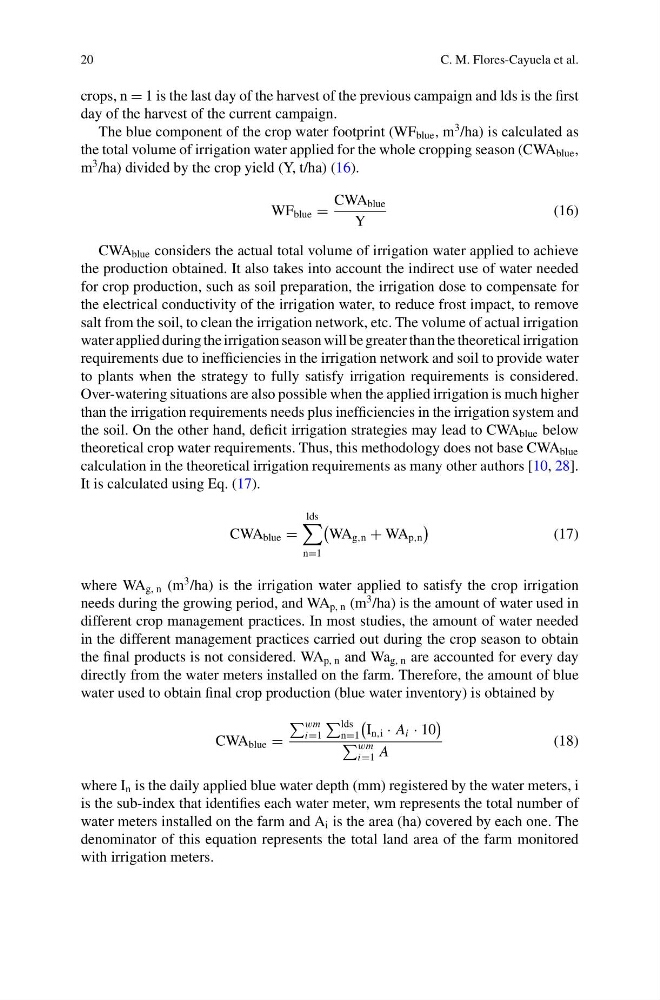
The blue component of the crop water footprint (WF blue , m
3 /ha) is calculated as
the total volume of irrigation water applied for the whole cropping season (CWA blue ,
m
3 /ha) divided by the crop yield (Y, t/ha) (16).
WF blue =
CWA blue
Y
(16)
CWA blue considers the actual total volume of irrigation water applied to achieve
the production obtained. It also takes into account the indirect use of water needed
for crop production, such as soil preparation, the irrigation dose to compensate for
the electrical conductivity of the irrigation water, to reduce frost impact, to remove
salt from the soil, to clean the irrigation network, etc. The volume of actual irrigation
water applied during the irrigation season will be greater than the theoretical irrigation
requirements due to inefficiencies in the irrigation network and soil to provide water
to plants when the strategy to fully satisfy irrigation requirements is considered.
Over-watering situations are also possible when the applied irrigation is much higher
than the irrigation requirements needs plus inefficiencies in the irrigation system and
the soil. On the other hand, deficit irrigation strategies may lead to CWA blue below
theoretical crop water requirements. Thus, this methodology does not base CWA blue
calculation in the theoretical irrigation requirements as many other authors [10, 28].
It is calculated using Eq. (17).
CWA blue =
lds
n=1
WA g,n + WA p,n
(17)
where WA g, n (m
3 /ha) is the irrigation water applied to satisfy the crop irrigation
needs during the growing period, and WA p, n (m
3 /ha) is the amount of water used in
different crop management practices. In most studies, the amount of water needed
in the different management practices carried out during the crop season to obtain
the final products is not considered. WA p, n and Wa g, n are accounted for every day
directly from the water meters installed on the farm. Therefore, the amount of blue
water used to obtain final crop production (blue water inventory) is obtained by
CWA blue =
wm
i=1
lds
n=1
I n,i · A i · 10
wm
i=1 A
(18)
where I n is the daily applied blue water depth (mm) registered by the water meters, i
is the sub-index that identifies each water meter, wm represents the total number of
water meters installed on the farm and A i is the area (ha) covered by each one. The
denominator of this equation represents the total land area of the farm monitored
with irrigation meters.
C. M. Flores-Cayuela et al.
crops, n = 1 is the last day of the harvest of the previous campaign and lds is the first
day of the harvest of the current campaign.
The blue component of the crop water footprint (WF blue , m
3 /ha) is calculated as
the total volume of irrigation water applied for the whole cropping season (CWA blue ,
m
3 /ha) divided by the crop yield (Y, t/ha) (16).
WF blue =
CWA blue
Y
(16)
CWA blue considers the actual total volume of irrigation water applied to achieve
the production obtained. It also takes into account the indirect use of water needed
for crop production, such as soil preparation, the irrigation dose to compensate for
the electrical conductivity of the irrigation water, to reduce frost impact, to remove
salt from the soil, to clean the irrigation network, etc. The volume of actual irrigation
water applied during the irrigation season will be greater than the theoretical irrigation
requirements due to inefficiencies in the irrigation network and soil to provide water
to plants when the strategy to fully satisfy irrigation requirements is considered.
Over-watering situations are also possible when the applied irrigation is much higher
than the irrigation requirements needs plus inefficiencies in the irrigation system and
the soil. On the other hand, deficit irrigation strategies may lead to CWA blue below
theoretical crop water requirements. Thus, this methodology does not base CWA blue
calculation in the theoretical irrigation requirements as many other authors [10, 28].
It is calculated using Eq. (17).
CWA blue =
lds
n=1
WA g,n + WA p,n
(17)
where WA g, n (m
3 /ha) is the irrigation water applied to satisfy the crop irrigation
needs during the growing period, and WA p, n (m
3 /ha) is the amount of water used in
different crop management practices. In most studies, the amount of water needed
in the different management practices carried out during the crop season to obtain
the final products is not considered. WA p, n and Wa g, n are accounted for every day
directly from the water meters installed on the farm. Therefore, the amount of blue
water used to obtain final crop production (blue water inventory) is obtained by
CWA blue =
wm
i=1
lds
n=1
I n,i · A i · 10
wm
i=1 A
(18)
where I n is the daily applied blue water depth (mm) registered by the water meters, i
is the sub-index that identifies each water meter, wm represents the total number of
water meters installed on the farm and A i is the area (ha) covered by each one. The
denominator of this equation represents the total land area of the farm monitored
with irrigation meters.