

14
C. M. Flores-Cayuela et al.
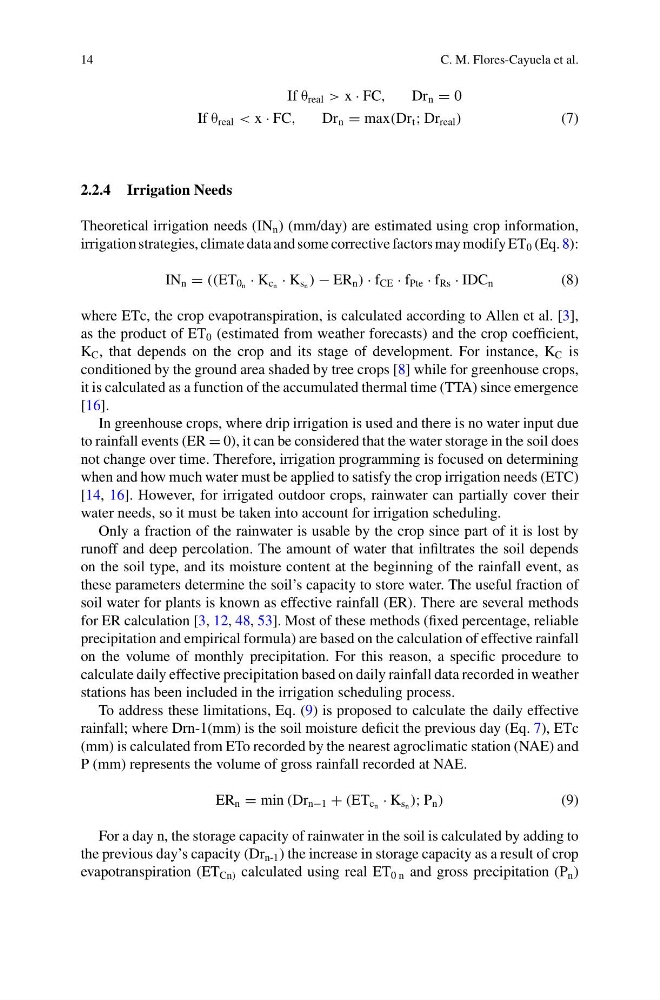
If θ real > x · FC,
Dr n = 0
If θ real < x · FC,
Dr n = max(Dr t ; Dr real )
(7)
2.2.4 Irrigation Needs
Theoretical irrigation needs (IN n ) (mm/day) are estimated using crop information,
irrigation strategies, climate data and some corrective factors may modify ET 0 (Eq. 8):
IN n = ((ET 0 n · K c n · K s n ) − ER n ) · f CE · f Pte · f Rs · IDC n
(8)
where ETc, the crop evapotranspiration, is calculated according to Allen et al. [3],
as the product of ET 0 (estimated from weather forecasts) and the crop coefficient,
K C , that depends on the crop and its stage of development. For instance, K C is
conditioned by the ground area shaded by tree crops [8] while for greenhouse crops,
it is calculated as a function of the accumulated thermal time (TTA) since emergence
[16].
In greenhouse crops, where drip irrigation is used and there is no water input due
to rainfall events (ER = 0), it can be considered that the water storage in the soil does
not change over time. Therefore, irrigation programming is focused on determining
when and how much water must be applied to satisfy the crop irrigation needs (ETC)
[14, 16]. However, for irrigated outdoor crops, rainwater can partially cover their
water needs, so it must be taken into account for irrigation scheduling.
Only a fraction of the rainwater is usable by the crop since part of it is lost by
runoff and deep percolation. The amount of water that infiltrates the soil depends
on the soil type, and its moisture content at the beginning of the rainfall event, as
these parameters determine the soil’s capacity to store water. The useful fraction of
soil water for plants is known as effective rainfall (ER). There are several methods
for ER calculation [3, 12, 48, 53]. Most of these methods (fixed percentage, reliable
precipitation and empirical formula) are based on the calculation of effective rainfall
on the volume of monthly precipitation. For this reason, a specific procedure to
calculate daily effective precipitation based on daily rainfall data recorded in weather
stations has been included in the irrigation scheduling process.
To address these limitations, Eq. (9) is proposed to calculate the daily effective
rainfall; where Drn-1(mm) is the soil moisture deficit the previous day (Eq. 7), ETc
(mm) is calculated from ETo recorded by the nearest agroclimatic station (NAE) and
P (mm) represents the volume of gross rainfall recorded at NAE.
ER n = min (Dr n−1 + (ET c n · K s n ); P n )
(9)
For a day n, the storage capacity of rainwater in the soil is calculated by adding to
the previous day’s capacity (Dr n-1 ) the increase in storage capacity as a result of crop
evapotranspiration (ET Cn) calculated using real ET 0 n and gross precipitation (P n )
C. M. Flores-Cayuela et al.
If θ real > x · FC,
Dr n = 0
If θ real < x · FC,
Dr n = max(Dr t ; Dr real )
(7)
2.2.4 Irrigation Needs
Theoretical irrigation needs (IN n ) (mm/day) are estimated using crop information,
irrigation strategies, climate data and some corrective factors may modify ET 0 (Eq. 8):
IN n = ((ET 0 n · K c n · K s n ) − ER n ) · f CE · f Pte · f Rs · IDC n
(8)
where ETc, the crop evapotranspiration, is calculated according to Allen et al. [3],
as the product of ET 0 (estimated from weather forecasts) and the crop coefficient,
K C , that depends on the crop and its stage of development. For instance, K C is
conditioned by the ground area shaded by tree crops [8] while for greenhouse crops,
it is calculated as a function of the accumulated thermal time (TTA) since emergence
[16].
In greenhouse crops, where drip irrigation is used and there is no water input due
to rainfall events (ER = 0), it can be considered that the water storage in the soil does
not change over time. Therefore, irrigation programming is focused on determining
when and how much water must be applied to satisfy the crop irrigation needs (ETC)
[14, 16]. However, for irrigated outdoor crops, rainwater can partially cover their
water needs, so it must be taken into account for irrigation scheduling.
Only a fraction of the rainwater is usable by the crop since part of it is lost by
runoff and deep percolation. The amount of water that infiltrates the soil depends
on the soil type, and its moisture content at the beginning of the rainfall event, as
these parameters determine the soil’s capacity to store water. The useful fraction of
soil water for plants is known as effective rainfall (ER). There are several methods
for ER calculation [3, 12, 48, 53]. Most of these methods (fixed percentage, reliable
precipitation and empirical formula) are based on the calculation of effective rainfall
on the volume of monthly precipitation. For this reason, a specific procedure to
calculate daily effective precipitation based on daily rainfall data recorded in weather
stations has been included in the irrigation scheduling process.
To address these limitations, Eq. (9) is proposed to calculate the daily effective
rainfall; where Drn-1(mm) is the soil moisture deficit the previous day (Eq. 7), ETc
(mm) is calculated from ETo recorded by the nearest agroclimatic station (NAE) and
P (mm) represents the volume of gross rainfall recorded at NAE.
ER n = min (Dr n−1 + (ET c n · K s n ); P n )
(9)
For a day n, the storage capacity of rainwater in the soil is calculated by adding to
the previous day’s capacity (Dr n-1 ) the increase in storage capacity as a result of crop
evapotranspiration (ET Cn) calculated using real ET 0 n and gross precipitation (P n )