

176
L. Chai et al.
5.1 Methodology
We first determined the water degradation intensity index, dilution water, which
means the minimum freshwater requirement for diluting pollutants at a safe concentration. According to this definition, gray water footprint is defined as the largest
dilution water among pollutants, and this concept can be used to evaluate key water
pollutants. Using this definition, we used the MUIO to calculate the gray water
footprint life cycle assessment of the energy sector:
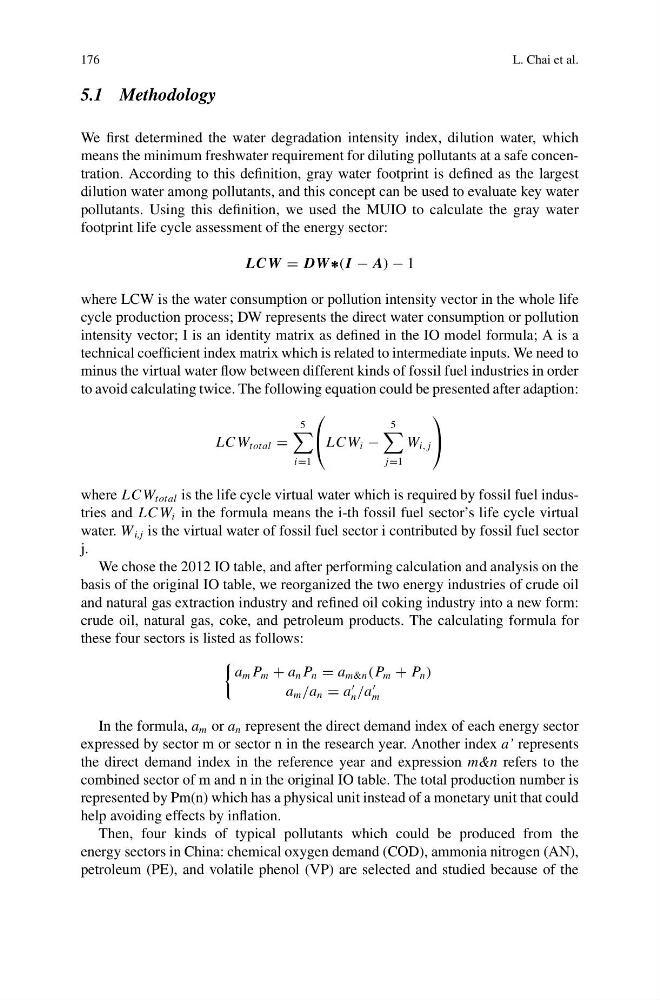
LCW = DW∗(I − A) − 1
where LCW is the water consumption or pollution intensity vector in the whole life
cycle production process; DW represents the direct water consumption or pollution
intensity vector; I is an identity matrix as defined in the IO model formula; A is a
technical coefficient index matrix which is related to intermediate inputs. We need to
minus the virtual water flow between different kinds of fossil fuel industries in order
to avoid calculating twice. The following equation could be presented after adaption:
LC W total =
5
i=1
⎛
⎝ LC W i −
5
j=1
W i, j
⎞
⎠
where LC W total is the life cycle virtual water which is required by fossil fuel industries and LC W i in the formula means the i-th fossil fuel sector’s life cycle virtual
water. W i,j is the virtual water of fossil fuel sector i contributed by fossil fuel sector
j.
We chose the 2012 IO table, and after performing calculation and analysis on the
basis of the original IO table, we reorganized the two energy industries of crude oil
and natural gas extraction industry and refined oil coking industry into a new form:
crude oil, natural gas, coke, and petroleum products. The calculating formula for
these four sectors is listed as follows:
a m P m + a n P n = a m&n (P m + P n )
a m /a n = a
n /a
m
In the formula, a m or a n represent the direct demand index of each energy sector
expressed by sector m or sector n in the research year. Another index a’ represents
the direct demand index in the reference year and expression m&n refers to the
combined sector of m and n in the original IO table. The total production number is
represented by Pm(n) which has a physical unit instead of a monetary unit that could
help avoiding effects by inflation.
Then, four kinds of typical pollutants which could be produced from the
energy sectors in China: chemical oxygen demand (COD), ammonia nitrogen (AN),
petroleum (PE), and volatile phenol (VP) are selected and studied because of the
L. Chai et al.
5.1 Methodology
We first determined the water degradation intensity index, dilution water, which
means the minimum freshwater requirement for diluting pollutants at a safe concentration. According to this definition, gray water footprint is defined as the largest
dilution water among pollutants, and this concept can be used to evaluate key water
pollutants. Using this definition, we used the MUIO to calculate the gray water
footprint life cycle assessment of the energy sector:
LCW = DW∗(I − A) − 1
where LCW is the water consumption or pollution intensity vector in the whole life
cycle production process; DW represents the direct water consumption or pollution
intensity vector; I is an identity matrix as defined in the IO model formula; A is a
technical coefficient index matrix which is related to intermediate inputs. We need to
minus the virtual water flow between different kinds of fossil fuel industries in order
to avoid calculating twice. The following equation could be presented after adaption:
LC W total =
5
i=1
⎛
⎝ LC W i −
5
j=1
W i, j
⎞
⎠
where LC W total is the life cycle virtual water which is required by fossil fuel industries and LC W i in the formula means the i-th fossil fuel sector’s life cycle virtual
water. W i,j is the virtual water of fossil fuel sector i contributed by fossil fuel sector
j.
We chose the 2012 IO table, and after performing calculation and analysis on the
basis of the original IO table, we reorganized the two energy industries of crude oil
and natural gas extraction industry and refined oil coking industry into a new form:
crude oil, natural gas, coke, and petroleum products. The calculating formula for
these four sectors is listed as follows:
a m P m + a n P n = a m&n (P m + P n )
a m /a n = a
n /a
m
In the formula, a m or a n represent the direct demand index of each energy sector
expressed by sector m or sector n in the research year. Another index a’ represents
the direct demand index in the reference year and expression m&n refers to the
combined sector of m and n in the original IO table. The total production number is
represented by Pm(n) which has a physical unit instead of a monetary unit that could
help avoiding effects by inflation.
Then, four kinds of typical pollutants which could be produced from the
energy sectors in China: chemical oxygen demand (COD), ammonia nitrogen (AN),
petroleum (PE), and volatile phenol (VP) are selected and studied because of the