

8
C. M. Flores-Cayuela et al.
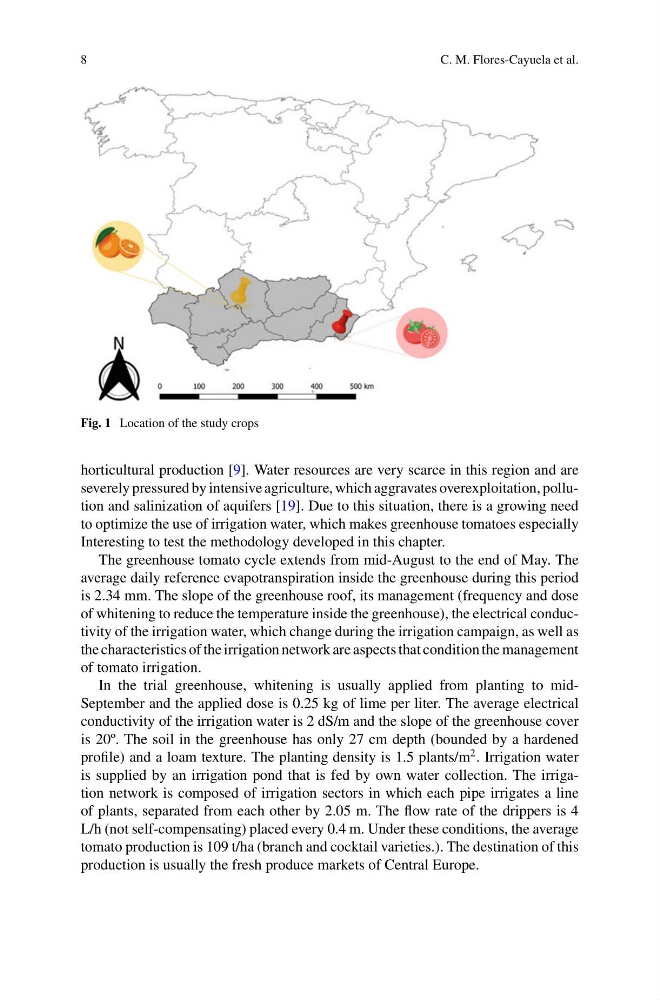
Fig. 1 Location of the study crops
horticultural production [9]. Water resources are very scarce in this region and are
severely pressured by intensive agriculture, which aggravates overexploitation, pollution and salinization of aquifers [19]. Due to this situation, there is a growing need
to optimize the use of irrigation water, which makes greenhouse tomatoes especially
Interesting to test the methodology developed in this chapter.
The greenhouse tomato cycle extends from mid-August to the end of May. The
average daily reference evapotranspiration inside the greenhouse during this period
is 2.34 mm. The slope of the greenhouse roof, its management (frequency and dose
of whitening to reduce the temperature inside the greenhouse), the electrical conductivity of the irrigation water, which change during the irrigation campaign, as well as
the characteristics of the irrigation network are aspects that condition the management
of tomato irrigation.
In the trial greenhouse, whitening is usually applied from planting to midSeptember and the applied dose is 0.25 kg of lime per liter. The average electrical
conductivity of the irrigation water is 2 dS/m and the slope of the greenhouse cover
is 20º. The soil in the greenhouse has only 27 cm depth (bounded by a hardened
profile) and a loam texture. The planting density is 1.5 plants/m
2 . Irrigation water
is supplied by an irrigation pond that is fed by own water collection. The irrigation network is composed of irrigation sectors in which each pipe irrigates a line
of plants, separated from each other by 2.05 m. The flow rate of the drippers is 4
L/h (not self-compensating) placed every 0.4 m. Under these conditions, the average
tomato production is 109 t/ha (branch and cocktail varieties.). The destination of this
production is usually the fresh produce markets of Central Europe.
C. M. Flores-Cayuela et al.
Fig. 1 Location of the study crops
horticultural production [9]. Water resources are very scarce in this region and are
severely pressured by intensive agriculture, which aggravates overexploitation, pollution and salinization of aquifers [19]. Due to this situation, there is a growing need
to optimize the use of irrigation water, which makes greenhouse tomatoes especially
Interesting to test the methodology developed in this chapter.
The greenhouse tomato cycle extends from mid-August to the end of May. The
average daily reference evapotranspiration inside the greenhouse during this period
is 2.34 mm. The slope of the greenhouse roof, its management (frequency and dose
of whitening to reduce the temperature inside the greenhouse), the electrical conductivity of the irrigation water, which change during the irrigation campaign, as well as
the characteristics of the irrigation network are aspects that condition the management
of tomato irrigation.
In the trial greenhouse, whitening is usually applied from planting to midSeptember and the applied dose is 0.25 kg of lime per liter. The average electrical
conductivity of the irrigation water is 2 dS/m and the slope of the greenhouse cover
is 20º. The soil in the greenhouse has only 27 cm depth (bounded by a hardened
profile) and a loam texture. The planting density is 1.5 plants/m
2 . Irrigation water
is supplied by an irrigation pond that is fed by own water collection. The irrigation network is composed of irrigation sectors in which each pipe irrigates a line
of plants, separated from each other by 2.05 m. The flow rate of the drippers is 4
L/h (not self-compensating) placed every 0.4 m. Under these conditions, the average
tomato production is 109 t/ha (branch and cocktail varieties.). The destination of this
production is usually the fresh produce markets of Central Europe.