

124
M. B. Johnson and M. Mehrvar
where WF grey is the grey water footprint (L
3 T
−1 ), ˙
m e is the mass loading rate of a
parameter discharged to a receiver (MT
−1 ), ˙
m a is the mass loading rate of a parameter
abstracted from the receiver that is incorporated into the product and effluent stream
(MT
−1 ), C max is the receiver target maximum concentration (ML
−3 ) and C nat is the
natural concentration in the receiver (ML
−3 ).
During viticulture, loadings to the environment ( ˙
m e ) would be those associated
with leaching, runoff and drifting to a particular receiver. Lamastra et al. [39] present
techniques to calculate these values. Loadings removed from the environment ( ˙
m a )
would be the loadings associated with water taken from the receiver and used for irrigation or other vineyard purposes (diluting chemicals, frost protection, etc.). During
vinification, ˙
m e would represent the loadings from wastewater effluents discharged
to a natural water body after treatment, if any, while ˙
m a would represent the loadings
of parameters in water abstracted from the receiver for process purposes (cleaning,
sanitizing, etc.). During vinification, the parameter concentrations in treated WWW
effluents are often orders of magnitude greater than that present in the receiver. In
addition, water is often abstracted from one source (such as a well) while discharged
as WWW effluent into another (such as a river or lake). Under such circumstances,
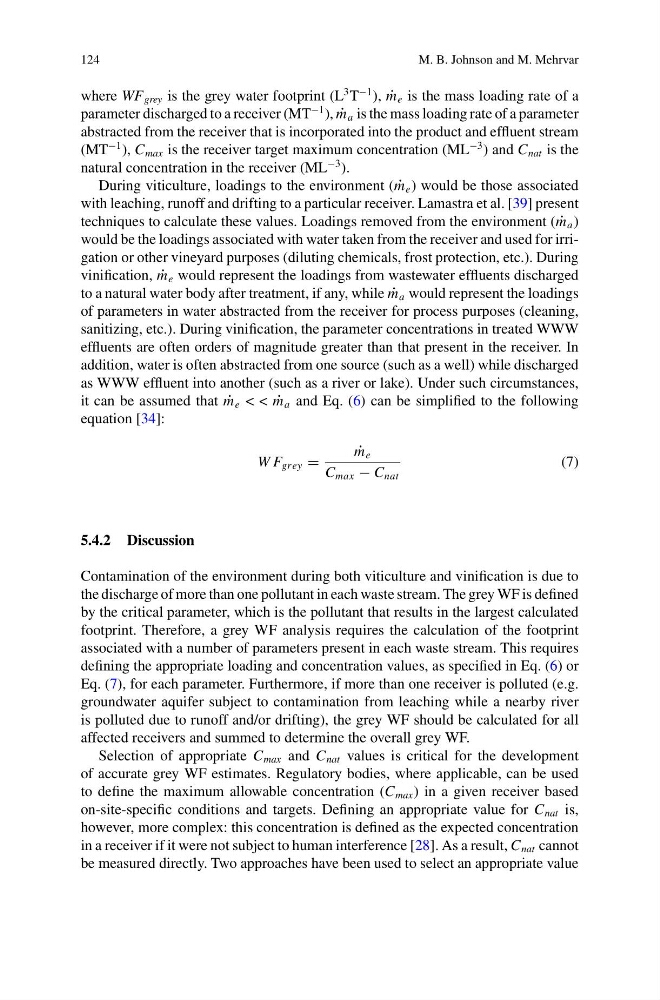
it can be assumed that ˙
m e < < ˙
m a and Eq. (6) can be simplified to the following
equation [34]:
W F grey =
˙
m e
C max − C nat
(7)
5.4.2 Discussion
Contamination of the environment during both viticulture and vinification is due to
the discharge of more than one pollutant in each waste stream. The grey WF is defined
by the critical parameter, which is the pollutant that results in the largest calculated
footprint. Therefore, a grey WF analysis requires the calculation of the footprint
associated with a number of parameters present in each waste stream. This requires
defining the appropriate loading and concentration values, as specified in Eq. (6) or
Eq. (7), for each parameter. Furthermore, if more than one receiver is polluted (e.g.
groundwater aquifer subject to contamination from leaching while a nearby river
is polluted due to runoff and/or drifting), the grey WF should be calculated for all
affected receivers and summed to determine the overall grey WF.
Selection of appropriate C max and C nat values is critical for the development
of accurate grey WF estimates. Regulatory bodies, where applicable, can be used
to define the maximum allowable concentration (C max ) in a given receiver based
on-site-specific conditions and targets. Defining an appropriate value for C nat is,
however, more complex: this concentration is defined as the expected concentration
in a receiver if it were not subject to human interference [28]. As a result, C nat cannot
be measured directly. Two approaches have been used to select an appropriate value
M. B. Johnson and M. Mehrvar
where WF grey is the grey water footprint (L
3 T
−1 ), ˙
m e is the mass loading rate of a
parameter discharged to a receiver (MT
−1 ), ˙
m a is the mass loading rate of a parameter
abstracted from the receiver that is incorporated into the product and effluent stream
(MT
−1 ), C max is the receiver target maximum concentration (ML
−3 ) and C nat is the
natural concentration in the receiver (ML
−3 ).
During viticulture, loadings to the environment ( ˙
m e ) would be those associated
with leaching, runoff and drifting to a particular receiver. Lamastra et al. [39] present
techniques to calculate these values. Loadings removed from the environment ( ˙
m a )
would be the loadings associated with water taken from the receiver and used for irrigation or other vineyard purposes (diluting chemicals, frost protection, etc.). During
vinification, ˙
m e would represent the loadings from wastewater effluents discharged
to a natural water body after treatment, if any, while ˙
m a would represent the loadings
of parameters in water abstracted from the receiver for process purposes (cleaning,
sanitizing, etc.). During vinification, the parameter concentrations in treated WWW
effluents are often orders of magnitude greater than that present in the receiver. In
addition, water is often abstracted from one source (such as a well) while discharged
as WWW effluent into another (such as a river or lake). Under such circumstances,
it can be assumed that ˙
m e < < ˙
m a and Eq. (6) can be simplified to the following
equation [34]:
W F grey =
˙
m e
C max − C nat
(7)
5.4.2 Discussion
Contamination of the environment during both viticulture and vinification is due to
the discharge of more than one pollutant in each waste stream. The grey WF is defined
by the critical parameter, which is the pollutant that results in the largest calculated
footprint. Therefore, a grey WF analysis requires the calculation of the footprint
associated with a number of parameters present in each waste stream. This requires
defining the appropriate loading and concentration values, as specified in Eq. (6) or
Eq. (7), for each parameter. Furthermore, if more than one receiver is polluted (e.g.
groundwater aquifer subject to contamination from leaching while a nearby river
is polluted due to runoff and/or drifting), the grey WF should be calculated for all
affected receivers and summed to determine the overall grey WF.
Selection of appropriate C max and C nat values is critical for the development
of accurate grey WF estimates. Regulatory bodies, where applicable, can be used
to define the maximum allowable concentration (C max ) in a given receiver based
on-site-specific conditions and targets. Defining an appropriate value for C nat is,
however, more complex: this concentration is defined as the expected concentration
in a receiver if it were not subject to human interference [28]. As a result, C nat cannot
be measured directly. Two approaches have been used to select an appropriate value