

122
M. B. Johnson and M. Mehrvar
provided the freshwater used during the vinification step is returned to the source
from which it was taken with minimal delay, the blue WF of the vinification step
could be negligible. However, in practice, the water used for cleaning and sanitation
generates WWW that requires treatment before it can be returned to the environment.
Because there is often a delay in the treatment and discharge of effluents and/or the
treated effluent is not always returned to the freshwater source from which it was
abstracted, the blue WF of vinification is generally reported as the volume of water
used for winery operations. The impact of any pollutant loadings associated with
effluent discharge would be addressed by the grey WF. The blue WF determined via
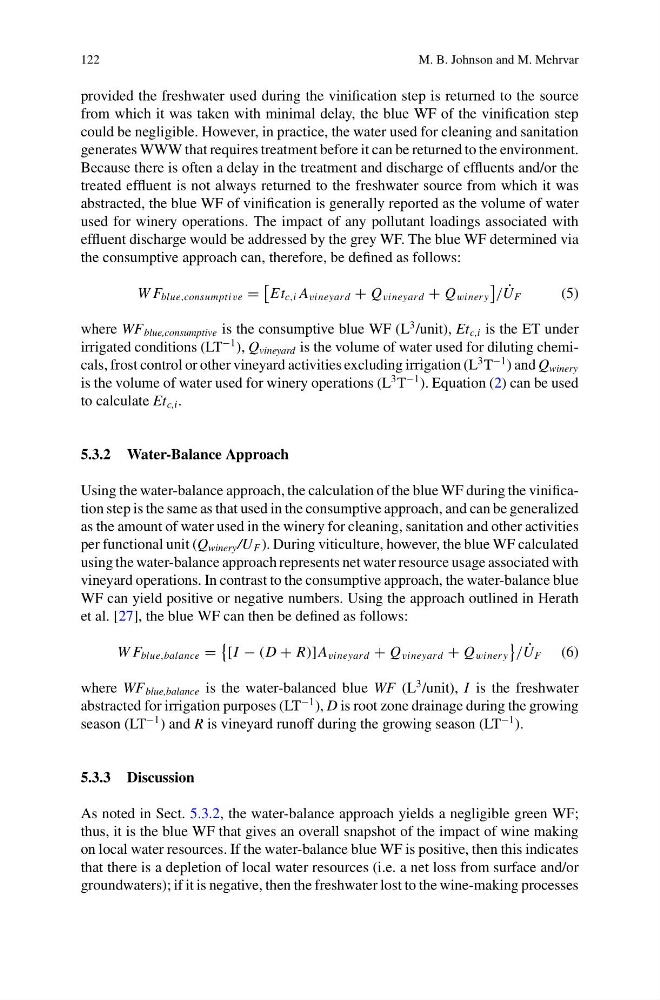
the consumptive approach can, therefore, be defined as follows:
W F blue,consumptive =
Et c,i A vineyard + Q vineyard + Q winer y
/ ˙
U F
(5)
where WF blue,consumptive is the consumptive blue WF (L
3 /unit), Et c,i is the ET under
irrigated conditions (LT
−1 ), Q vineyard is the volume of water used for diluting chemicals, frost control or other vineyard activities excluding irrigation (L
3 T
−1 ) and Q winery
is the volume of water used for winery operations (L
3 T
−1 ). Equation (2) can be used
to calculate Et c,i .
5.3.2 Water-Balance Approach
Using the water-balance approach, the calculation of the blue WF during the vinification step is the same as that used in the consumptive approach, and can be generalized
as the amount of water used in the winery for cleaning, sanitation and other activities
per functional unit (Q winery /U F ). During viticulture, however, the blue WF calculated
using the water-balance approach represents net water resource usage associated with
vineyard operations. In contrast to the consumptive approach, the water-balance blue
WF can yield positive or negative numbers. Using the approach outlined in Herath
et al. [27], the blue WF can then be defined as follows:
W F blue,balance =
[I − (D + R)]A vineyard + Q vineyard + Q winer y
/ ˙
U F (6)
where WF blue,balance is the water-balanced blue WF (L
3 /unit), I is the freshwater
abstracted for irrigation purposes (LT
−1 ), D is root zone drainage during the growing
season (LT
−1 ) and R is vineyard runoff during the growing season (LT
−1 ).
5.3.3 Discussion
As noted in Sect. 5.3.2, the water-balance approach yields a negligible green WF;
thus, it is the blue WF that gives an overall snapshot of the impact of wine making
on local water resources. If the water-balance blue WF is positive, then this indicates
that there is a depletion of local water resources (i.e. a net loss from surface and/or
groundwaters); if it is negative, then the freshwater lost to the wine-making processes
M. B. Johnson and M. Mehrvar
provided the freshwater used during the vinification step is returned to the source
from which it was taken with minimal delay, the blue WF of the vinification step
could be negligible. However, in practice, the water used for cleaning and sanitation
generates WWW that requires treatment before it can be returned to the environment.
Because there is often a delay in the treatment and discharge of effluents and/or the
treated effluent is not always returned to the freshwater source from which it was
abstracted, the blue WF of vinification is generally reported as the volume of water
used for winery operations. The impact of any pollutant loadings associated with
effluent discharge would be addressed by the grey WF. The blue WF determined via
the consumptive approach can, therefore, be defined as follows:
W F blue,consumptive =
Et c,i A vineyard + Q vineyard + Q winer y
/ ˙
U F
(5)
where WF blue,consumptive is the consumptive blue WF (L
3 /unit), Et c,i is the ET under
irrigated conditions (LT
−1 ), Q vineyard is the volume of water used for diluting chemicals, frost control or other vineyard activities excluding irrigation (L
3 T
−1 ) and Q winery
is the volume of water used for winery operations (L
3 T
−1 ). Equation (2) can be used
to calculate Et c,i .
5.3.2 Water-Balance Approach
Using the water-balance approach, the calculation of the blue WF during the vinification step is the same as that used in the consumptive approach, and can be generalized
as the amount of water used in the winery for cleaning, sanitation and other activities
per functional unit (Q winery /U F ). During viticulture, however, the blue WF calculated
using the water-balance approach represents net water resource usage associated with
vineyard operations. In contrast to the consumptive approach, the water-balance blue
WF can yield positive or negative numbers. Using the approach outlined in Herath
et al. [27], the blue WF can then be defined as follows:
W F blue,balance =
[I − (D + R)]A vineyard + Q vineyard + Q winer y
/ ˙
U F (6)
where WF blue,balance is the water-balanced blue WF (L
3 /unit), I is the freshwater
abstracted for irrigation purposes (LT
−1 ), D is root zone drainage during the growing
season (LT
−1 ) and R is vineyard runoff during the growing season (LT
−1 ).
5.3.3 Discussion
As noted in Sect. 5.3.2, the water-balance approach yields a negligible green WF;
thus, it is the blue WF that gives an overall snapshot of the impact of wine making
on local water resources. If the water-balance blue WF is positive, then this indicates
that there is a depletion of local water resources (i.e. a net loss from surface and/or
groundwaters); if it is negative, then the freshwater lost to the wine-making processes