

112
M. B. Johnson and M. Mehrvar
nitrogen fixing, further reducing fertilizer needs [25]. Physical runoff can be reduced
by planting perennial cover crops (up to 50% reduction) or inter-row soil working
(up to 40% reduction) [39].
4.2 Wastewater During Vinification
During the vinification stage, cleaning tanks, crushers, presses/filters, piping and
bottles are the main source of wastewater. Being for human consumption, the production process must meet high cleaning and sanitation standards, requiring the use of
sanitizing chemicals and large volumes of water. Other significant sources of wastewater include spillage during transfer and/or overfilling vessels which can be reduced
by implementing better process control strategies to minimize transfers and active
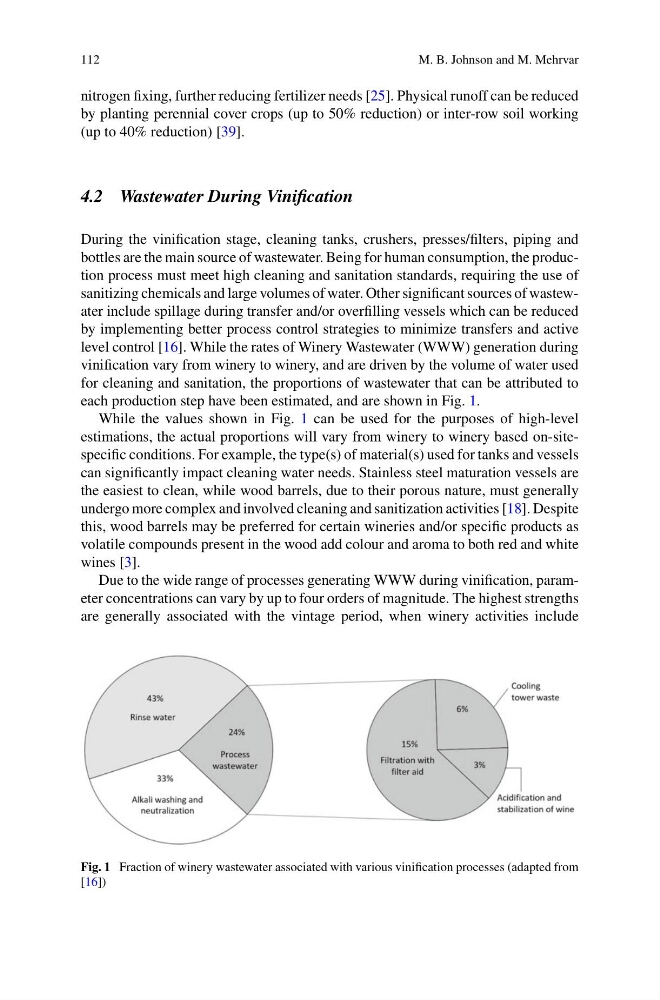
level control [16]. While the rates of Winery Wastewater (WWW) generation during
vinification vary from winery to winery, and are driven by the volume of water used
for cleaning and sanitation, the proportions of wastewater that can be attributed to
each production step have been estimated, and are shown in Fig. 1.
While the values shown in Fig. 1 can be used for the purposes of high-level
estimations, the actual proportions will vary from winery to winery based on-sitespecific conditions. For example, the type(s) of material(s) used for tanks and vessels
can significantly impact cleaning water needs. Stainless steel maturation vessels are
the easiest to clean, while wood barrels, due to their porous nature, must generally
undergo more complex and involved cleaning and sanitization activities [18]. Despite
this, wood barrels may be preferred for certain wineries and/or specific products as
volatile compounds present in the wood add colour and aroma to both red and white
wines [3].
Due to the wide range of processes generating WWW during vinification, parameter concentrations can vary by up to four orders of magnitude. The highest strengths
are generally associated with the vintage period, when winery activities include
Fig. 1 Fraction of winery wastewater associated with various vinification processes (adapted from
[16])
M. B. Johnson and M. Mehrvar
nitrogen fixing, further reducing fertilizer needs [25]. Physical runoff can be reduced
by planting perennial cover crops (up to 50% reduction) or inter-row soil working
(up to 40% reduction) [39].
4.2 Wastewater During Vinification
During the vinification stage, cleaning tanks, crushers, presses/filters, piping and
bottles are the main source of wastewater. Being for human consumption, the production process must meet high cleaning and sanitation standards, requiring the use of
sanitizing chemicals and large volumes of water. Other significant sources of wastewater include spillage during transfer and/or overfilling vessels which can be reduced
by implementing better process control strategies to minimize transfers and active
level control [16]. While the rates of Winery Wastewater (WWW) generation during
vinification vary from winery to winery, and are driven by the volume of water used
for cleaning and sanitation, the proportions of wastewater that can be attributed to
each production step have been estimated, and are shown in Fig. 1.
While the values shown in Fig. 1 can be used for the purposes of high-level
estimations, the actual proportions will vary from winery to winery based on-sitespecific conditions. For example, the type(s) of material(s) used for tanks and vessels
can significantly impact cleaning water needs. Stainless steel maturation vessels are
the easiest to clean, while wood barrels, due to their porous nature, must generally
undergo more complex and involved cleaning and sanitization activities [18]. Despite
this, wood barrels may be preferred for certain wineries and/or specific products as
volatile compounds present in the wood add colour and aroma to both red and white
wines [3].
Due to the wide range of processes generating WWW during vinification, parameter concentrations can vary by up to four orders of magnitude. The highest strengths
are generally associated with the vintage period, when winery activities include
Fig. 1 Fraction of winery wastewater associated with various vinification processes (adapted from
[16])