

4.6 Environmental Implications
81
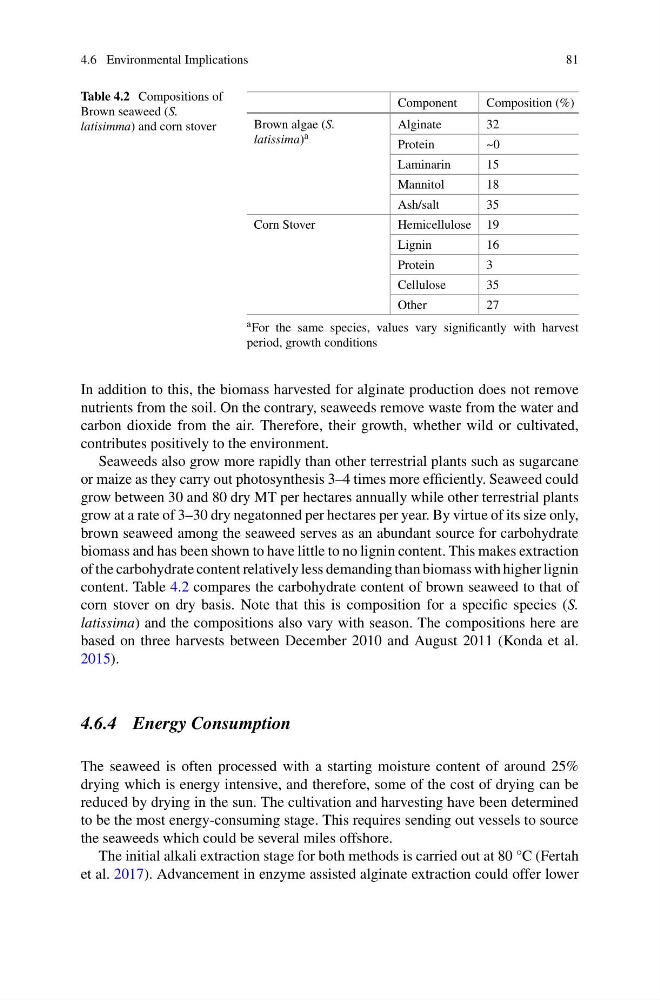
Table 4.2 Compositions of
Brown seaweed (S.
latisimma) and corn stover
Component
Composition (%)
Brown algae (S.
latissima) a
Alginate
32
Protein
~0
Laminarin
15
Mannitol
18
Ash/salt
35
Corn Stover
Hemicellulose 19
Lignin
16
Protein
3
Cellulose
35
Other
27
a For the same species, values vary significantly with harvest
period, growth conditions
In addition to this, the biomass harvested for alginate production does not remove
nutrients from the soil. On the contrary, seaweeds remove waste from the water and
carbon dioxide from the air. Therefore, their growth, whether wild or cultivated,
contributes positively to the environment.
Seaweeds also grow more rapidly than other terrestrial plants such as sugarcane
or maize as they carry out photosynthesis 3–4 times more efficiently. Seaweed could
grow between 30 and 80 dry MT per hectares annually while other terrestrial plants
grow at a rate of 3–30 dry negatonned per hectares per year. By virtue of its size only,
brown seaweed among the seaweed serves as an abundant source for carbohydrate
biomass and has been shown to have little to no lignin content. This makes extraction
of the carbohydrate content relatively less demanding than biomass with higher lignin
content. Table 4.2 compares the carbohydrate content of brown seaweed to that of
corn stover on dry basis. Note that this is composition for a specific species (S.
latissima) and the compositions also vary with season. The compositions here are
based on three harvests between December 2010 and August 2011 (Konda et al.
2015).
4.6.4 Energy Consumption
The seaweed is often processed with a starting moisture content of around 25%
drying which is energy intensive, and therefore, some of the cost of drying can be
reduced by drying in the sun. The cultivation and harvesting have been determined
to be the most energy-consuming stage. This requires sending out vessels to source
the seaweeds which could be several miles offshore.
The initial alkali extraction stage for both methods is carried out at 80 °C (Fertah
et al. 2017). Advancement in enzyme assisted alginate extraction could offer lower
81
Table 4.2 Compositions of
Brown seaweed (S.
latisimma) and corn stover
Component
Composition (%)
Brown algae (S.
latissima) a
Alginate
32
Protein
~0
Laminarin
15
Mannitol
18
Ash/salt
35
Corn Stover
Hemicellulose 19
Lignin
16
Protein
3
Cellulose
35
Other
27
a For the same species, values vary significantly with harvest
period, growth conditions
In addition to this, the biomass harvested for alginate production does not remove
nutrients from the soil. On the contrary, seaweeds remove waste from the water and
carbon dioxide from the air. Therefore, their growth, whether wild or cultivated,
contributes positively to the environment.
Seaweeds also grow more rapidly than other terrestrial plants such as sugarcane
or maize as they carry out photosynthesis 3–4 times more efficiently. Seaweed could
grow between 30 and 80 dry MT per hectares annually while other terrestrial plants
grow at a rate of 3–30 dry negatonned per hectares per year. By virtue of its size only,
brown seaweed among the seaweed serves as an abundant source for carbohydrate
biomass and has been shown to have little to no lignin content. This makes extraction
of the carbohydrate content relatively less demanding than biomass with higher lignin
content. Table 4.2 compares the carbohydrate content of brown seaweed to that of
corn stover on dry basis. Note that this is composition for a specific species (S.
latissima) and the compositions also vary with season. The compositions here are
based on three harvests between December 2010 and August 2011 (Konda et al.
2015).
4.6.4 Energy Consumption
The seaweed is often processed with a starting moisture content of around 25%
drying which is energy intensive, and therefore, some of the cost of drying can be
reduced by drying in the sun. The cultivation and harvesting have been determined
to be the most energy-consuming stage. This requires sending out vessels to source
the seaweeds which could be several miles offshore.
The initial alkali extraction stage for both methods is carried out at 80 °C (Fertah
et al. 2017). Advancement in enzyme assisted alginate extraction could offer lower