

3.7 Applications
61
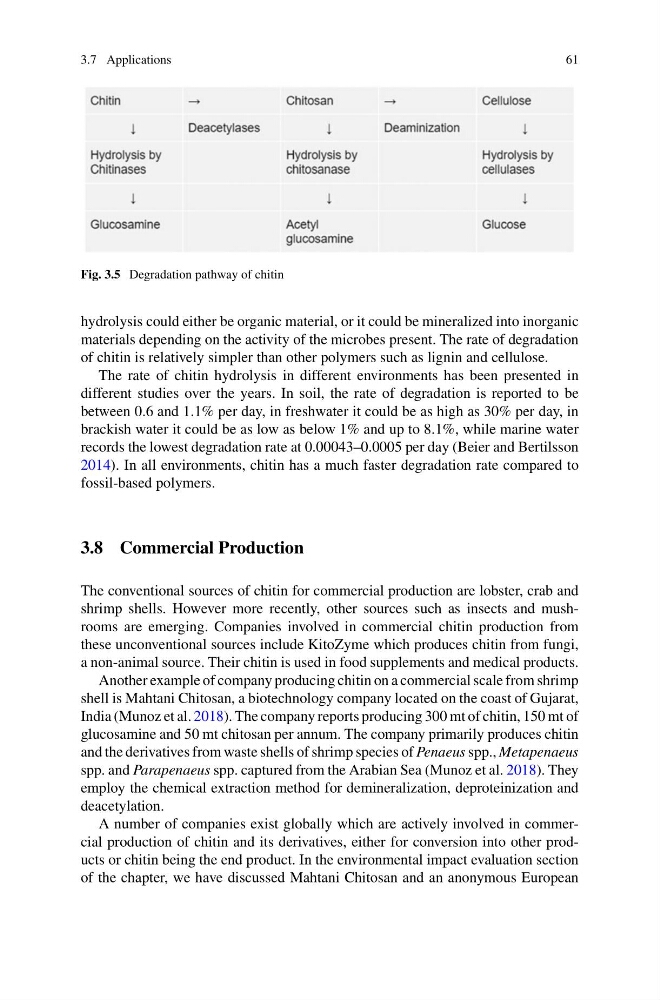
Fig. 3.5 Degradation pathway of chitin
hydrolysis could either be organic material, or it could be mineralized into inorganic
materials depending on the activity of the microbes present. The rate of degradation
of chitin is relatively simpler than other polymers such as lignin and cellulose.
The rate of chitin hydrolysis in different environments has been presented in
different studies over the years. In soil, the rate of degradation is reported to be
between 0.6 and 1.1% per day, in freshwater it could be as high as 30% per day, in
brackish water it could be as low as below 1% and up to 8.1%, while marine water
records the lowest degradation rate at 0.00043–0.0005 per day (Beier and Bertilsson
2014). In all environments, chitin has a much faster degradation rate compared to
fossil-based polymers.
3.8 Commercial Production
The conventional sources of chitin for commercial production are lobster, crab and
shrimp shells. However more recently, other sources such as insects and mushrooms are emerging. Companies involved in commercial chitin production from
these unconventional sources include KitoZyme which produces chitin from fungi,
a non-animal source. Their chitin is used in food supplements and medical products.
Another example of company producing chitin on a commercial scale from shrimp
shell is Mahtani Chitosan, a biotechnology company located on the coast of Gujarat,
India (Munoz et al. 2018). The company reports producing 300 mt of chitin, 150 mt of
glucosamine and 50 mt chitosan per annum. The company primarily produces chitin
and the derivatives from waste shells of shrimp species of Penaeus spp., Metapenaeus
spp. and Parapenaeus spp. captured from the Arabian Sea (Munoz et al. 2018). They
employ the chemical extraction method for demineralization, deproteinization and
deacetylation.
A number of companies exist globally which are actively involved in commercial production of chitin and its derivatives, either for conversion into other products or chitin being the end product. In the environmental impact evaluation section
of the chapter, we have discussed Mahtani Chitosan and an anonymous European
61
Fig. 3.5 Degradation pathway of chitin
hydrolysis could either be organic material, or it could be mineralized into inorganic
materials depending on the activity of the microbes present. The rate of degradation
of chitin is relatively simpler than other polymers such as lignin and cellulose.
The rate of chitin hydrolysis in different environments has been presented in
different studies over the years. In soil, the rate of degradation is reported to be
between 0.6 and 1.1% per day, in freshwater it could be as high as 30% per day, in
brackish water it could be as low as below 1% and up to 8.1%, while marine water
records the lowest degradation rate at 0.00043–0.0005 per day (Beier and Bertilsson
2014). In all environments, chitin has a much faster degradation rate compared to
fossil-based polymers.
3.8 Commercial Production
The conventional sources of chitin for commercial production are lobster, crab and
shrimp shells. However more recently, other sources such as insects and mushrooms are emerging. Companies involved in commercial chitin production from
these unconventional sources include KitoZyme which produces chitin from fungi,
a non-animal source. Their chitin is used in food supplements and medical products.
Another example of company producing chitin on a commercial scale from shrimp
shell is Mahtani Chitosan, a biotechnology company located on the coast of Gujarat,
India (Munoz et al. 2018). The company reports producing 300 mt of chitin, 150 mt of
glucosamine and 50 mt chitosan per annum. The company primarily produces chitin
and the derivatives from waste shells of shrimp species of Penaeus spp., Metapenaeus
spp. and Parapenaeus spp. captured from the Arabian Sea (Munoz et al. 2018). They
employ the chemical extraction method for demineralization, deproteinization and
deacetylation.
A number of companies exist globally which are actively involved in commercial production of chitin and its derivatives, either for conversion into other products or chitin being the end product. In the environmental impact evaluation section
of the chapter, we have discussed Mahtani Chitosan and an anonymous European