

3.5 Extraction of Chitin
45
is required to chemically demineralize the shell waste to get rid of the calcium
carbonate.
These enzymes are commercially available and can be isolated from a variety
of organisms. Examples of such enzymes include Alcalase, Pancreatin, Delvolase,
Cytolase, Econase, Maxazime and Cellupulin. Enzymatic deproteinization can
achieve between 54 and 97% protein removal from shell waste and minimizes the
need for alkali deproteinization (Gortari and Hours 2013).
While enzyme and lactic acid fermentation-based extractions of chitin from shell
waste show potential for more environmental and economical alternative to chemicalbased extraction using acid and alkali, more research needs to be carried out toward
a safe, eco-friendly and reproducible method for commercial extraction of chitin of
high quality.
3.6 Environmental Implications
In order to assess the environmental impact of chitin and chitosan production, here
we make use of the life cycle assessment report by Munoz et al. (2018). The life cycle
assessment was carried out using data from two chitosan production companies: one
of which is Mahtani Chitosan and the other an anonymous European company herein
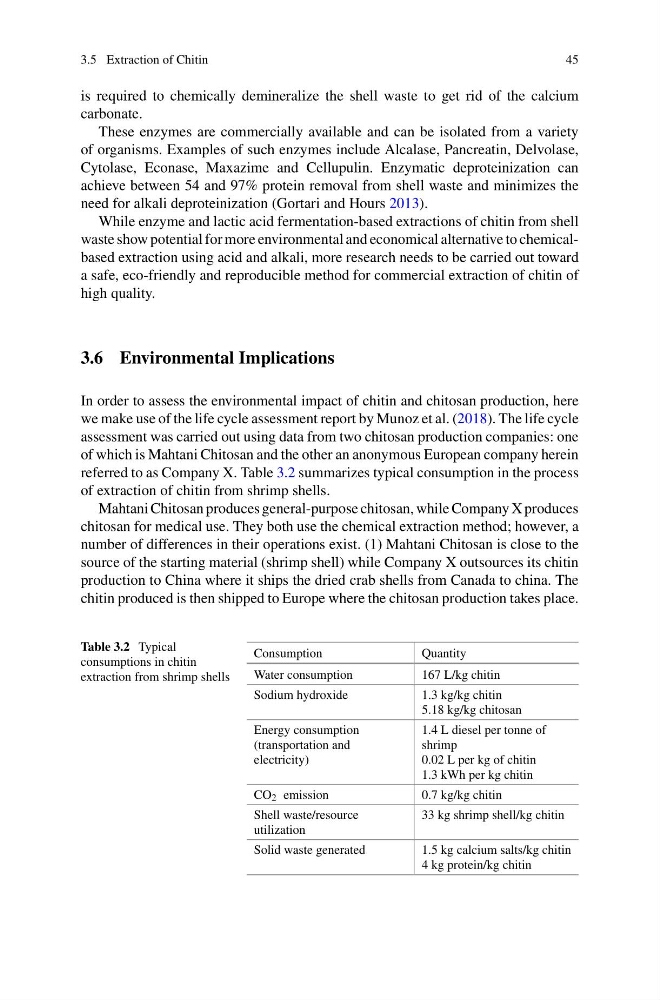
referred to as Company X. Table 3.2 summarizes typical consumption in the process
of extraction of chitin from shrimp shells.
Mahtani Chitosan produces general-purpose chitosan, while Company X produces
chitosan for medical use. They both use the chemical extraction method; however, a
number of differences in their operations exist. (1) Mahtani Chitosan is close to the
source of the starting material (shrimp shell) while Company X outsources its chitin
production to China where it ships the dried crab shells from Canada to china. The
chitin produced is then shipped to Europe where the chitosan production takes place.
Table 3.2 Typical
consumptions in chitin
extraction from shrimp shells
Consumption
Quantity
Water consumption
167 L/kg chitin
Sodium hydroxide
1.3 kg/kg chitin
5.18 kg/kg chitosan
Energy consumption
(transportation and
electricity)
1.4 L diesel per tonne of
shrimp
0.02 L per kg of chitin
1.3 kWh per kg chitin
CO 2 emission
0.7 kg/kg chitin
Shell waste/resource
utilization
33 kg shrimp shell/kg chitin
Solid waste generated
1.5 kg calcium salts/kg chitin
4 kg protein/kg chitin
45
is required to chemically demineralize the shell waste to get rid of the calcium
carbonate.
These enzymes are commercially available and can be isolated from a variety
of organisms. Examples of such enzymes include Alcalase, Pancreatin, Delvolase,
Cytolase, Econase, Maxazime and Cellupulin. Enzymatic deproteinization can
achieve between 54 and 97% protein removal from shell waste and minimizes the
need for alkali deproteinization (Gortari and Hours 2013).
While enzyme and lactic acid fermentation-based extractions of chitin from shell
waste show potential for more environmental and economical alternative to chemicalbased extraction using acid and alkali, more research needs to be carried out toward
a safe, eco-friendly and reproducible method for commercial extraction of chitin of
high quality.
3.6 Environmental Implications
In order to assess the environmental impact of chitin and chitosan production, here
we make use of the life cycle assessment report by Munoz et al. (2018). The life cycle
assessment was carried out using data from two chitosan production companies: one
of which is Mahtani Chitosan and the other an anonymous European company herein
referred to as Company X. Table 3.2 summarizes typical consumption in the process
of extraction of chitin from shrimp shells.
Mahtani Chitosan produces general-purpose chitosan, while Company X produces
chitosan for medical use. They both use the chemical extraction method; however, a
number of differences in their operations exist. (1) Mahtani Chitosan is close to the
source of the starting material (shrimp shell) while Company X outsources its chitin
production to China where it ships the dried crab shells from Canada to china. The
chitin produced is then shipped to Europe where the chitosan production takes place.
Table 3.2 Typical
consumptions in chitin
extraction from shrimp shells
Consumption
Quantity
Water consumption
167 L/kg chitin
Sodium hydroxide
1.3 kg/kg chitin
5.18 kg/kg chitosan
Energy consumption
(transportation and
electricity)
1.4 L diesel per tonne of
shrimp
0.02 L per kg of chitin
1.3 kWh per kg chitin
CO 2 emission
0.7 kg/kg chitin
Shell waste/resource
utilization
33 kg shrimp shell/kg chitin
Solid waste generated
1.5 kg calcium salts/kg chitin
4 kg protein/kg chitin