

350
16 Others Aquatic Biopolymers
possess bioluminescence include mollusks, copepods, shrimp, zooplankton and fish
among others.
While some of the organisms produce this light through chemical reactions within
their systems, others are able to create this light through symbiotic relationships with
other organisms which they host within their bodies, mainly bacteria. They then have
means through which they switch on and off the biological light. Some of this “living
light” as it is often referred to, are continuous while some have a frequency which
could range from a fraction of a second to every 10 s. There are fish known to produce
light which remains luminous even hours after the organism itself has died.
Bioluminescence has almost exclusively been observed in marine aquatic organisms (also occurs in some terrestrial organisms such as the fireflies; Kricka et al.
2019), with the exception of one freshwater snail known as the Latia neritoides (Harvey 1952). The possibilities that there might be some more bioluminescent aquatic
organisms that are yet to be discovered do exist.
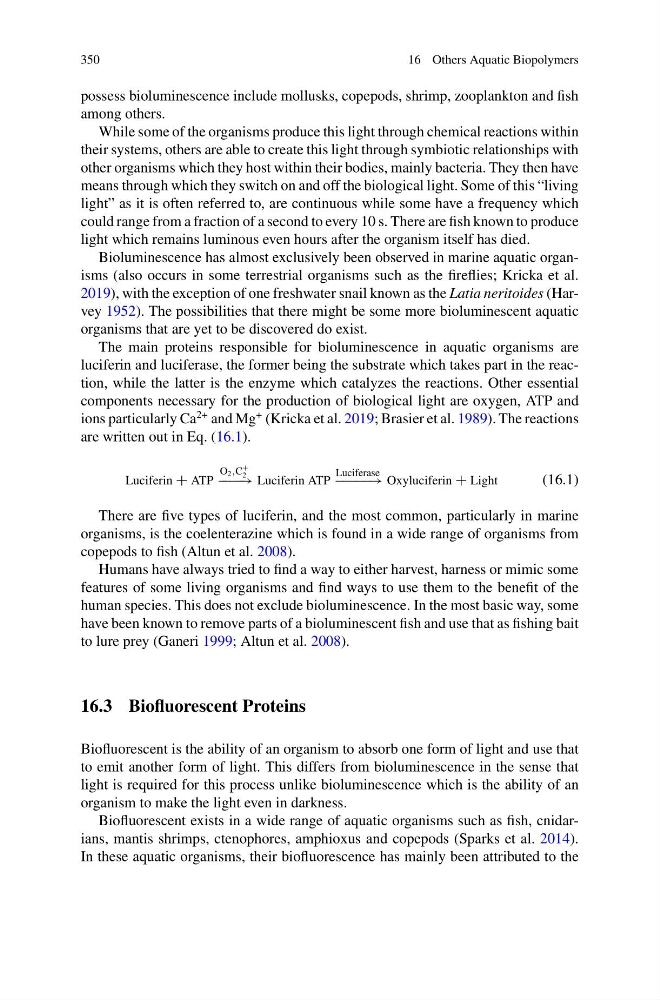
The main proteins responsible for bioluminescence in aquatic organisms are
luciferin and luciferase, the former being the substrate which takes part in the reaction, while the latter is the enzyme which catalyzes the reactions. Other essential
components necessary for the production of biological light are oxygen, ATP and
ions particularly Ca
2+ and Mg
+ (Kricka et al. 2019; Brasier et al. 1989). The reactions
are written out in Eq. (16.1).
Luciferin + ATP
O 2 ,C
+
2
− −−− → Luciferin ATP
Luciferase
−−−−−→ Oxyluciferin + Light
(16.1)
There are five types of luciferin, and the most common, particularly in marine
organisms, is the coelenterazine which is found in a wide range of organisms from
copepods to fish (Altun et al. 2008).
Humans have always tried to find a way to either harvest, harness or mimic some
features of some living organisms and find ways to use them to the benefit of the
human species. This does not exclude bioluminescence. In the most basic way, some
have been known to remove parts of a bioluminescent fish and use that as fishing bait
to lure prey (Ganeri 1999; Altun et al. 2008).
16.3 Biofluorescent Proteins
Biofluorescent is the ability of an organism to absorb one form of light and use that
to emit another form of light. This differs from bioluminescence in the sense that
light is required for this process unlike bioluminescence which is the ability of an
organism to make the light even in darkness.
Biofluorescent exists in a wide range of aquatic organisms such as fish, cnidarians, mantis shrimps, ctenophores, amphioxus and copepods (Sparks et al. 2014).
In these aquatic organisms, their biofluorescence has mainly been attributed to the
16 Others Aquatic Biopolymers
possess bioluminescence include mollusks, copepods, shrimp, zooplankton and fish
among others.
While some of the organisms produce this light through chemical reactions within
their systems, others are able to create this light through symbiotic relationships with
other organisms which they host within their bodies, mainly bacteria. They then have
means through which they switch on and off the biological light. Some of this “living
light” as it is often referred to, are continuous while some have a frequency which
could range from a fraction of a second to every 10 s. There are fish known to produce
light which remains luminous even hours after the organism itself has died.
Bioluminescence has almost exclusively been observed in marine aquatic organisms (also occurs in some terrestrial organisms such as the fireflies; Kricka et al.
2019), with the exception of one freshwater snail known as the Latia neritoides (Harvey 1952). The possibilities that there might be some more bioluminescent aquatic
organisms that are yet to be discovered do exist.
The main proteins responsible for bioluminescence in aquatic organisms are
luciferin and luciferase, the former being the substrate which takes part in the reaction, while the latter is the enzyme which catalyzes the reactions. Other essential
components necessary for the production of biological light are oxygen, ATP and
ions particularly Ca
2+ and Mg
+ (Kricka et al. 2019; Brasier et al. 1989). The reactions
are written out in Eq. (16.1).
Luciferin + ATP
O 2 ,C
+
2
− −−− → Luciferin ATP
Luciferase
−−−−−→ Oxyluciferin + Light
(16.1)
There are five types of luciferin, and the most common, particularly in marine
organisms, is the coelenterazine which is found in a wide range of organisms from
copepods to fish (Altun et al. 2008).
Humans have always tried to find a way to either harvest, harness or mimic some
features of some living organisms and find ways to use them to the benefit of the
human species. This does not exclude bioluminescence. In the most basic way, some
have been known to remove parts of a bioluminescent fish and use that as fishing bait
to lure prey (Ganeri 1999; Altun et al. 2008).
16.3 Biofluorescent Proteins
Biofluorescent is the ability of an organism to absorb one form of light and use that
to emit another form of light. This differs from bioluminescence in the sense that
light is required for this process unlike bioluminescence which is the ability of an
organism to make the light even in darkness.
Biofluorescent exists in a wide range of aquatic organisms such as fish, cnidarians, mantis shrimps, ctenophores, amphioxus and copepods (Sparks et al. 2014).
In these aquatic organisms, their biofluorescence has mainly been attributed to the