

306
13 Starch
metabolism in the digestive system when administered orally such that the active
ingredient gets to the walls of the small intestine in its intact form. Usually in combination with other polymers and compounds, for example, floating gel tablets made
from starch and cellulose blend in the weight ratio 3:7 used in gastric drug delivery. Starch is also used in wound dressings and tissue engineering (Liu et al. 2017).
Although starch from aquatic plants and algae is yet to be explored in pharmaceutical
applications, they have the same structure as the starch from terrestrial plants used in
these applications, the aquatic-sourced starch can potentially be used for such. This is
highly dependent on the aquatic-sourced starch meeting the same safety requirement.
13.9 Commercial Production and Applications
Present rate of biofuel production from algae cannot replace fossil fuels in terms of
cost of production. Microalgae and seaweeds are a potential source of commercialscale production of starch. The most economic way of commercial production of
algal starch is the use of wastewater which contains the nutrients required for algae
growth and are already the cause of uncontrolled algal pollution anyway. Current
challenges in this area are the fluctuation of wastewater which depends on the source.
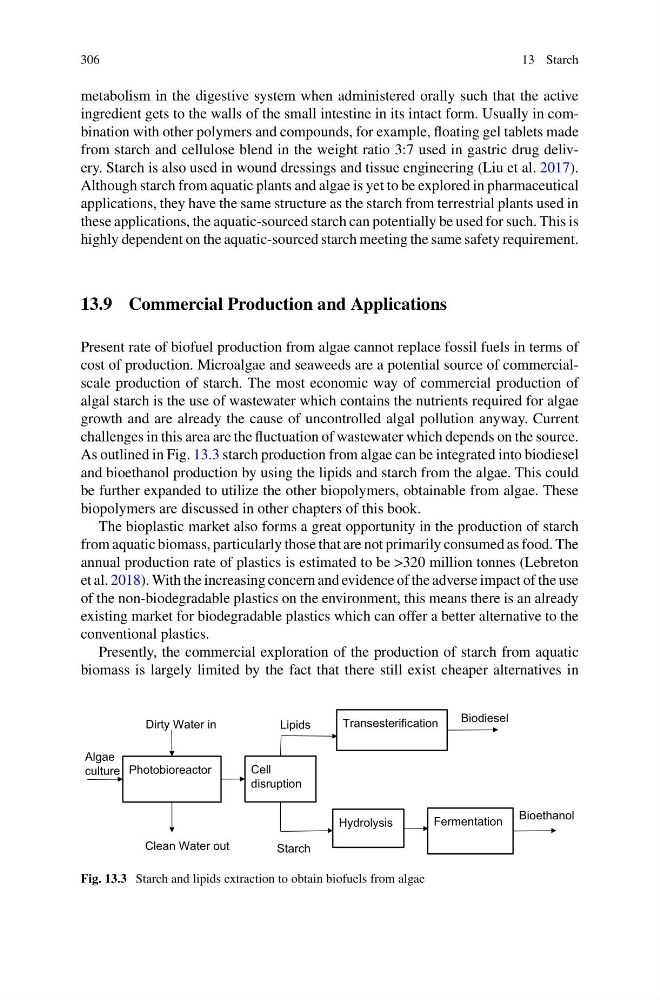
As outlined in Fig. 13.3 starch production from algae can be integrated into biodiesel
and bioethanol production by using the lipids and starch from the algae. This could
be further expanded to utilize the other biopolymers, obtainable from algae. These
biopolymers are discussed in other chapters of this book.
The bioplastic market also forms a great opportunity in the production of starch
from aquatic biomass, particularly those that are not primarily consumed as food. The
annual production rate of plastics is estimated to be >320 million tonnes (Lebreton
et al. 2018). With the increasing concern and evidence of the adverse impact of the use
of the non-biodegradable plastics on the environment, this means there is an already
existing market for biodegradable plastics which can offer a better alternative to the
conventional plastics.
Presently, the commercial exploration of the production of starch from aquatic
biomass is largely limited by the fact that there still exist cheaper alternatives in
Photobioreactor
Dirty Water in
Clean Water out
Algae
culture
Cell
disruption
Transesterification
Hydrolysis
Fermentation
Biodiesel
Bioethanol
Lipids
Starch
Fig. 13.3 Starch and lipids extraction to obtain biofuels from algae
13 Starch
metabolism in the digestive system when administered orally such that the active
ingredient gets to the walls of the small intestine in its intact form. Usually in combination with other polymers and compounds, for example, floating gel tablets made
from starch and cellulose blend in the weight ratio 3:7 used in gastric drug delivery. Starch is also used in wound dressings and tissue engineering (Liu et al. 2017).
Although starch from aquatic plants and algae is yet to be explored in pharmaceutical
applications, they have the same structure as the starch from terrestrial plants used in
these applications, the aquatic-sourced starch can potentially be used for such. This is
highly dependent on the aquatic-sourced starch meeting the same safety requirement.
13.9 Commercial Production and Applications
Present rate of biofuel production from algae cannot replace fossil fuels in terms of
cost of production. Microalgae and seaweeds are a potential source of commercialscale production of starch. The most economic way of commercial production of
algal starch is the use of wastewater which contains the nutrients required for algae
growth and are already the cause of uncontrolled algal pollution anyway. Current
challenges in this area are the fluctuation of wastewater which depends on the source.
As outlined in Fig. 13.3 starch production from algae can be integrated into biodiesel
and bioethanol production by using the lipids and starch from the algae. This could
be further expanded to utilize the other biopolymers, obtainable from algae. These
biopolymers are discussed in other chapters of this book.
The bioplastic market also forms a great opportunity in the production of starch
from aquatic biomass, particularly those that are not primarily consumed as food. The
annual production rate of plastics is estimated to be >320 million tonnes (Lebreton
et al. 2018). With the increasing concern and evidence of the adverse impact of the use
of the non-biodegradable plastics on the environment, this means there is an already
existing market for biodegradable plastics which can offer a better alternative to the
conventional plastics.
Presently, the commercial exploration of the production of starch from aquatic
biomass is largely limited by the fact that there still exist cheaper alternatives in
Photobioreactor
Dirty Water in
Clean Water out
Algae
culture
Cell
disruption
Transesterification
Hydrolysis
Fermentation
Biodiesel
Bioethanol
Lipids
Starch
Fig. 13.3 Starch and lipids extraction to obtain biofuels from algae