

300
13 Starch
13.6.4 Extraction of Floridean Starch from Red Algae
To extract floridean starch from red algae, the algal biomass is pulverized to smaller
particle sizes. This can be achieved using equipment such as a hammer mill- or
motor-driven mortar and pestle. The pulverization is done under liquid nitrogen to
prevent oxidation. 50 mM of citrate buffer is then added to the biomass at a pH of
6.5. At this stage, the floridean starch is dispersed as smaller particles and the protein
dissolved in the liquid state since acid-soluble proteins will dissolve out of the algae
tissue at low pH. These are separated from the larger solid residues of the algae tissue
by filtration. The filtrate is then centrifuged at 13,000× g for 10 min. This separates
the dispersed starch granules which settle at the bottom from the dissolved proteins
which is decanted off. Further, purification is achieved by subsequent addition of
distilled water and centrifugation. Using this method of extraction, a yield of 1%
starch has been reported for starch extracted from the Gracilariales red algae species
(Yu et al. 2002). The process for extraction of floridean starch from red algae is
therefore similar to that used for the extraction of starch.
13.7 Environmental Impact
As a biopolymer, starch is a benign material. Within the organisms from which it is
sourced, starch serves as a source of energy and is accumulated in different parts of
the organism. The edible plants and algae can be consumed whole as dietary starch
sources with less input of energy or materials. In order to make use of starch in its
isolated form for more advanced applications such as additives in food and pharmaceuticals, further consumption other than the biomass is involved. In this section, the
environmental impact of some processes involved in the extraction of starch from
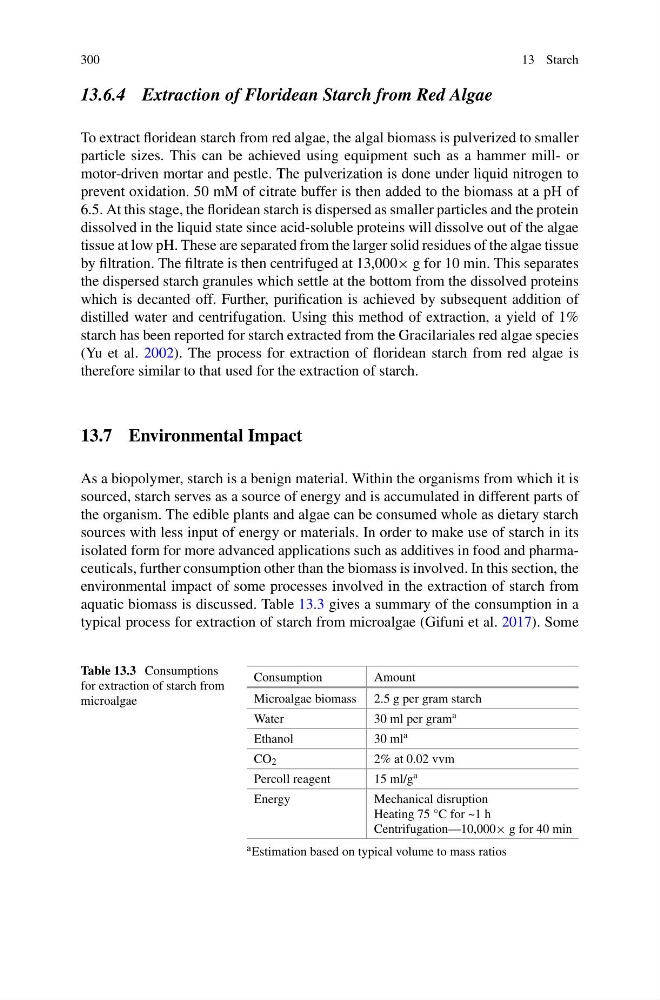
aquatic biomass is discussed. Table 13.3 gives a summary of the consumption in a
typical process for extraction of starch from microalgae (Gifuni et al. 2017). Some
Table 13.3 Consumptions
for extraction of starch from
microalgae
Consumption
Amount
Microalgae biomass 2.5 g per gram starch
Water
30 ml per gram a
Ethanol
30 ml a
CO 2
2% at 0.02 vvm
Percoll reagent
15 ml/g a
Energy
Mechanical disruption
Heating 75 °C for ~1 h
Centrifugation—10,000× g for 40 min
a Estimation based on typical volume to mass ratios
13 Starch
13.6.4 Extraction of Floridean Starch from Red Algae
To extract floridean starch from red algae, the algal biomass is pulverized to smaller
particle sizes. This can be achieved using equipment such as a hammer mill- or
motor-driven mortar and pestle. The pulverization is done under liquid nitrogen to
prevent oxidation. 50 mM of citrate buffer is then added to the biomass at a pH of
6.5. At this stage, the floridean starch is dispersed as smaller particles and the protein
dissolved in the liquid state since acid-soluble proteins will dissolve out of the algae
tissue at low pH. These are separated from the larger solid residues of the algae tissue
by filtration. The filtrate is then centrifuged at 13,000× g for 10 min. This separates
the dispersed starch granules which settle at the bottom from the dissolved proteins
which is decanted off. Further, purification is achieved by subsequent addition of
distilled water and centrifugation. Using this method of extraction, a yield of 1%
starch has been reported for starch extracted from the Gracilariales red algae species
(Yu et al. 2002). The process for extraction of floridean starch from red algae is
therefore similar to that used for the extraction of starch.
13.7 Environmental Impact
As a biopolymer, starch is a benign material. Within the organisms from which it is
sourced, starch serves as a source of energy and is accumulated in different parts of
the organism. The edible plants and algae can be consumed whole as dietary starch
sources with less input of energy or materials. In order to make use of starch in its
isolated form for more advanced applications such as additives in food and pharmaceuticals, further consumption other than the biomass is involved. In this section, the
environmental impact of some processes involved in the extraction of starch from
aquatic biomass is discussed. Table 13.3 gives a summary of the consumption in a
typical process for extraction of starch from microalgae (Gifuni et al. 2017). Some
Table 13.3 Consumptions
for extraction of starch from
microalgae
Consumption
Amount
Microalgae biomass 2.5 g per gram starch
Water
30 ml per gram a
Ethanol
30 ml a
CO 2
2% at 0.02 vvm
Percoll reagent
15 ml/g a
Energy
Mechanical disruption
Heating 75 °C for ~1 h
Centrifugation—10,000× g for 40 min
a Estimation based on typical volume to mass ratios