

298
13 Starch
this is a way to utilize the microalgae generated from green tides. The limitation of
harvesting microalgae from the open aquatic ecosystem includes risk of contamination and uncontrolled growth condition therefore the starch content might not be
optimized.
In the closed harvest system, the microalgae are cultivated in photobioreactors
in Bold’s Basal algae growth medium. The growth conditions are maintained at
25 °C, illumination of 300 µE m
−2 s
−1 , aerated at 0.02 vvm with air containing 2%
CO 2 . The system was allowed to run until it reached nitrogen starvation to optimize
starch accumulation by the microalgae. The microalgae biomass is then harvested
and taken through cell disruption. This process of cell disruption disintegrates the
cell wall freeing up the components which include starch. Cell disruption can be
achieved by methods such as enzyme or alkali pretreatment of mechanically by bead
beating with 0.5 mm glass beads while suspended in ethanol. Further, cell disruption
is achieved by heating at a temperature of 75 °C. The starch is then separated from
the other component of the microalgae by centrifugation at 10,000 g for 20 min.
The starch is recovered as the solid residue and is resuspended in distilled water
and centrifugation is repeated and separation carried out through Percoll gradient to
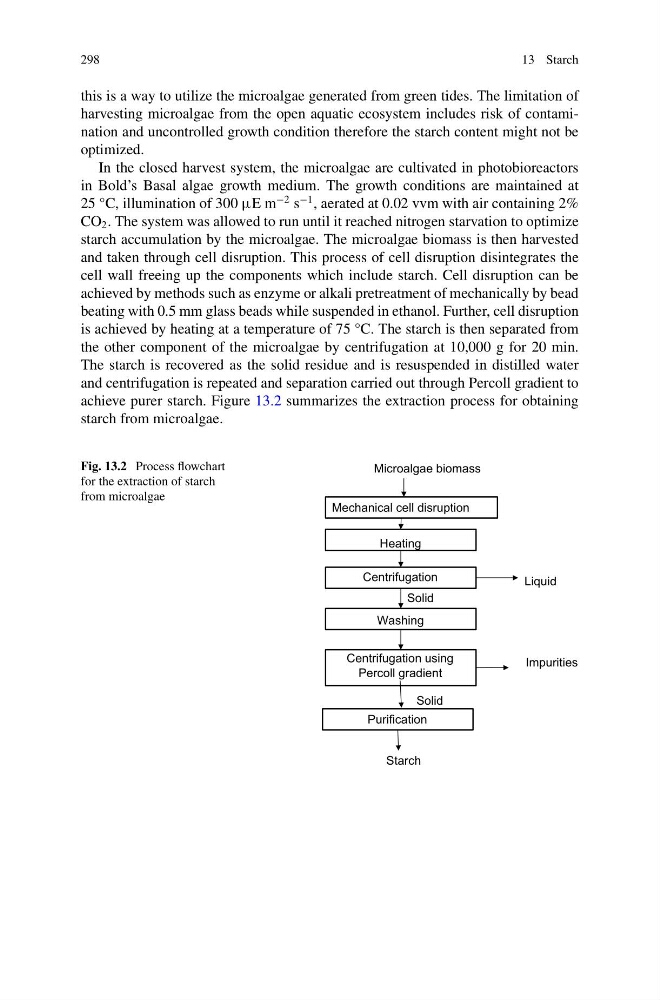
achieve purer starch. Figure 13.2 summarizes the extraction process for obtaining
starch from microalgae.
Fig. 13.2 Process flowchart
for the extraction of starch
from microalgae
Microalgae biomass
Mechanical cell disruption
Washing
Heating
Centrifugation
Centrifugation using
Percoll gradient
Purification
Starch
Solid
Liquid
Impurities
Solid
13 Starch
this is a way to utilize the microalgae generated from green tides. The limitation of
harvesting microalgae from the open aquatic ecosystem includes risk of contamination and uncontrolled growth condition therefore the starch content might not be
optimized.
In the closed harvest system, the microalgae are cultivated in photobioreactors
in Bold’s Basal algae growth medium. The growth conditions are maintained at
25 °C, illumination of 300 µE m
−2 s
−1 , aerated at 0.02 vvm with air containing 2%
CO 2 . The system was allowed to run until it reached nitrogen starvation to optimize
starch accumulation by the microalgae. The microalgae biomass is then harvested
and taken through cell disruption. This process of cell disruption disintegrates the
cell wall freeing up the components which include starch. Cell disruption can be
achieved by methods such as enzyme or alkali pretreatment of mechanically by bead
beating with 0.5 mm glass beads while suspended in ethanol. Further, cell disruption
is achieved by heating at a temperature of 75 °C. The starch is then separated from
the other component of the microalgae by centrifugation at 10,000 g for 20 min.
The starch is recovered as the solid residue and is resuspended in distilled water
and centrifugation is repeated and separation carried out through Percoll gradient to
achieve purer starch. Figure 13.2 summarizes the extraction process for obtaining
starch from microalgae.
Fig. 13.2 Process flowchart
for the extraction of starch
from microalgae
Microalgae biomass
Mechanical cell disruption
Washing
Heating
Centrifugation
Centrifugation using
Percoll gradient
Purification
Starch
Solid
Liquid
Impurities
Solid