

292
13 Starch
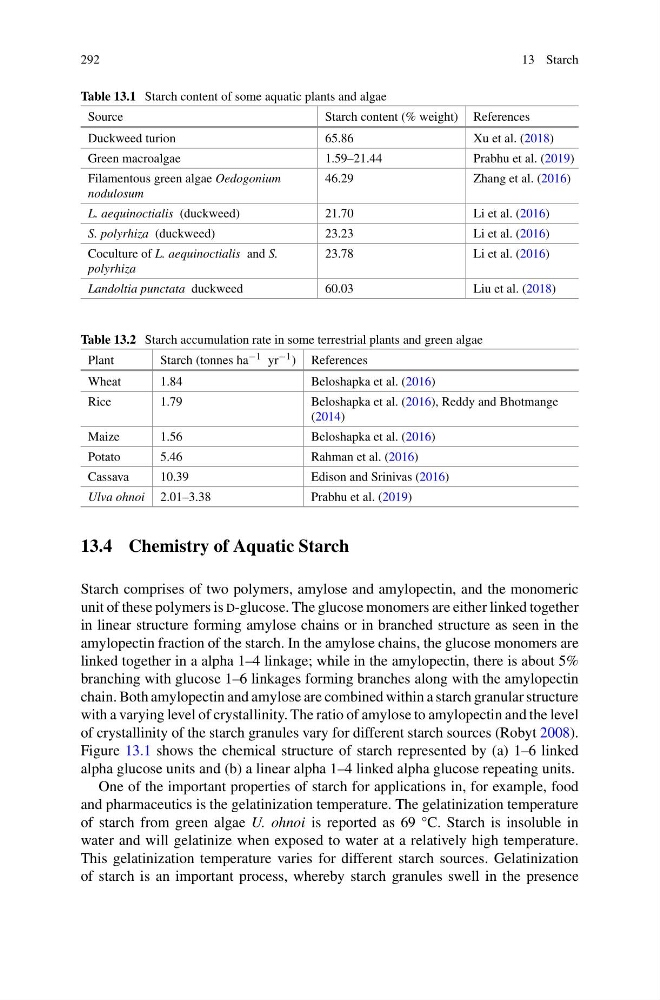
Table 13.1 Starch content of some aquatic plants and algae
Source
Starch content (% weight) References
Duckweed turion
65.86
Xu et al. (2018)
Green macroalgae
1.59–21.44
Prabhu et al. (2019)
Filamentous green algae Oedogonium
nodulosum
46.29
Zhang et al. (2016)
L. aequinoctialis (duckweed)
21.70
Li et al. (2016)
S. polyrhiza (duckweed)
23.23
Li et al. (2016)
Coculture of L. aequinoctialis and S.
polyrhiza
23.78
Li et al. (2016)
Landoltia punctata duckweed
60.03
Liu et al. (2018)
Table 13.2 Starch accumulation rate in some terrestrial plants and green algae
Plant
Starch (tonnes ha −1 yr −1 ) References
Wheat
1.84
Beloshapka et al. (2016)
Rice
1.79
Beloshapka et al. (2016), Reddy and Bhotmange
(2014)
Maize
1.56
Beloshapka et al. (2016)
Potato
5.46
Rahman et al. (2016)
Cassava
10.39
Edison and Srinivas (2016)
Ulva ohnoi 2.01–3.38
Prabhu et al. (2019)
13.4 Chemistry of Aquatic Starch
Starch comprises of two polymers, amylose and amylopectin, and the monomeric
unit of these polymers is d-glucose. The glucose monomers are either linked together
in linear structure forming amylose chains or in branched structure as seen in the
amylopectin fraction of the starch. In the amylose chains, the glucose monomers are
linked together in a alpha 1–4 linkage; while in the amylopectin, there is about 5%
branching with glucose 1–6 linkages forming branches along with the amylopectin
chain. Both amylopectin and amylose are combined within a starch granular structure
with a varying level of crystallinity. The ratio of amylose to amylopectin and the level
of crystallinity of the starch granules vary for different starch sources (Robyt 2008).
Figure 13.1 shows the chemical structure of starch represented by (a) 1–6 linked
alpha glucose units and (b) a linear alpha 1–4 linked alpha glucose repeating units.
One of the important properties of starch for applications in, for example, food
and pharmaceutics is the gelatinization temperature. The gelatinization temperature
of starch from green algae U. ohnoi is reported as 69 °C. Starch is insoluble in
water and will gelatinize when exposed to water at a relatively high temperature.
This gelatinization temperature varies for different starch sources. Gelatinization
of starch is an important process, whereby starch granules swell in the presence
13 Starch
Table 13.1 Starch content of some aquatic plants and algae
Source
Starch content (% weight) References
Duckweed turion
65.86
Xu et al. (2018)
Green macroalgae
1.59–21.44
Prabhu et al. (2019)
Filamentous green algae Oedogonium
nodulosum
46.29
Zhang et al. (2016)
L. aequinoctialis (duckweed)
21.70
Li et al. (2016)
S. polyrhiza (duckweed)
23.23
Li et al. (2016)
Coculture of L. aequinoctialis and S.
polyrhiza
23.78
Li et al. (2016)
Landoltia punctata duckweed
60.03
Liu et al. (2018)
Table 13.2 Starch accumulation rate in some terrestrial plants and green algae
Plant
Starch (tonnes ha −1 yr −1 ) References
Wheat
1.84
Beloshapka et al. (2016)
Rice
1.79
Beloshapka et al. (2016), Reddy and Bhotmange
(2014)
Maize
1.56
Beloshapka et al. (2016)
Potato
5.46
Rahman et al. (2016)
Cassava
10.39
Edison and Srinivas (2016)
Ulva ohnoi 2.01–3.38
Prabhu et al. (2019)
13.4 Chemistry of Aquatic Starch
Starch comprises of two polymers, amylose and amylopectin, and the monomeric
unit of these polymers is d-glucose. The glucose monomers are either linked together
in linear structure forming amylose chains or in branched structure as seen in the
amylopectin fraction of the starch. In the amylose chains, the glucose monomers are
linked together in a alpha 1–4 linkage; while in the amylopectin, there is about 5%
branching with glucose 1–6 linkages forming branches along with the amylopectin
chain. Both amylopectin and amylose are combined within a starch granular structure
with a varying level of crystallinity. The ratio of amylose to amylopectin and the level
of crystallinity of the starch granules vary for different starch sources (Robyt 2008).
Figure 13.1 shows the chemical structure of starch represented by (a) 1–6 linked
alpha glucose units and (b) a linear alpha 1–4 linked alpha glucose repeating units.
One of the important properties of starch for applications in, for example, food
and pharmaceutics is the gelatinization temperature. The gelatinization temperature
of starch from green algae U. ohnoi is reported as 69 °C. Starch is insoluble in
water and will gelatinize when exposed to water at a relatively high temperature.
This gelatinization temperature varies for different starch sources. Gelatinization
of starch is an important process, whereby starch granules swell in the presence