

274
12 Collagen
Table 12.1 Consumptions
for extraction of acid-soluble
collagen from fish skin
Consumption
Amount
Butyl alcohol
10 ml of 10% v/v per gram of
fish skin
Acetic acid
30 ml of 0.5 M per gram of
fish skin
Tris (hydroxymethyl)
aminomethane
10 ml of 0.05 M per gram of
crude extract
NaCl
2.6 M 10 ml per gram of
crude extract
contribute to altering the salinity and pH of the water. There is therefore a need for
careful regulation of these processes involving large-scale use of these compounds
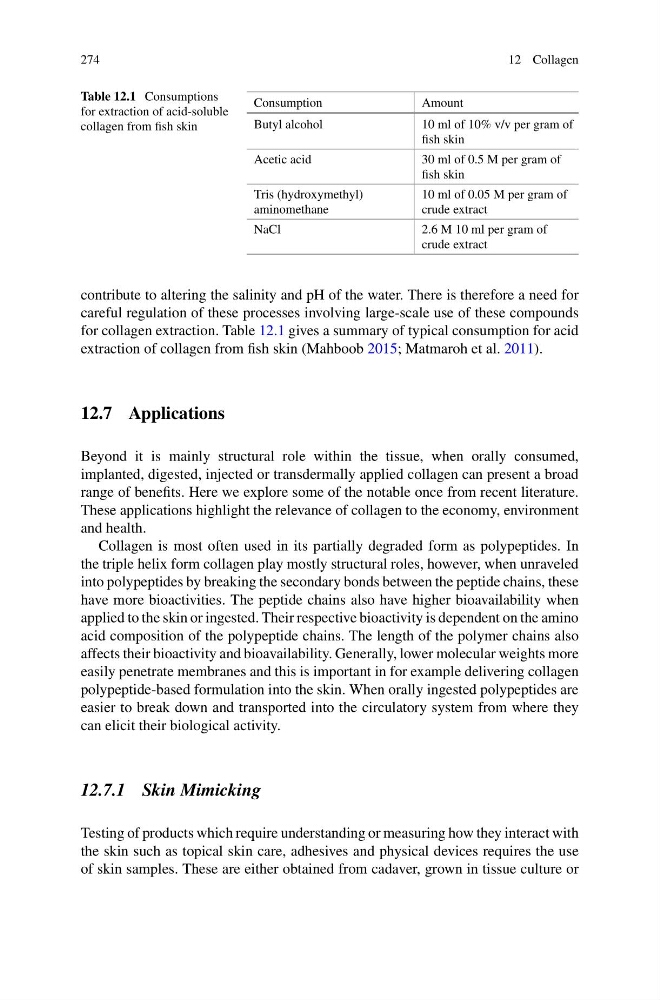
for collagen extraction. Table 12.1 gives a summary of typical consumption for acid
extraction of collagen from fish skin (Mahboob 2015; Matmaroh et al. 2011).
12.7 Applications
Beyond it is mainly structural role within the tissue, when orally consumed,
implanted, digested, injected or transdermally applied collagen can present a broad
range of benefits. Here we explore some of the notable once from recent literature.
These applications highlight the relevance of collagen to the economy, environment
and health.
Collagen is most often used in its partially degraded form as polypeptides. In
the triple helix form collagen play mostly structural roles, however, when unraveled
into polypeptides by breaking the secondary bonds between the peptide chains, these
have more bioactivities. The peptide chains also have higher bioavailability when
applied to the skin or ingested. Their respective bioactivity is dependent on the amino
acid composition of the polypeptide chains. The length of the polymer chains also
affects their bioactivity and bioavailability. Generally, lower molecular weights more
easily penetrate membranes and this is important in for example delivering collagen
polypeptide-based formulation into the skin. When orally ingested polypeptides are
easier to break down and transported into the circulatory system from where they
can elicit their biological activity.
12.7.1 Skin Mimicking
Testing of products which require understanding or measuring how they interact with
the skin such as topical skin care, adhesives and physical devices requires the use
of skin samples. These are either obtained from cadaver, grown in tissue culture or
12 Collagen
Table 12.1 Consumptions
for extraction of acid-soluble
collagen from fish skin
Consumption
Amount
Butyl alcohol
10 ml of 10% v/v per gram of
fish skin
Acetic acid
30 ml of 0.5 M per gram of
fish skin
Tris (hydroxymethyl)
aminomethane
10 ml of 0.05 M per gram of
crude extract
NaCl
2.6 M 10 ml per gram of
crude extract
contribute to altering the salinity and pH of the water. There is therefore a need for
careful regulation of these processes involving large-scale use of these compounds
for collagen extraction. Table 12.1 gives a summary of typical consumption for acid
extraction of collagen from fish skin (Mahboob 2015; Matmaroh et al. 2011).
12.7 Applications
Beyond it is mainly structural role within the tissue, when orally consumed,
implanted, digested, injected or transdermally applied collagen can present a broad
range of benefits. Here we explore some of the notable once from recent literature.
These applications highlight the relevance of collagen to the economy, environment
and health.
Collagen is most often used in its partially degraded form as polypeptides. In
the triple helix form collagen play mostly structural roles, however, when unraveled
into polypeptides by breaking the secondary bonds between the peptide chains, these
have more bioactivities. The peptide chains also have higher bioavailability when
applied to the skin or ingested. Their respective bioactivity is dependent on the amino
acid composition of the polypeptide chains. The length of the polymer chains also
affects their bioactivity and bioavailability. Generally, lower molecular weights more
easily penetrate membranes and this is important in for example delivering collagen
polypeptide-based formulation into the skin. When orally ingested polypeptides are
easier to break down and transported into the circulatory system from where they
can elicit their biological activity.
12.7.1 Skin Mimicking
Testing of products which require understanding or measuring how they interact with
the skin such as topical skin care, adhesives and physical devices requires the use
of skin samples. These are either obtained from cadaver, grown in tissue culture or