

264
12 Collagen
Collagen
Fibre
Triple Helix
Single protein
Chain
Hydrolyzed
collagen
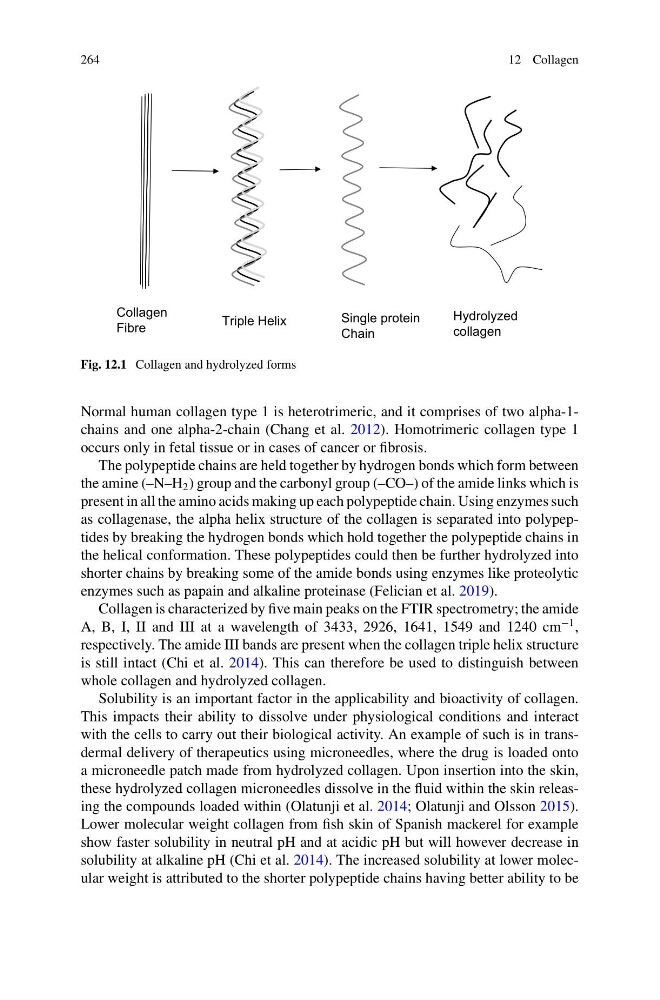
Fig. 12.1 Collagen and hydrolyzed forms
Normal human collagen type 1 is heterotrimeric, and it comprises of two alpha-1chains and one alpha-2-chain (Chang et al. 2012). Homotrimeric collagen type 1
occurs only in fetal tissue or in cases of cancer or fibrosis.
The polypeptide chains are held together by hydrogen bonds which form between
the amine (–N–H 2 ) group and the carbonyl group (–CO–) of the amide links which is
present in all the amino acids making up each polypeptide chain. Using enzymes such
as collagenase, the alpha helix structure of the collagen is separated into polypeptides by breaking the hydrogen bonds which hold together the polypeptide chains in
the helical conformation. These polypeptides could then be further hydrolyzed into
shorter chains by breaking some of the amide bonds using enzymes like proteolytic
enzymes such as papain and alkaline proteinase (Felician et al. 2019).
Collagen is characterized by five main peaks on the FTIR spectrometry; the amide
A, B, I, II and III at a wavelength of 3433, 2926, 1641, 1549 and 1240 cm
−1 ,
respectively. The amide III bands are present when the collagen triple helix structure
is still intact (Chi et al. 2014). This can therefore be used to distinguish between
whole collagen and hydrolyzed collagen.
Solubility is an important factor in the applicability and bioactivity of collagen.
This impacts their ability to dissolve under physiological conditions and interact
with the cells to carry out their biological activity. An example of such is in transdermal delivery of therapeutics using microneedles, where the drug is loaded onto
a microneedle patch made from hydrolyzed collagen. Upon insertion into the skin,
these hydrolyzed collagen microneedles dissolve in the fluid within the skin releasing the compounds loaded within (Olatunji et al. 2014; Olatunji and Olsson 2015).
Lower molecular weight collagen from fish skin of Spanish mackerel for example
show faster solubility in neutral pH and at acidic pH but will however decrease in
solubility at alkaline pH (Chi et al. 2014). The increased solubility at lower molecular weight is attributed to the shorter polypeptide chains having better ability to be
12 Collagen
Collagen
Fibre
Triple Helix
Single protein
Chain
Hydrolyzed
collagen
Fig. 12.1 Collagen and hydrolyzed forms
Normal human collagen type 1 is heterotrimeric, and it comprises of two alpha-1chains and one alpha-2-chain (Chang et al. 2012). Homotrimeric collagen type 1
occurs only in fetal tissue or in cases of cancer or fibrosis.
The polypeptide chains are held together by hydrogen bonds which form between
the amine (–N–H 2 ) group and the carbonyl group (–CO–) of the amide links which is
present in all the amino acids making up each polypeptide chain. Using enzymes such
as collagenase, the alpha helix structure of the collagen is separated into polypeptides by breaking the hydrogen bonds which hold together the polypeptide chains in
the helical conformation. These polypeptides could then be further hydrolyzed into
shorter chains by breaking some of the amide bonds using enzymes like proteolytic
enzymes such as papain and alkaline proteinase (Felician et al. 2019).
Collagen is characterized by five main peaks on the FTIR spectrometry; the amide
A, B, I, II and III at a wavelength of 3433, 2926, 1641, 1549 and 1240 cm
−1 ,
respectively. The amide III bands are present when the collagen triple helix structure
is still intact (Chi et al. 2014). This can therefore be used to distinguish between
whole collagen and hydrolyzed collagen.
Solubility is an important factor in the applicability and bioactivity of collagen.
This impacts their ability to dissolve under physiological conditions and interact
with the cells to carry out their biological activity. An example of such is in transdermal delivery of therapeutics using microneedles, where the drug is loaded onto
a microneedle patch made from hydrolyzed collagen. Upon insertion into the skin,
these hydrolyzed collagen microneedles dissolve in the fluid within the skin releasing the compounds loaded within (Olatunji et al. 2014; Olatunji and Olsson 2015).
Lower molecular weight collagen from fish skin of Spanish mackerel for example
show faster solubility in neutral pH and at acidic pH but will however decrease in
solubility at alkaline pH (Chi et al. 2014). The increased solubility at lower molecular weight is attributed to the shorter polypeptide chains having better ability to be