

250
11 Enzymes
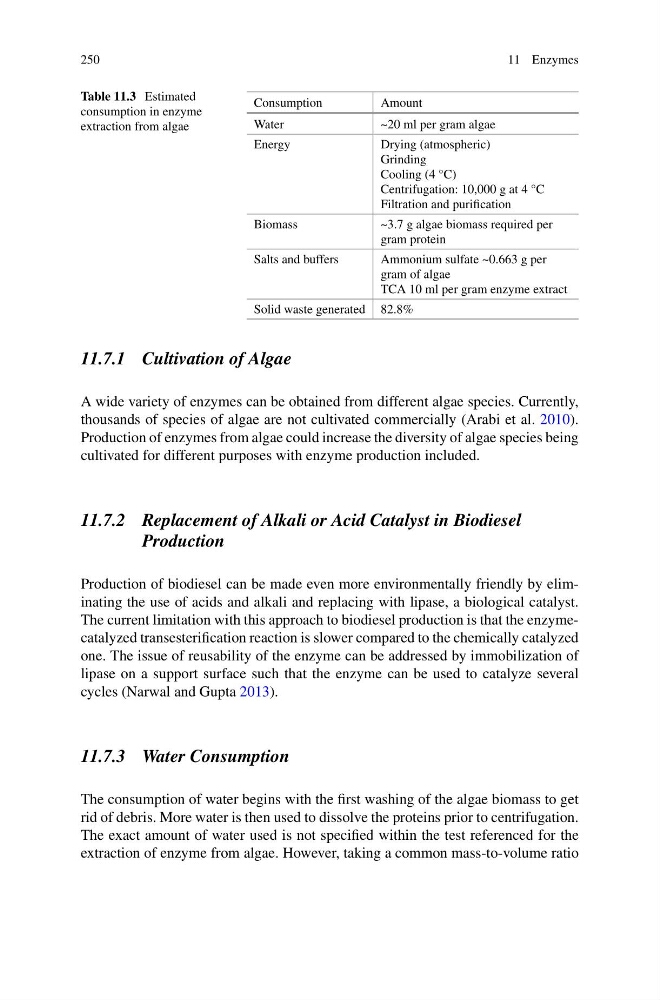
Table 11.3 Estimated
consumption in enzyme
extraction from algae
Consumption
Amount
Water
~20 ml per gram algae
Energy
Drying (atmospheric)
Grinding
Cooling (4 °C)
Centrifugation: 10,000 g at 4 °C
Filtration and purification
Biomass
~3.7 g algae biomass required per
gram protein
Salts and buffers
Ammonium sulfate ~0.663 g per
gram of algae
TCA 10 ml per gram enzyme extract
Solid waste generated 82.8%
11.7.1 Cultivation of Algae
A wide variety of enzymes can be obtained from different algae species. Currently,
thousands of species of algae are not cultivated commercially (Arabi et al. 2010).
Production of enzymes from algae could increase the diversity of algae species being
cultivated for different purposes with enzyme production included.
11.7.2 Replacement of Alkali or Acid Catalyst in Biodiesel
Production
Production of biodiesel can be made even more environmentally friendly by eliminating the use of acids and alkali and replacing with lipase, a biological catalyst.
The current limitation with this approach to biodiesel production is that the enzymecatalyzed transesterification reaction is slower compared to the chemically catalyzed
one. The issue of reusability of the enzyme can be addressed by immobilization of
lipase on a support surface such that the enzyme can be used to catalyze several
cycles (Narwal and Gupta 2013).
11.7.3 Water Consumption
The consumption of water begins with the first washing of the algae biomass to get
rid of debris. More water is then used to dissolve the proteins prior to centrifugation.
The exact amount of water used is not specified within the test referenced for the
extraction of enzyme from algae. However, taking a common mass-to-volume ratio
11 Enzymes
Table 11.3 Estimated
consumption in enzyme
extraction from algae
Consumption
Amount
Water
~20 ml per gram algae
Energy
Drying (atmospheric)
Grinding
Cooling (4 °C)
Centrifugation: 10,000 g at 4 °C
Filtration and purification
Biomass
~3.7 g algae biomass required per
gram protein
Salts and buffers
Ammonium sulfate ~0.663 g per
gram of algae
TCA 10 ml per gram enzyme extract
Solid waste generated 82.8%
11.7.1 Cultivation of Algae
A wide variety of enzymes can be obtained from different algae species. Currently,
thousands of species of algae are not cultivated commercially (Arabi et al. 2010).
Production of enzymes from algae could increase the diversity of algae species being
cultivated for different purposes with enzyme production included.
11.7.2 Replacement of Alkali or Acid Catalyst in Biodiesel
Production
Production of biodiesel can be made even more environmentally friendly by eliminating the use of acids and alkali and replacing with lipase, a biological catalyst.
The current limitation with this approach to biodiesel production is that the enzymecatalyzed transesterification reaction is slower compared to the chemically catalyzed
one. The issue of reusability of the enzyme can be addressed by immobilization of
lipase on a support surface such that the enzyme can be used to catalyze several
cycles (Narwal and Gupta 2013).
11.7.3 Water Consumption
The consumption of water begins with the first washing of the algae biomass to get
rid of debris. More water is then used to dissolve the proteins prior to centrifugation.
The exact amount of water used is not specified within the test referenced for the
extraction of enzyme from algae. However, taking a common mass-to-volume ratio