

2.1 Introduction
7
This predicted rise in population is necessitating the expansion of the food industry
in general. Aquatic food serves as a key source of protein and essential nutrients in
which many developing and advanced economies rely on. This will mean a rise
in the amount of aquatic waste and by-products being generated—thus indicating
long-term availability of feedstock such as shrimp and lobster shells, fish scales and
internal organs to power the marine biorefinery. Going further, we shall explore the
availability trends of the respective aquatic feedstocks for biopolymer production.
This chapter gives the reader an overview of the aquatic environment and in doing
so provides an insight into the diversity of the aquatic ecosystem which serves as a
source of a wide variety of biopolymers which will be discussed in the subsequent
chapters.
2.2 Types of Aquatic Ecosystems
Through exploring the various aquatic biosystems, we can then understand the various roles played by these biopolymers within the living organisms and within the
aquatic environment as well as how to extract and utilize them. Aquatic ecosystem
can refer to either inland or marine waters. Inland waters refer to aquatic ecosystem within the land borders, while the marine waters refer to generally the seas
and oceans. These coastal lands/waters refer to the boundary between the aquatic
ecosystem and terrestrial ecosystem. These are generally referred to with terms such
as beach, shore, coastlines and waterside.
Based on source and salinity, aquatic ecosystem can be classified as marine and
freshwater. Brackish water is formed where the saltwater from the marine mixes with
freshwater. There are five oceans on earth: the Atlantic, Pacific, Indian, Arctic and
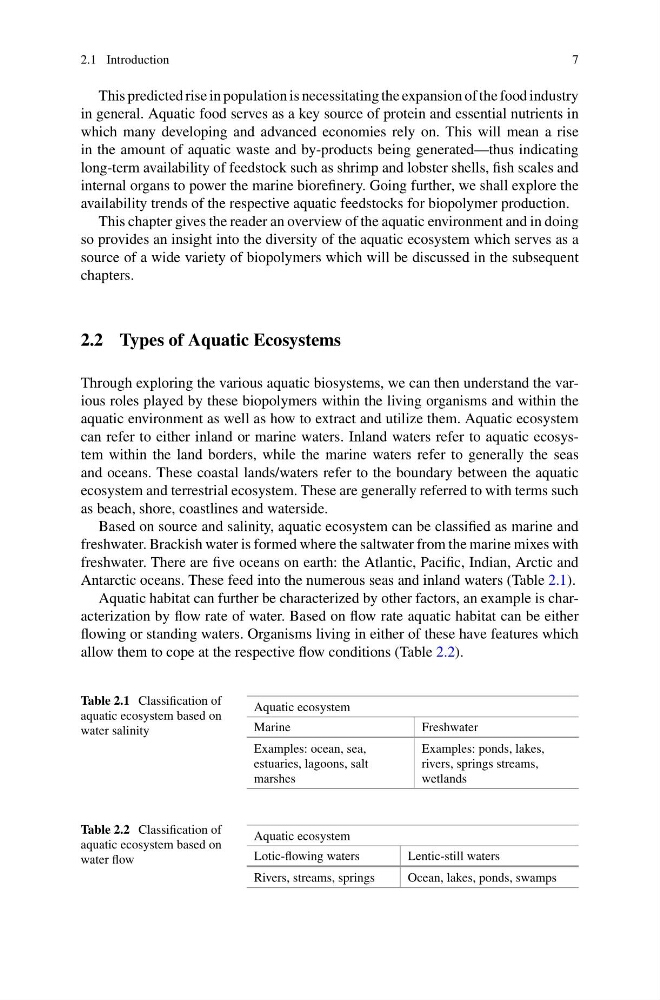
Antarctic oceans. These feed into the numerous seas and inland waters (Table 2.1).
Aquatic habitat can further be characterized by other factors, an example is characterization by flow rate of water. Based on flow rate aquatic habitat can be either
flowing or standing waters. Organisms living in either of these have features which
allow them to cope at the respective flow conditions (Table 2.2).
Table 2.1 Classification of
aquatic ecosystem based on
water salinity
Aquatic ecosystem
Marine
Freshwater
Examples: ocean, sea,
estuaries, lagoons, salt
marshes
Examples: ponds, lakes,
rivers, springs streams,
wetlands
Table 2.2 Classification of
aquatic ecosystem based on
water flow
Aquatic ecosystem
Lotic-flowing waters
Lentic-still waters
Rivers, streams, springs
Ocean, lakes, ponds, swamps
7
This predicted rise in population is necessitating the expansion of the food industry
in general. Aquatic food serves as a key source of protein and essential nutrients in
which many developing and advanced economies rely on. This will mean a rise
in the amount of aquatic waste and by-products being generated—thus indicating
long-term availability of feedstock such as shrimp and lobster shells, fish scales and
internal organs to power the marine biorefinery. Going further, we shall explore the
availability trends of the respective aquatic feedstocks for biopolymer production.
This chapter gives the reader an overview of the aquatic environment and in doing
so provides an insight into the diversity of the aquatic ecosystem which serves as a
source of a wide variety of biopolymers which will be discussed in the subsequent
chapters.
2.2 Types of Aquatic Ecosystems
Through exploring the various aquatic biosystems, we can then understand the various roles played by these biopolymers within the living organisms and within the
aquatic environment as well as how to extract and utilize them. Aquatic ecosystem
can refer to either inland or marine waters. Inland waters refer to aquatic ecosystem within the land borders, while the marine waters refer to generally the seas
and oceans. These coastal lands/waters refer to the boundary between the aquatic
ecosystem and terrestrial ecosystem. These are generally referred to with terms such
as beach, shore, coastlines and waterside.
Based on source and salinity, aquatic ecosystem can be classified as marine and
freshwater. Brackish water is formed where the saltwater from the marine mixes with
freshwater. There are five oceans on earth: the Atlantic, Pacific, Indian, Arctic and
Antarctic oceans. These feed into the numerous seas and inland waters (Table 2.1).
Aquatic habitat can further be characterized by other factors, an example is characterization by flow rate of water. Based on flow rate aquatic habitat can be either
flowing or standing waters. Organisms living in either of these have features which
allow them to cope at the respective flow conditions (Table 2.2).
Table 2.1 Classification of
aquatic ecosystem based on
water salinity
Aquatic ecosystem
Marine
Freshwater
Examples: ocean, sea,
estuaries, lagoons, salt
marshes
Examples: ponds, lakes,
rivers, springs streams,
wetlands
Table 2.2 Classification of
aquatic ecosystem based on
water flow
Aquatic ecosystem
Lotic-flowing waters
Lentic-still waters
Rivers, streams, springs
Ocean, lakes, ponds, swamps