

9.6 Environmental Implications
201
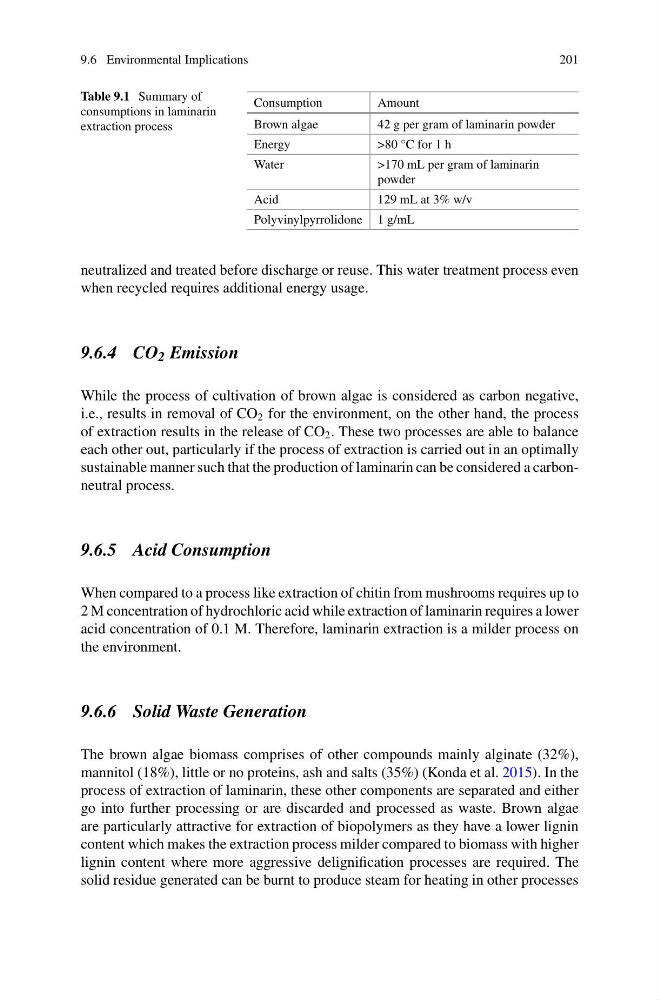
Table 9.1 Summary of
consumptions in laminarin
extraction process
Consumption
Amount
Brown algae
42 g per gram of laminarin powder
Energy
>80 °C for 1 h
Water
>170 mL per gram of laminarin
powder
Acid
129 mL at 3% w/v
Polyvinylpyrrolidone 1 g/mL
neutralized and treated before discharge or reuse. This water treatment process even
when recycled requires additional energy usage.
9.6.4 CO 2 Emission
While the process of cultivation of brown algae is considered as carbon negative,
i.e., results in removal of CO 2 for the environment, on the other hand, the process
of extraction results in the release of CO 2 . These two processes are able to balance
each other out, particularly if the process of extraction is carried out in an optimally
sustainable manner such that the production of laminarin can be considered a carbonneutral process.
9.6.5 Acid Consumption
When compared to a process like extraction of chitin from mushrooms requires up to
2 M concentration of hydrochloric acid while extraction of laminarin requires a lower
acid concentration of 0.1 M. Therefore, laminarin extraction is a milder process on
the environment.
9.6.6 Solid Waste Generation
The brown algae biomass comprises of other compounds mainly alginate (32%),
mannitol (18%), little or no proteins, ash and salts (35%) (Konda et al. 2015). In the
process of extraction of laminarin, these other components are separated and either
go into further processing or are discarded and processed as waste. Brown algae
are particularly attractive for extraction of biopolymers as they have a lower lignin
content which makes the extraction process milder compared to biomass with higher
lignin content where more aggressive delignification processes are required. The
solid residue generated can be burnt to produce steam for heating in other processes
201
Table 9.1 Summary of
consumptions in laminarin
extraction process
Consumption
Amount
Brown algae
42 g per gram of laminarin powder
Energy
>80 °C for 1 h
Water
>170 mL per gram of laminarin
powder
Acid
129 mL at 3% w/v
Polyvinylpyrrolidone 1 g/mL
neutralized and treated before discharge or reuse. This water treatment process even
when recycled requires additional energy usage.
9.6.4 CO 2 Emission
While the process of cultivation of brown algae is considered as carbon negative,
i.e., results in removal of CO 2 for the environment, on the other hand, the process
of extraction results in the release of CO 2 . These two processes are able to balance
each other out, particularly if the process of extraction is carried out in an optimally
sustainable manner such that the production of laminarin can be considered a carbonneutral process.
9.6.5 Acid Consumption
When compared to a process like extraction of chitin from mushrooms requires up to
2 M concentration of hydrochloric acid while extraction of laminarin requires a lower
acid concentration of 0.1 M. Therefore, laminarin extraction is a milder process on
the environment.
9.6.6 Solid Waste Generation
The brown algae biomass comprises of other compounds mainly alginate (32%),
mannitol (18%), little or no proteins, ash and salts (35%) (Konda et al. 2015). In the
process of extraction of laminarin, these other components are separated and either
go into further processing or are discarded and processed as waste. Brown algae
are particularly attractive for extraction of biopolymers as they have a lower lignin
content which makes the extraction process milder compared to biomass with higher
lignin content where more aggressive delignification processes are required. The
solid residue generated can be burnt to produce steam for heating in other processes