

194
9 Laminarins
dialysis condition for separation is dialysis against deionized water and a molecular
weight cutoff point of 2000 Da. Using this method, laminarin with a degree of
methacrylation of 5–10, 10–20 and 20–30% is obtained when 0.75, 1.5 and 3.0 mmol
of glycidyl methacrylate were used, respectively (Wang et al. 2018).
The methacrylated laminarin is then cross-linked to obtain hydrogels. The hydrogels obtained from methacrylated laminarin have a tensile strength of up to 0.63 MPa,
a compressive strength of 3.2 MPa, and will stretch by 650% of their original length
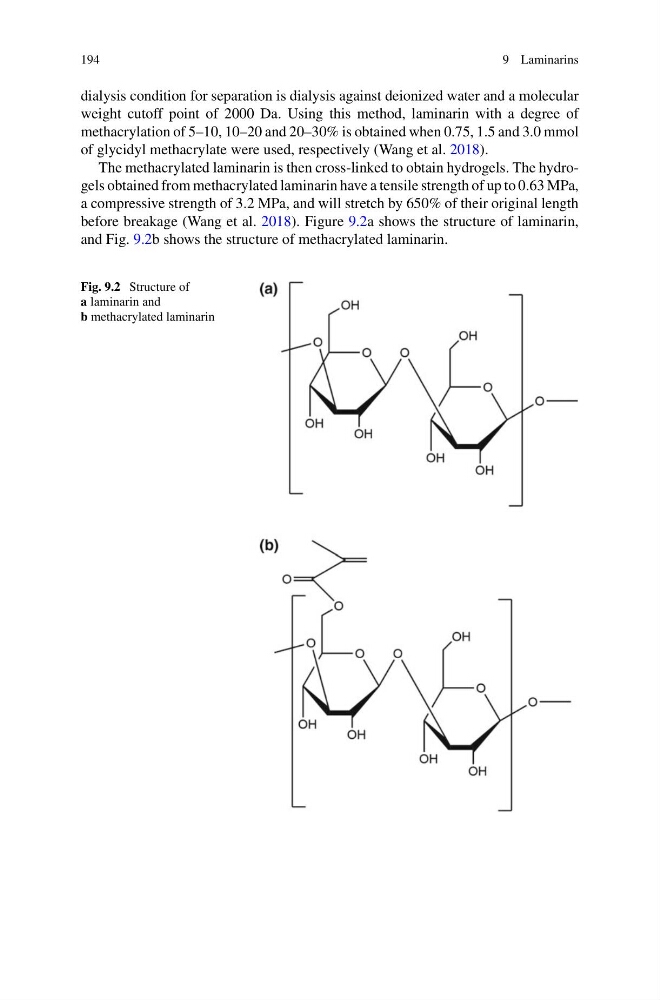
before breakage (Wang et al. 2018). Figure 9.2a shows the structure of laminarin,
and Fig. 9.2b shows the structure of methacrylated laminarin.
Fig. 9.2 Structure of
a laminarin and
b methacrylated laminarin
9 Laminarins
dialysis condition for separation is dialysis against deionized water and a molecular
weight cutoff point of 2000 Da. Using this method, laminarin with a degree of
methacrylation of 5–10, 10–20 and 20–30% is obtained when 0.75, 1.5 and 3.0 mmol
of glycidyl methacrylate were used, respectively (Wang et al. 2018).
The methacrylated laminarin is then cross-linked to obtain hydrogels. The hydrogels obtained from methacrylated laminarin have a tensile strength of up to 0.63 MPa,
a compressive strength of 3.2 MPa, and will stretch by 650% of their original length
before breakage (Wang et al. 2018). Figure 9.2a shows the structure of laminarin,
and Fig. 9.2b shows the structure of methacrylated laminarin.
Fig. 9.2 Structure of
a laminarin and
b methacrylated laminarin