

180
8 Ulvans
Table 8.1 Typical
consumption in ulvan
extraction process
Component
Amount
Green algae biomass
3–12.5 g per gram algae a
Water
30 ml/g ulva
Ammonium oxalate
0.02M
Ethanol
80% 10 ml
90% 10 ml
Acetone
98%
Energy
• Grinding
0.5 mm particle size
• Heating
65 °C 2 h
• Drying
60 °C overnight
• Centrifugation
8000 rpm 10 min
10,000 rpm 10 min
a Based on yield of ulvan ranging between 6 and 30%
unit operations which follow extraction such as separation and drying. Separation is
done using centrifugation at 10,000 rpm at 10 °C for 10 min. Centrifuges operate
from low rpm to medium rpm of about 2000 rpm to high rpm > 6000 rpm with
60,000 rpm being in the ultracentrifugation range. Therefore at 10,000 rpm, the ulvan
production separation process is making use of relatively high centrifugal force, thus
implying that the energy used up at this stage is considerably high. Manufacturers
also need to consider the energy consumed further down in the production process
for fractionating into different molecular weight ranges to obtain a less polydisperse
sample and for purification which is important in improving the value of the product.
As discussed within the chapter, molecular weight and purity have significant effect
on the bioactivity of ulvans.
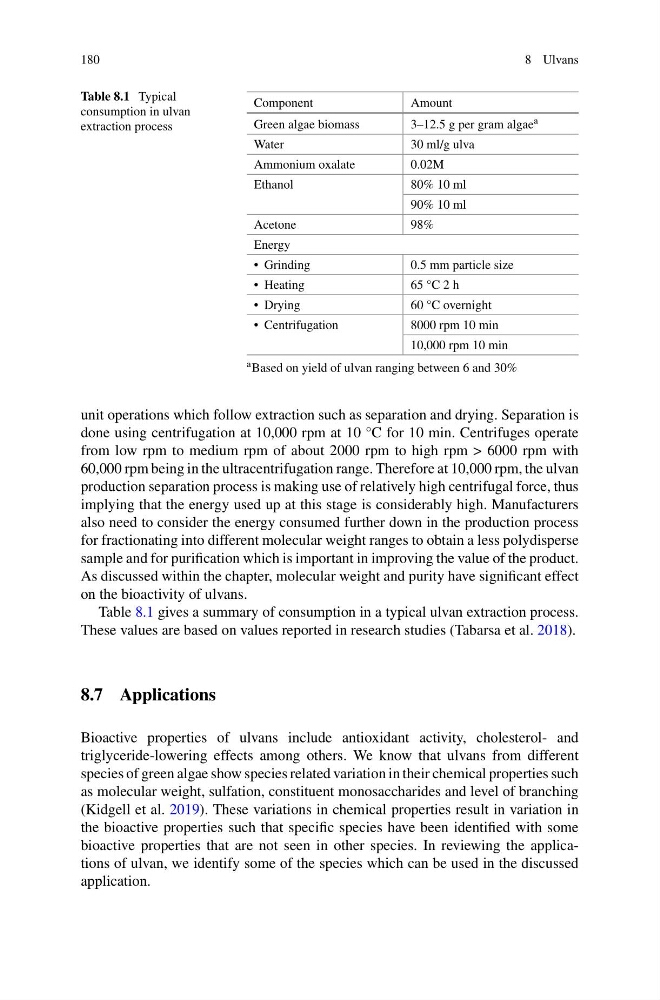
Table 8.1 gives a summary of consumption in a typical ulvan extraction process.
These values are based on values reported in research studies (Tabarsa et al. 2018).
8.7 Applications
Bioactive properties of ulvans include antioxidant activity, cholesterol- and
triglyceride-lowering effects among others. We know that ulvans from different
species of green algae show species related variation in their chemical properties such
as molecular weight, sulfation, constituent monosaccharides and level of branching
(Kidgell et al. 2019). These variations in chemical properties result in variation in
the bioactive properties such that specific species have been identified with some
bioactive properties that are not seen in other species. In reviewing the applications of ulvan, we identify some of the species which can be used in the discussed
application.
8 Ulvans
Table 8.1 Typical
consumption in ulvan
extraction process
Component
Amount
Green algae biomass
3–12.5 g per gram algae a
Water
30 ml/g ulva
Ammonium oxalate
0.02M
Ethanol
80% 10 ml
90% 10 ml
Acetone
98%
Energy
• Grinding
0.5 mm particle size
• Heating
65 °C 2 h
• Drying
60 °C overnight
• Centrifugation
8000 rpm 10 min
10,000 rpm 10 min
a Based on yield of ulvan ranging between 6 and 30%
unit operations which follow extraction such as separation and drying. Separation is
done using centrifugation at 10,000 rpm at 10 °C for 10 min. Centrifuges operate
from low rpm to medium rpm of about 2000 rpm to high rpm > 6000 rpm with
60,000 rpm being in the ultracentrifugation range. Therefore at 10,000 rpm, the ulvan
production separation process is making use of relatively high centrifugal force, thus
implying that the energy used up at this stage is considerably high. Manufacturers
also need to consider the energy consumed further down in the production process
for fractionating into different molecular weight ranges to obtain a less polydisperse
sample and for purification which is important in improving the value of the product.
As discussed within the chapter, molecular weight and purity have significant effect
on the bioactivity of ulvans.
Table 8.1 gives a summary of consumption in a typical ulvan extraction process.
These values are based on values reported in research studies (Tabarsa et al. 2018).
8.7 Applications
Bioactive properties of ulvans include antioxidant activity, cholesterol- and
triglyceride-lowering effects among others. We know that ulvans from different
species of green algae show species related variation in their chemical properties such
as molecular weight, sulfation, constituent monosaccharides and level of branching
(Kidgell et al. 2019). These variations in chemical properties result in variation in
the bioactive properties such that specific species have been identified with some
bioactive properties that are not seen in other species. In reviewing the applications of ulvan, we identify some of the species which can be used in the discussed
application.