

8.5 Extraction of Ulvan
177
Washing
Green algae biomass
Drying
Pulverization
Pretreatment with
ethanol
333K
Particle size
<0.5mm
80% 1:10
(g:ml)
Centrifugation
Rinsing with
Acetone
8000 rpm for 10 minutes.
Supernatant decanted off
Filtration
Pigments,
impurities, low
molecular
weight
compounds
Solid residue, a mix of polysaccharides
Drying
338K in distilled
water 1:20 (g:ml)
Aqueous
Extraction
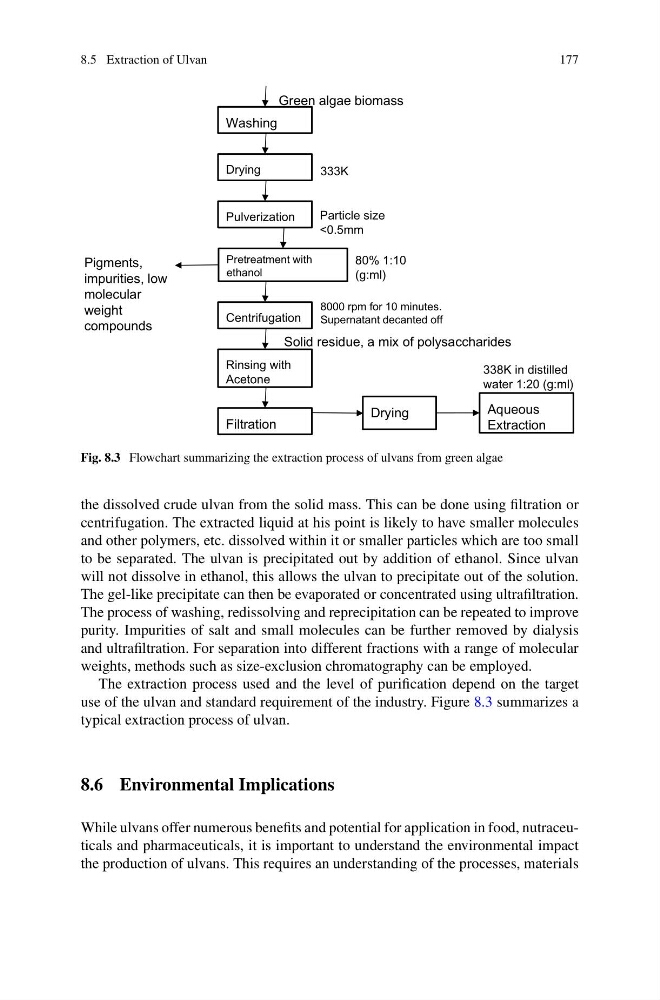
Fig. 8.3 Flowchart summarizing the extraction process of ulvans from green algae
the dissolved crude ulvan from the solid mass. This can be done using filtration or
centrifugation. The extracted liquid at his point is likely to have smaller molecules
and other polymers, etc. dissolved within it or smaller particles which are too small
to be separated. The ulvan is precipitated out by addition of ethanol. Since ulvan
will not dissolve in ethanol, this allows the ulvan to precipitate out of the solution.
The gel-like precipitate can then be evaporated or concentrated using ultrafiltration.
The process of washing, redissolving and reprecipitation can be repeated to improve
purity. Impurities of salt and small molecules can be further removed by dialysis
and ultrafiltration. For separation into different fractions with a range of molecular
weights, methods such as size-exclusion chromatography can be employed.
The extraction process used and the level of purification depend on the target
use of the ulvan and standard requirement of the industry. Figure 8.3 summarizes a
typical extraction process of ulvan.
8.6 Environmental Implications
While ulvans offer numerous benefits and potential for application in food, nutraceuticals and pharmaceuticals, it is important to understand the environmental impact
the production of ulvans. This requires an understanding of the processes, materials
177
Washing
Green algae biomass
Drying
Pulverization
Pretreatment with
ethanol
333K
Particle size
<0.5mm
80% 1:10
(g:ml)
Centrifugation
Rinsing with
Acetone
8000 rpm for 10 minutes.
Supernatant decanted off
Filtration
Pigments,
impurities, low
molecular
weight
compounds
Solid residue, a mix of polysaccharides
Drying
338K in distilled
water 1:20 (g:ml)
Aqueous
Extraction
Fig. 8.3 Flowchart summarizing the extraction process of ulvans from green algae
the dissolved crude ulvan from the solid mass. This can be done using filtration or
centrifugation. The extracted liquid at his point is likely to have smaller molecules
and other polymers, etc. dissolved within it or smaller particles which are too small
to be separated. The ulvan is precipitated out by addition of ethanol. Since ulvan
will not dissolve in ethanol, this allows the ulvan to precipitate out of the solution.
The gel-like precipitate can then be evaporated or concentrated using ultrafiltration.
The process of washing, redissolving and reprecipitation can be repeated to improve
purity. Impurities of salt and small molecules can be further removed by dialysis
and ultrafiltration. For separation into different fractions with a range of molecular
weights, methods such as size-exclusion chromatography can be employed.
The extraction process used and the level of purification depend on the target
use of the ulvan and standard requirement of the industry. Figure 8.3 summarizes a
typical extraction process of ulvan.
8.6 Environmental Implications
While ulvans offer numerous benefits and potential for application in food, nutraceuticals and pharmaceuticals, it is important to understand the environmental impact
the production of ulvans. This requires an understanding of the processes, materials