

158
7 Agar
and running of the plants are processes which result in CO 2 emission into the environment. It is therefore important that the CO 2 emissions in the processes involved
in the extraction as well as other ancillary processes are minimized.
7.6.3 Water Consumption
Much of the water used in the extraction process can be recovered during dewatering
using the gel press method. This water then needs to be treated to remove impurities. The process of water treatment requires further use of energy and resources.
During the drying process, there is return of water to the environment, especially in
less sophisticated small or medium-scale production processes where the evaporated
water is not recondenced. The water used in the extraction varies for different process
and choice of processor. An example process for extraction of agar uses 150 ml of
water per gram of algae biomass in the alkali pretreatment stage (Rejeki et al. 2018).
7.6.4 Use of Acid and Alkali
In the acid extraction method, a low pH is required to aid the process of cell wall
disruption, a slightly acidic solution of pH ~6 at a temperature of 90–100 °C. In
the alkali extraction method, a NaOH concentration of 5% w/v is used at a lower
temperature of 30 °C, where a weight-to-volume ratio of 1:150 is used, that means
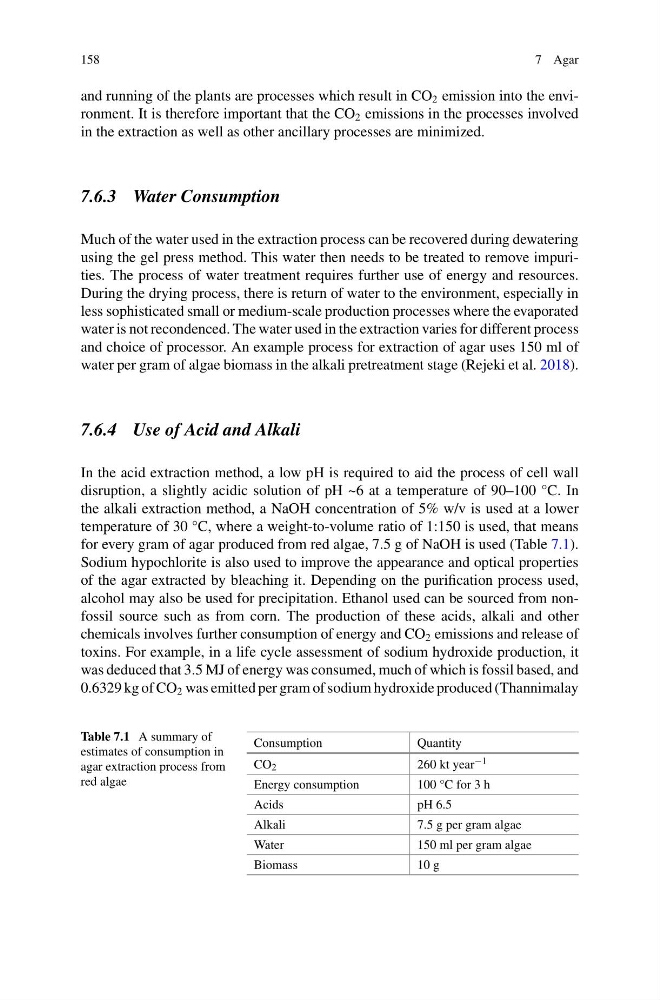
for every gram of agar produced from red algae, 7.5 g of NaOH is used (Table 7.1).
Sodium hypochlorite is also used to improve the appearance and optical properties
of the agar extracted by bleaching it. Depending on the purification process used,
alcohol may also be used for precipitation. Ethanol used can be sourced from nonfossil source such as from corn. The production of these acids, alkali and other
chemicals involves further consumption of energy and CO 2 emissions and release of
toxins. For example, in a life cycle assessment of sodium hydroxide production, it
was deduced that 3.5 MJ of energy was consumed, much of which is fossil based, and
0.6329 kg of CO 2 was emitted per gram of sodium hydroxide produced (Thannimalay
Table 7.1 A summary of
estimates of consumption in
agar extraction process from
red algae
Consumption
Quantity
CO 2
260 kt year −1
Energy consumption
100 °C for 3 h
Acids
pH 6.5
Alkali
7.5 g per gram algae
Water
150 ml per gram algae
Biomass
10 g
7 Agar
and running of the plants are processes which result in CO 2 emission into the environment. It is therefore important that the CO 2 emissions in the processes involved
in the extraction as well as other ancillary processes are minimized.
7.6.3 Water Consumption
Much of the water used in the extraction process can be recovered during dewatering
using the gel press method. This water then needs to be treated to remove impurities. The process of water treatment requires further use of energy and resources.
During the drying process, there is return of water to the environment, especially in
less sophisticated small or medium-scale production processes where the evaporated
water is not recondenced. The water used in the extraction varies for different process
and choice of processor. An example process for extraction of agar uses 150 ml of
water per gram of algae biomass in the alkali pretreatment stage (Rejeki et al. 2018).
7.6.4 Use of Acid and Alkali
In the acid extraction method, a low pH is required to aid the process of cell wall
disruption, a slightly acidic solution of pH ~6 at a temperature of 90–100 °C. In
the alkali extraction method, a NaOH concentration of 5% w/v is used at a lower
temperature of 30 °C, where a weight-to-volume ratio of 1:150 is used, that means
for every gram of agar produced from red algae, 7.5 g of NaOH is used (Table 7.1).
Sodium hypochlorite is also used to improve the appearance and optical properties
of the agar extracted by bleaching it. Depending on the purification process used,
alcohol may also be used for precipitation. Ethanol used can be sourced from nonfossil source such as from corn. The production of these acids, alkali and other
chemicals involves further consumption of energy and CO 2 emissions and release of
toxins. For example, in a life cycle assessment of sodium hydroxide production, it
was deduced that 3.5 MJ of energy was consumed, much of which is fossil based, and
0.6329 kg of CO 2 was emitted per gram of sodium hydroxide produced (Thannimalay
Table 7.1 A summary of
estimates of consumption in
agar extraction process from
red algae
Consumption
Quantity
CO 2
260 kt year −1
Energy consumption
100 °C for 3 h
Acids
pH 6.5
Alkali
7.5 g per gram algae
Water
150 ml per gram algae
Biomass
10 g