

based NC, it has unique properties, such as high purity, high degree of polymerization, high crystallinity (70–80%), high water content (90%), and high heat and
mechanical stability; however, expensive fermentation processes, involved in its
production have limited its widespread use (Torres et al. 2019; Chen et al. 2016; da
Gama and Dourado 2018). Other forms of nanocellulose include amorphous
nanocellulose and cellulose nanoyarn (CNY). Amorphous nanocellulose is mainly
prepared from regenerated cellulose via acid hydrolysis followed by ultrasound
disintegration (Ioelovich 2008). An electrospinning technique is applied to solutions
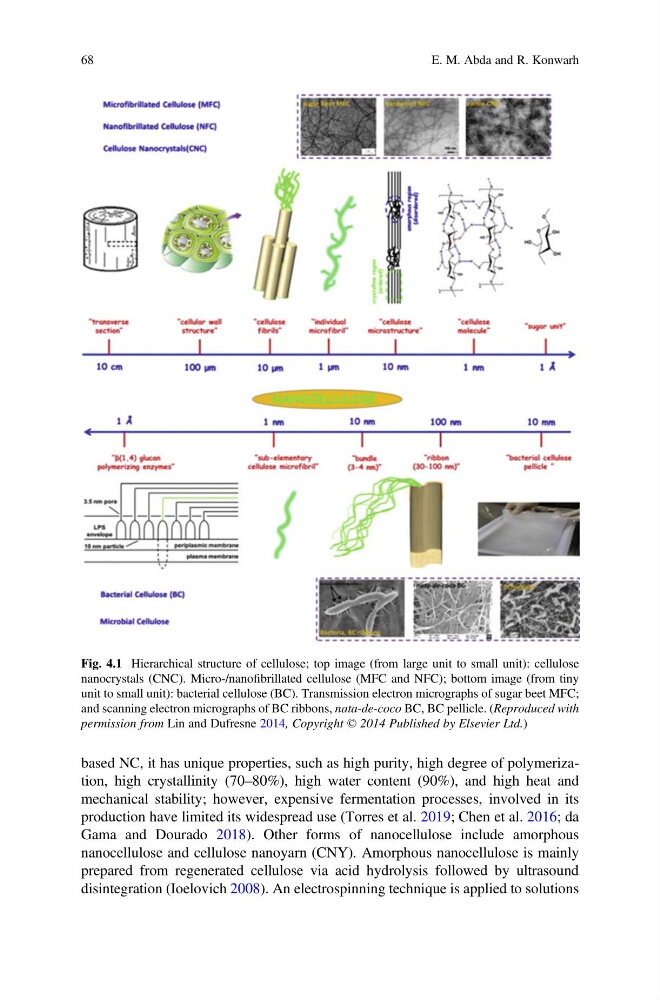
Fig. 4.1 Hierarchical structure of cellulose; top image (from large unit to small unit): cellulose
nanocrystals (CNC). Micro-/nanofibrillated cellulose (MFC and NFC); bottom image (from tiny
unit to small unit): bacterial cellulose (BC). Transmission electron micrographs of sugar beet MFC;
and scanning electron micrographs of BC ribbons, nata-de-coco BC, BC pellicle. (Reproduced with
permission from Lin and Dufresne 2014, Copyright © 2014 Published by Elsevier Ltd.)
68
E. M. Abda and R. Konwarh
mechanical stability; however, expensive fermentation processes, involved in its
production have limited its widespread use (Torres et al. 2019; Chen et al. 2016; da
Gama and Dourado 2018). Other forms of nanocellulose include amorphous
nanocellulose and cellulose nanoyarn (CNY). Amorphous nanocellulose is mainly
prepared from regenerated cellulose via acid hydrolysis followed by ultrasound
disintegration (Ioelovich 2008). An electrospinning technique is applied to solutions
Fig. 4.1 Hierarchical structure of cellulose; top image (from large unit to small unit): cellulose
nanocrystals (CNC). Micro-/nanofibrillated cellulose (MFC and NFC); bottom image (from tiny
unit to small unit): bacterial cellulose (BC). Transmission electron micrographs of sugar beet MFC;
and scanning electron micrographs of BC ribbons, nata-de-coco BC, BC pellicle. (Reproduced with
permission from Lin and Dufresne 2014, Copyright © 2014 Published by Elsevier Ltd.)
68
E. M. Abda and R. Konwarh