

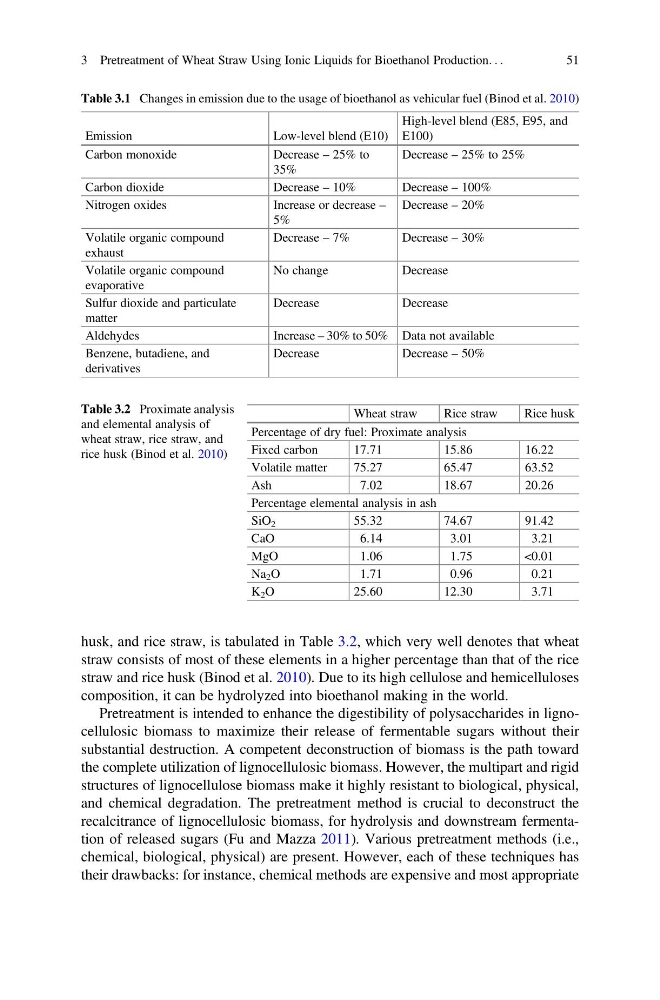
husk, and rice straw, is tabulated in Table 3.2, which very well denotes that wheat
straw consists of most of these elements in a higher percentage than that of the rice
straw and rice husk (Binod et al. 2010). Due to its high cellulose and hemicelluloses
composition, it can be hydrolyzed into bioethanol making in the world.
Pretreatment is intended to enhance the digestibility of polysaccharides in lignocellulosic biomass to maximize their release of fermentable sugars without their
substantial destruction. A competent deconstruction of biomass is the path toward
the complete utilization of lignocellulosic biomass. However, the multipart and rigid
structures of lignocellulose biomass make it highly resistant to biological, physical,
and chemical degradation. The pretreatment method is crucial to deconstruct the
recalcitrance of lignocellulosic biomass, for hydrolysis and downstream fermentation of released sugars (Fu and Mazza 2011). Various pretreatment methods (i.e.,
chemical, biological, physical) are present. However, each of these techniques has
their drawbacks: for instance, chemical methods are expensive and most appropriate
Table 3.1 Changes in emission due to the usage of bioethanol as vehicular fuel (Binod et al. 2010)
Emission
Low-level blend (E10)
High-level blend (E85, E95, and
E100)
Carbon monoxide
Decrease – 25% to
35%
Decrease – 25% to 25%
Carbon dioxide
Decrease – 10%
Decrease – 100%
Nitrogen oxides
Increase or decrease –
5%
Decrease – 20%
Volatile organic compound
exhaust
Decrease – 7%
Decrease – 30%
Volatile organic compound
evaporative
No change
Decrease
Sulfur dioxide and particulate
matter
Decrease
Decrease
Aldehydes
Increase – 30% to 50% Data not available
Benzene, butadiene, and
derivatives
Decrease
Decrease – 50%
Table 3.2 Proximate analysis
and elemental analysis of
wheat straw, rice straw, and
rice husk (Binod et al. 2010)
Wheat straw
Rice straw
Rice husk
Percentage of dry fuel: Proximate analysis
Fixed carbon
17.71
15.86
16.22
Volatile matter
75.27
65.47
63.52
Ash
7.02
18.67
20.26
Percentage elemental analysis in ash
SiO 2
55.32
74.67
91.42
CaO
6.14
3.01
3.21
MgO
1.06
1.75
<0.01
Na 2 O
1.71
0.96
0.21
K 2 O
25.60
12.30
3.71
3 Pretreatment of Wheat Straw Using Ionic Liquids for Bioethanol Production. . .
51
straw consists of most of these elements in a higher percentage than that of the rice
straw and rice husk (Binod et al. 2010). Due to its high cellulose and hemicelluloses
composition, it can be hydrolyzed into bioethanol making in the world.
Pretreatment is intended to enhance the digestibility of polysaccharides in lignocellulosic biomass to maximize their release of fermentable sugars without their
substantial destruction. A competent deconstruction of biomass is the path toward
the complete utilization of lignocellulosic biomass. However, the multipart and rigid
structures of lignocellulose biomass make it highly resistant to biological, physical,
and chemical degradation. The pretreatment method is crucial to deconstruct the
recalcitrance of lignocellulosic biomass, for hydrolysis and downstream fermentation of released sugars (Fu and Mazza 2011). Various pretreatment methods (i.e.,
chemical, biological, physical) are present. However, each of these techniques has
their drawbacks: for instance, chemical methods are expensive and most appropriate
Table 3.1 Changes in emission due to the usage of bioethanol as vehicular fuel (Binod et al. 2010)
Emission
Low-level blend (E10)
High-level blend (E85, E95, and
E100)
Carbon monoxide
Decrease – 25% to
35%
Decrease – 25% to 25%
Carbon dioxide
Decrease – 10%
Decrease – 100%
Nitrogen oxides
Increase or decrease –
5%
Decrease – 20%
Volatile organic compound
exhaust
Decrease – 7%
Decrease – 30%
Volatile organic compound
evaporative
No change
Decrease
Sulfur dioxide and particulate
matter
Decrease
Decrease
Aldehydes
Increase – 30% to 50% Data not available
Benzene, butadiene, and
derivatives
Decrease
Decrease – 50%
Table 3.2 Proximate analysis
and elemental analysis of
wheat straw, rice straw, and
rice husk (Binod et al. 2010)
Wheat straw
Rice straw
Rice husk
Percentage of dry fuel: Proximate analysis
Fixed carbon
17.71
15.86
16.22
Volatile matter
75.27
65.47
63.52
Ash
7.02
18.67
20.26
Percentage elemental analysis in ash
SiO 2
55.32
74.67
91.42
CaO
6.14
3.01
3.21
MgO
1.06
1.75
<0.01
Na 2 O
1.71
0.96
0.21
K 2 O
25.60
12.30
3.71
3 Pretreatment of Wheat Straw Using Ionic Liquids for Bioethanol Production. . .
51