

4.1.4 Phosphorus Use Efficiency Improvement
One-third of the world’s cultivable lands have deficient of phosphorus (P) to fulfill
the requisite for best plant development and growth (MacDonald et al. 2007). To
overcome this P deficiency, artificial fertilizers have been applying in higher
amounts that influence the soil parameters. So, identifying and developing for low
phosphorus-tolerant (LPT) varieties are the main parameter for high phosphorus use
efficiency improvement in crop production. Due to their grain yield, 6 LPT genotypes of rice were identified as IET5854, Rasi, IET14554, IET15328, IET17467, and
PRH122 with the aid of molecular characterization (Krishnamurthy et al. 2010).
From rice mapping population and several groups, two cultivars (DJ123 and Mudgo)
were developed with careful selection procedures in the laboratory stage to minimize
the requirement for extensive field evaluations. This used to detect best traits
contributed intolerance of low P (Yugandhar et al. 2017; Mahender et al. 2017;
Chithrameenal et al. 2017).Via mutation induction, one of the molecular breeding
approaches, for the development of resistance variety for both abiotic and biotic
stress conditions (Panigrahy et al. 2014) by using ethane methanesulfonate (EMS)
4 LPT varieties were identified. Various QTLs and genes controlling agronomic
traits associated to LPT had been identified and categorized by researchers as shown
in Table 20.1. For instance, QTLs for P insufficiency tolerance have been identified
from the rice population by crossing P-efficient Kasalath (indica landrace) and
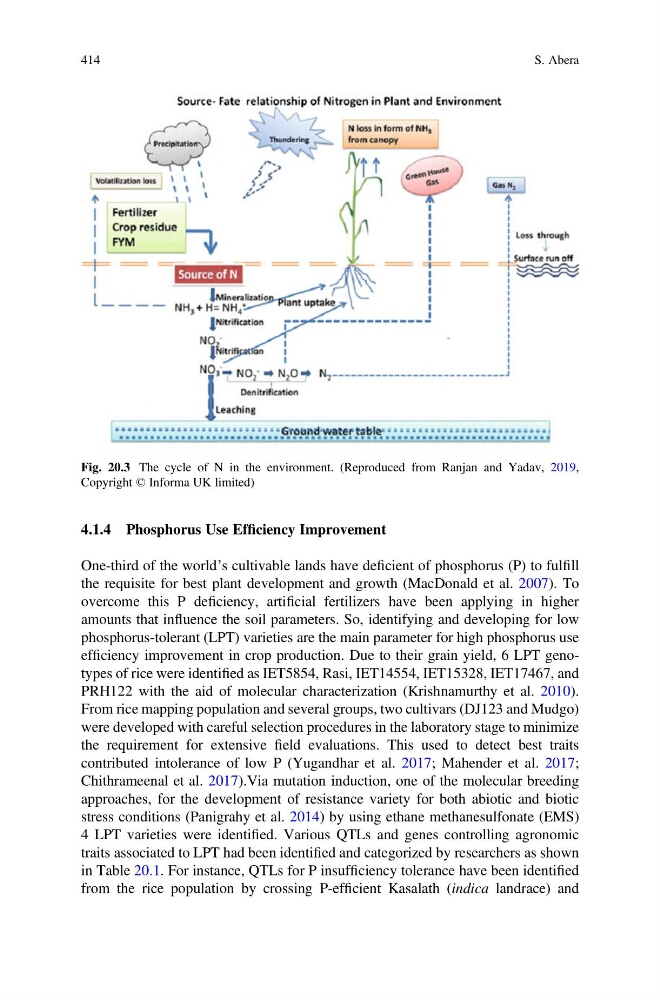
Fig. 20.3 The cycle of N in the environment. (Reproduced from Ranjan and Yadav, 2019,
Copyright © Informa UK limited)
414
S. Abera
One-third of the world’s cultivable lands have deficient of phosphorus (P) to fulfill
the requisite for best plant development and growth (MacDonald et al. 2007). To
overcome this P deficiency, artificial fertilizers have been applying in higher
amounts that influence the soil parameters. So, identifying and developing for low
phosphorus-tolerant (LPT) varieties are the main parameter for high phosphorus use
efficiency improvement in crop production. Due to their grain yield, 6 LPT genotypes of rice were identified as IET5854, Rasi, IET14554, IET15328, IET17467, and
PRH122 with the aid of molecular characterization (Krishnamurthy et al. 2010).
From rice mapping population and several groups, two cultivars (DJ123 and Mudgo)
were developed with careful selection procedures in the laboratory stage to minimize
the requirement for extensive field evaluations. This used to detect best traits
contributed intolerance of low P (Yugandhar et al. 2017; Mahender et al. 2017;
Chithrameenal et al. 2017).Via mutation induction, one of the molecular breeding
approaches, for the development of resistance variety for both abiotic and biotic
stress conditions (Panigrahy et al. 2014) by using ethane methanesulfonate (EMS)
4 LPT varieties were identified. Various QTLs and genes controlling agronomic
traits associated to LPT had been identified and categorized by researchers as shown
in Table 20.1. For instance, QTLs for P insufficiency tolerance have been identified
from the rice population by crossing P-efficient Kasalath (indica landrace) and
Fig. 20.3 The cycle of N in the environment. (Reproduced from Ranjan and Yadav, 2019,
Copyright © Informa UK limited)
414
S. Abera