

encoding putative transport proteins mediating the uptake of Zn, Fe, Cu, and Mn
from the soil solution (Ferrol et al. 2016). The fungus Botrytis cinerea was challenged to heavy metal (copper, nickel, zinc, cadmium) stress and secreted large panel
of proteins, oxidoreductases and cell-wall degrading enzymes which are modified in
response to metals (Cherrad et al. 2012).
4.2.3 Intracellular Chelation
Heavy metal chelation through high-affinity ligands by cytosol is potentially a very
useful mechanism of heavy metal detoxification and resilience. Potential ligands
include amino acids and organic acids, and two classes of peptides, phytochelatins
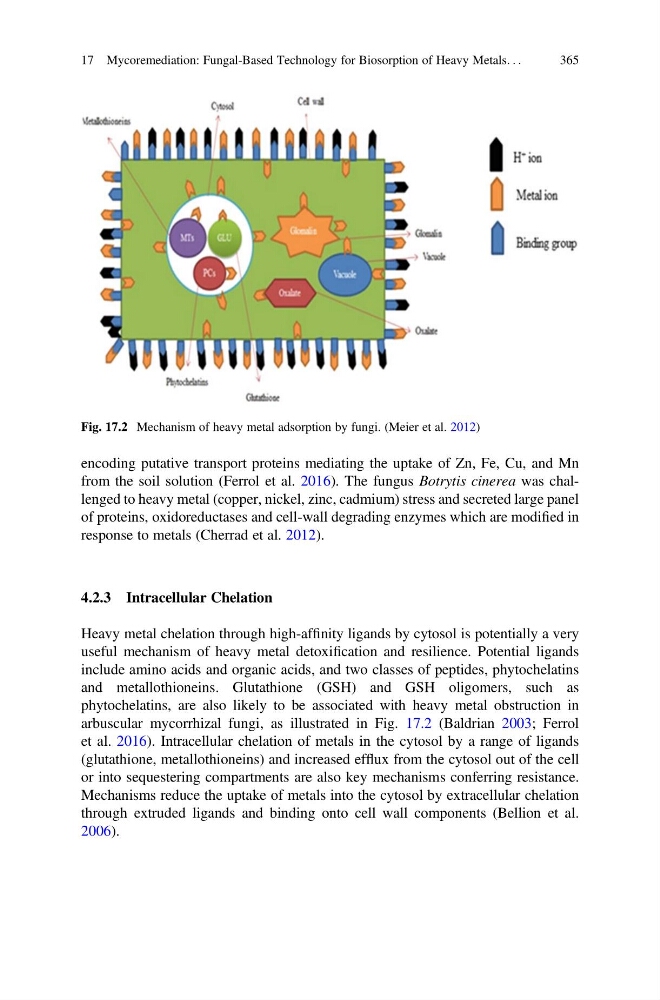
and metallothioneins. Glutathione (GSH) and GSH oligomers, such as
phytochelatins, are also likely to be associated with heavy metal obstruction in
arbuscular mycorrhizal fungi, as illustrated in Fig. 17.2 (Baldrian 2003; Ferrol
et al. 2016). Intracellular chelation of metals in the cytosol by a range of ligands
(glutathione, metallothioneins) and increased efflux from the cytosol out of the cell
or into sequestering compartments are also key mechanisms conferring resistance.
Mechanisms reduce the uptake of metals into the cytosol by extracellular chelation
through extruded ligands and binding onto cell wall components (Bellion et al.
2006).
Fig. 17.2 Mechanism of heavy metal adsorption by fungi. (Meier et al. 2012)
17 Mycoremediation: Fungal-Based Technology for Biosorption of Heavy Metals. . .
365
from the soil solution (Ferrol et al. 2016). The fungus Botrytis cinerea was challenged to heavy metal (copper, nickel, zinc, cadmium) stress and secreted large panel
of proteins, oxidoreductases and cell-wall degrading enzymes which are modified in
response to metals (Cherrad et al. 2012).
4.2.3 Intracellular Chelation
Heavy metal chelation through high-affinity ligands by cytosol is potentially a very
useful mechanism of heavy metal detoxification and resilience. Potential ligands
include amino acids and organic acids, and two classes of peptides, phytochelatins
and metallothioneins. Glutathione (GSH) and GSH oligomers, such as
phytochelatins, are also likely to be associated with heavy metal obstruction in
arbuscular mycorrhizal fungi, as illustrated in Fig. 17.2 (Baldrian 2003; Ferrol
et al. 2016). Intracellular chelation of metals in the cytosol by a range of ligands
(glutathione, metallothioneins) and increased efflux from the cytosol out of the cell
or into sequestering compartments are also key mechanisms conferring resistance.
Mechanisms reduce the uptake of metals into the cytosol by extracellular chelation
through extruded ligands and binding onto cell wall components (Bellion et al.
2006).
Fig. 17.2 Mechanism of heavy metal adsorption by fungi. (Meier et al. 2012)
17 Mycoremediation: Fungal-Based Technology for Biosorption of Heavy Metals. . .
365