

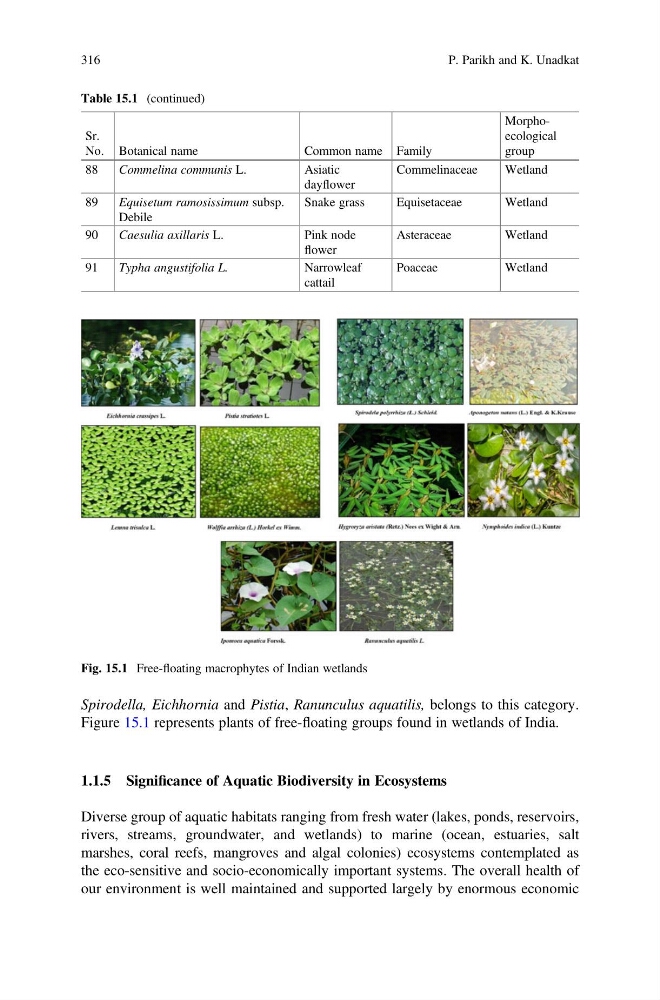
Spirodella, Eichhornia and Pistia, Ranunculus aquatilis, belongs to this category.
Figure 15.1 represents plants of free-floating groups found in wetlands of India.
1.1.5 Significance of Aquatic Biodiversity in Ecosystems
Diverse group of aquatic habitats ranging from fresh water (lakes, ponds, reservoirs,
rivers, streams, groundwater, and wetlands) to marine (ocean, estuaries, salt
marshes, coral reefs, mangroves and algal colonies) ecosystems contemplated as
the eco-sensitive and socio-economically important systems. The overall health of
our environment is well maintained and supported largely by enormous economic
Table 15.1 (continued)
Sr.
No. Botanical name
Common name Family
Morphoecological
group
88
Commelina communis L.
Asiatic
dayflower
Commelinaceae
Wetland
89
Equisetum ramosissimum subsp.
Debile
Snake grass
Equisetaceae
Wetland
90
Caesulia axillaris L.
Pink node
flower
Asteraceae
Wetland
91
Typha angustifolia L.
Narrowleaf
cattail
Poaceae
Wetland
Fig. 15.1 Free-floating macrophytes of Indian wetlands
316
P. Parikh and K. Unadkat
Figure 15.1 represents plants of free-floating groups found in wetlands of India.
1.1.5 Significance of Aquatic Biodiversity in Ecosystems
Diverse group of aquatic habitats ranging from fresh water (lakes, ponds, reservoirs,
rivers, streams, groundwater, and wetlands) to marine (ocean, estuaries, salt
marshes, coral reefs, mangroves and algal colonies) ecosystems contemplated as
the eco-sensitive and socio-economically important systems. The overall health of
our environment is well maintained and supported largely by enormous economic
Table 15.1 (continued)
Sr.
No. Botanical name
Common name Family
Morphoecological
group
88
Commelina communis L.
Asiatic
dayflower
Commelinaceae
Wetland
89
Equisetum ramosissimum subsp.
Debile
Snake grass
Equisetaceae
Wetland
90
Caesulia axillaris L.
Pink node
flower
Asteraceae
Wetland
91
Typha angustifolia L.
Narrowleaf
cattail
Poaceae
Wetland
Fig. 15.1 Free-floating macrophytes of Indian wetlands
316
P. Parikh and K. Unadkat