

5.2 Electrochemical Methods
In bioleaching processes, the dissolution of elemental metal (E
) or metal oxides
(EO) from e-waste is predominantly based on the following reactions (Brandl
et al. 2008):
Fe
2þ
þ H
þ
þ O 2 ! Fe
3þ
þ H 2 O
by microbial catalysis
ð
Þ
S
þ H 2 O þ O 2 ! H
þ
þ SO 4
2À
by microbial catalysis
ð
Þ
Fe
3þ
þ E
s
ð Þ ! Fe
2þ
þ E
nþ
by chemical reaction
ð
Þ
E
s
ð Þ þ H
þ
þ O 2 ! E
nþ
þ H 2 O
by chemical reaction
ð
Þ
EO s
ð Þ þ H
þ
! E
nþ
þ H 2 O
by chemical reaction
ð
Þ
From these mechanisms, electrons play a vital part in bioleaching reactions. So,
electrochemical influences alter the efficiency of bioleaching (Wang et al. 2016). In
this sense, bioleaching can be promoted by accelerating extracellular electron
transmission (EET). Several research studies have proposed that the bacterium
A. ferrooxidans has remarkable EET activity. Through A. ferrooxidans catalysis,
electrons are transferred for the oxidation of ferrous iron and reduce sulfur substances to oxygen that acts as electron acceptor. In the EET pathway, surfaceexposed fibers, rusticyanin, type IV pili, and cytochrome c play an important role.
Better e-waste bioleaching can be expected by promoting EET and electron transfer
mediators (ETMs) (Cao et al. 2011).
The extraordinary redox-potential performance of ETMs to improve EET is done
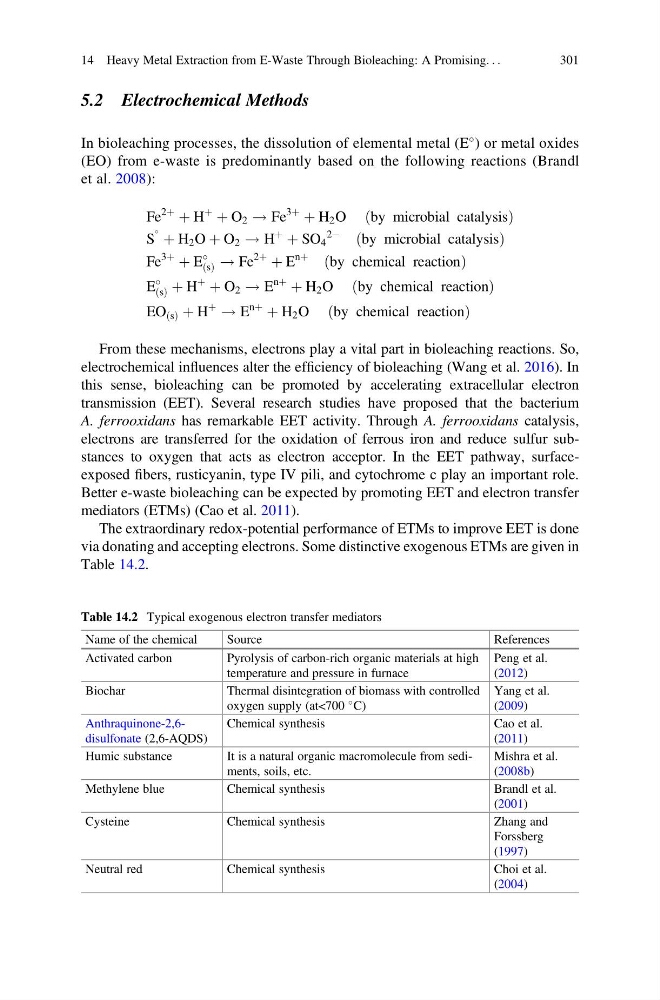
via donating and accepting electrons. Some distinctive exogenous ETMs are given in
Table 14.2.
Table 14.2 Typical exogenous electron transfer mediators
Name of the chemical
Source
References
Activated carbon
Pyrolysis of carbon-rich organic materials at high
temperature and pressure in furnace
Peng et al.
(2012)
Biochar
Thermal disintegration of biomass with controlled
oxygen supply (at<700
C)
Yang et al.
(2009)
Anthraquinone-2,6disulfonate (2,6-AQDS)
Chemical synthesis
Cao et al.
(2011)
Humic substance
It is a natural organic macromolecule from sediments, soils, etc.
Mishra et al.
(2008b)
Methylene blue
Chemical synthesis
Brandl et al.
(2001)
Cysteine
Chemical synthesis
Zhang and
Forssberg
(1997)
Neutral red
Chemical synthesis
Choi et al.
(2004)
14 Heavy Metal Extraction from E-Waste Through Bioleaching: A Promising. . .
301
In bioleaching processes, the dissolution of elemental metal (E
) or metal oxides
(EO) from e-waste is predominantly based on the following reactions (Brandl
et al. 2008):
Fe
2þ
þ H
þ
þ O 2 ! Fe
3þ
þ H 2 O
by microbial catalysis
ð
Þ
S
þ H 2 O þ O 2 ! H
þ
þ SO 4
2À
by microbial catalysis
ð
Þ
Fe
3þ
þ E
s
ð Þ ! Fe
2þ
þ E
nþ
by chemical reaction
ð
Þ
E
s
ð Þ þ H
þ
þ O 2 ! E
nþ
þ H 2 O
by chemical reaction
ð
Þ
EO s
ð Þ þ H
þ
! E
nþ
þ H 2 O
by chemical reaction
ð
Þ
From these mechanisms, electrons play a vital part in bioleaching reactions. So,
electrochemical influences alter the efficiency of bioleaching (Wang et al. 2016). In
this sense, bioleaching can be promoted by accelerating extracellular electron
transmission (EET). Several research studies have proposed that the bacterium
A. ferrooxidans has remarkable EET activity. Through A. ferrooxidans catalysis,
electrons are transferred for the oxidation of ferrous iron and reduce sulfur substances to oxygen that acts as electron acceptor. In the EET pathway, surfaceexposed fibers, rusticyanin, type IV pili, and cytochrome c play an important role.
Better e-waste bioleaching can be expected by promoting EET and electron transfer
mediators (ETMs) (Cao et al. 2011).
The extraordinary redox-potential performance of ETMs to improve EET is done
via donating and accepting electrons. Some distinctive exogenous ETMs are given in
Table 14.2.
Table 14.2 Typical exogenous electron transfer mediators
Name of the chemical
Source
References
Activated carbon
Pyrolysis of carbon-rich organic materials at high
temperature and pressure in furnace
Peng et al.
(2012)
Biochar
Thermal disintegration of biomass with controlled
oxygen supply (at<700
C)
Yang et al.
(2009)
Anthraquinone-2,6disulfonate (2,6-AQDS)
Chemical synthesis
Cao et al.
(2011)
Humic substance
It is a natural organic macromolecule from sediments, soils, etc.
Mishra et al.
(2008b)
Methylene blue
Chemical synthesis
Brandl et al.
(2001)
Cysteine
Chemical synthesis
Zhang and
Forssberg
(1997)
Neutral red
Chemical synthesis
Choi et al.
(2004)
14 Heavy Metal Extraction from E-Waste Through Bioleaching: A Promising. . .
301