

Sharma et al. (2018) established the advantage of biosurfactants in enhanced oil
recovery when they produced them from two isolates Bacillus amyloliquefaciens
SAS-1 and Bacillus subtilis BR-15, also confirming the other strong attributes such
as emulsification (60–78%) at a higher temperature and under flexible pH condition.
They also reported better oil recovery of 56.91 Æ 1.52 and 66.31 Æ 2.32%, respectively, for the two reported strains, which was 75–94% higher to that of conventional
ways (Sharma et al. 2018).
Many studies are reported on the role of biosurfactant on various environmental
applications, mainly on its role in oil recovery to minimize the pollution at the site.
El-Sheshtawya et al. (2016) employed Bacillus licheniformis and Candida albicans
for this purpose and recorded the recovery as 16.6 and 8.6 wt%, respectively. In the
similar context, Ivshina et al. (2016) postulated the exile of PAHs from soil using
Rhodococcus ruber biosurfactants and found out that the application of biosurfactant
assisted greatly the bio-treatability of the contaminated soils. In yet another investigation, Xia et al. (2011) evaluated the performance of biosurfactants from the three
bacteria: P. aeruginosa, B. subtilis, and Rhodococcus erythropolis. The results
revealed that P. aeruginosa exhibited a maximal emulsification index at 80%, and
the isolates also proved to be used in the elimination of heavy metals.
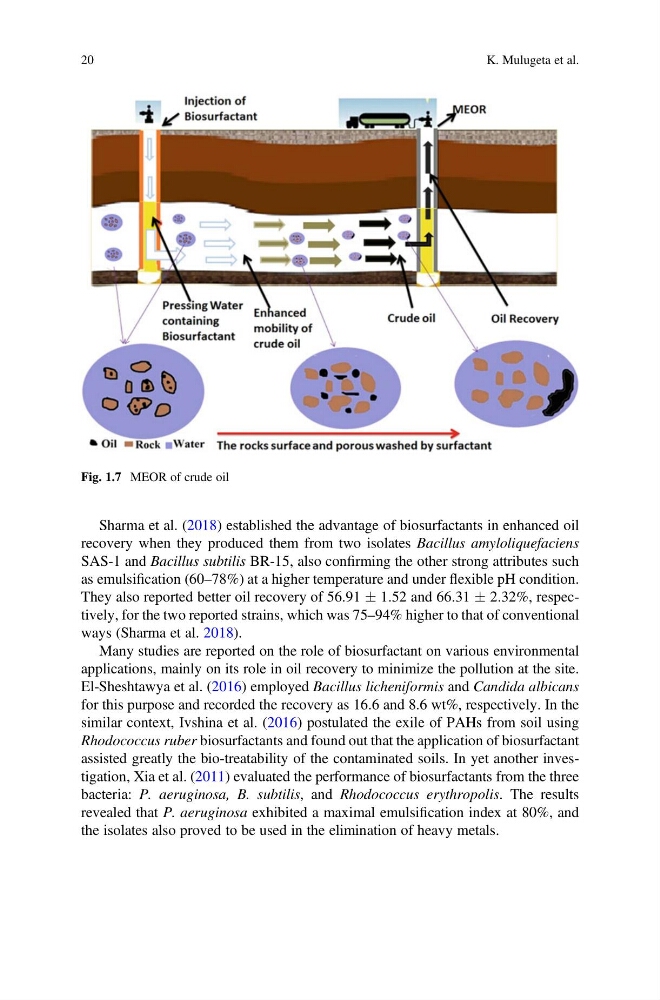
Fig. 1.7 MEOR of crude oil
20
K. Mulugeta et al.
recovery when they produced them from two isolates Bacillus amyloliquefaciens
SAS-1 and Bacillus subtilis BR-15, also confirming the other strong attributes such
as emulsification (60–78%) at a higher temperature and under flexible pH condition.
They also reported better oil recovery of 56.91 Æ 1.52 and 66.31 Æ 2.32%, respectively, for the two reported strains, which was 75–94% higher to that of conventional
ways (Sharma et al. 2018).
Many studies are reported on the role of biosurfactant on various environmental
applications, mainly on its role in oil recovery to minimize the pollution at the site.
El-Sheshtawya et al. (2016) employed Bacillus licheniformis and Candida albicans
for this purpose and recorded the recovery as 16.6 and 8.6 wt%, respectively. In the
similar context, Ivshina et al. (2016) postulated the exile of PAHs from soil using
Rhodococcus ruber biosurfactants and found out that the application of biosurfactant
assisted greatly the bio-treatability of the contaminated soils. In yet another investigation, Xia et al. (2011) evaluated the performance of biosurfactants from the three
bacteria: P. aeruginosa, B. subtilis, and Rhodococcus erythropolis. The results
revealed that P. aeruginosa exhibited a maximal emulsification index at 80%, and
the isolates also proved to be used in the elimination of heavy metals.
Fig. 1.7 MEOR of crude oil
20
K. Mulugeta et al.