

2012). In another study, microorganisms have removed 90% cadmium and 97%
zinc, using single-chamber MFCs by electricity simultaneously (Abourached et al.
2014). Iron(III) was removed using single-chamber MFC with >89% conversion
efficiency at 150 h (Li et al. 2014). Gold cations (Au
3+ ) were removed using
Shewanella putrefaciens, which showed electrodeposition of gold on grade G-10
graphite electrodes (Varia et al. 2014). Cobalt was reported to be recovered at a rate
of 0.079 Æ 0.001 mmolL
À1 h
À1 (Huang et al. 2015). Hence, large amount of energy
output have been generated using microorganisms in MFCs (Table 11.3).
The uses of microalgae in MFC have also been investigated (Rajesh and
Ghangrekar 2016). Microalgae such as Golenkinia sp. produced a maximum energy
Anode
Cathode
External
Proton Exchange Membrane
H
+
e
-
e
-
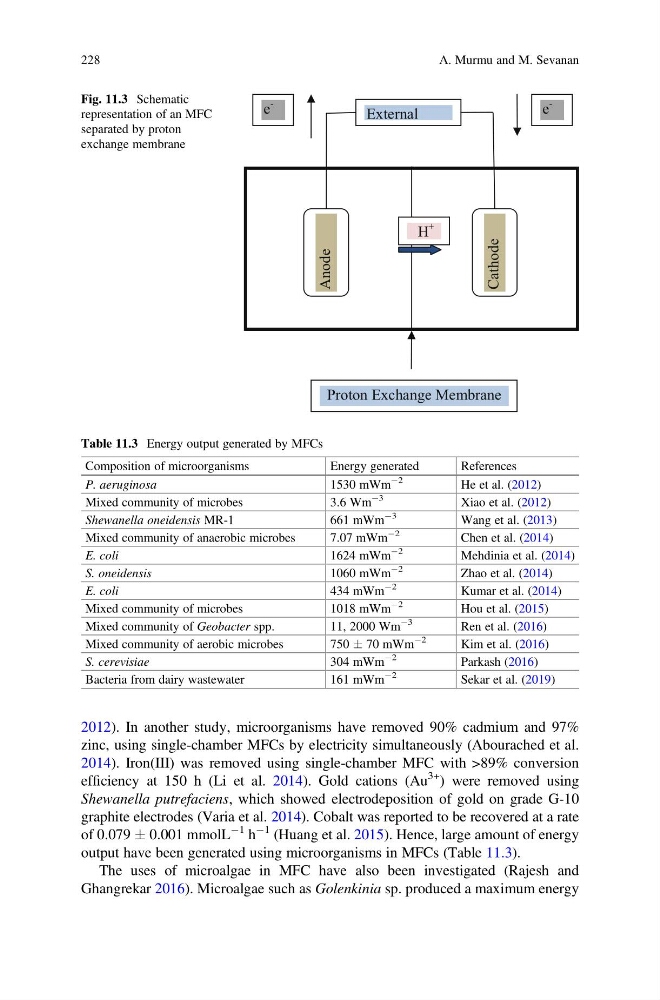
Fig. 11.3 Schematic
representation of an MFC
separated by proton
exchange membrane
Table 11.3 Energy output generated by MFCs
Composition of microorganisms
Energy generated
References
P. aeruginosa
1530 mWm
À2
He et al. (2012)
Mixed community of microbes
3.6 Wm
À3
Xiao et al. (2012)
Shewanella oneidensis MR-1
661 mWm
À3
Wang et al. (2013)
Mixed community of anaerobic microbes
7.07 mWm
À2
Chen et al. (2014)
E. coli
1624 mWm
À2
Mehdinia et al. (2014)
S. oneidensis
1060 mWm
À2
Zhao et al. (2014)
E. coli
434 mWm
À2
Kumar et al. (2014)
Mixed community of microbes
1018 mWm
À2
Hou et al. (2015)
Mixed community of Geobacter spp.
11, 2000 Wm
À3
Ren et al. (2016)
Mixed community of aerobic microbes
750 Æ 70 mWm
À2
Kim et al. (2016)
S. cerevisiae
304 mWm
À2
Parkash (2016)
Bacteria from dairy wastewater
161 mWm
À2
Sekar et al. (2019)
228
A. Murmu and M. Sevanan
zinc, using single-chamber MFCs by electricity simultaneously (Abourached et al.
2014). Iron(III) was removed using single-chamber MFC with >89% conversion
efficiency at 150 h (Li et al. 2014). Gold cations (Au
3+ ) were removed using
Shewanella putrefaciens, which showed electrodeposition of gold on grade G-10
graphite electrodes (Varia et al. 2014). Cobalt was reported to be recovered at a rate
of 0.079 Æ 0.001 mmolL
À1 h
À1 (Huang et al. 2015). Hence, large amount of energy
output have been generated using microorganisms in MFCs (Table 11.3).
The uses of microalgae in MFC have also been investigated (Rajesh and
Ghangrekar 2016). Microalgae such as Golenkinia sp. produced a maximum energy
Anode
Cathode
External
Proton Exchange Membrane
H
+
e
-
e
-
Fig. 11.3 Schematic
representation of an MFC
separated by proton
exchange membrane
Table 11.3 Energy output generated by MFCs
Composition of microorganisms
Energy generated
References
P. aeruginosa
1530 mWm
À2
He et al. (2012)
Mixed community of microbes
3.6 Wm
À3
Xiao et al. (2012)
Shewanella oneidensis MR-1
661 mWm
À3
Wang et al. (2013)
Mixed community of anaerobic microbes
7.07 mWm
À2
Chen et al. (2014)
E. coli
1624 mWm
À2
Mehdinia et al. (2014)
S. oneidensis
1060 mWm
À2
Zhao et al. (2014)
E. coli
434 mWm
À2
Kumar et al. (2014)
Mixed community of microbes
1018 mWm
À2
Hou et al. (2015)
Mixed community of Geobacter spp.
11, 2000 Wm
À3
Ren et al. (2016)
Mixed community of aerobic microbes
750 Æ 70 mWm
À2
Kim et al. (2016)
S. cerevisiae
304 mWm
À2
Parkash (2016)
Bacteria from dairy wastewater
161 mWm
À2
Sekar et al. (2019)
228
A. Murmu and M. Sevanan