

animal fat (Banat et al. 2014). Soap stocks or oil cakes are obtained from oilseed
processing involving the use of chemicals with the refining of seed-based edible oils.
Biosurfactant production achieves a greater yield when C. apicola or C. antarctica
grow on soap stock and oil refinery wastes (Bednarski et al. 2004). Corn steep liquor
is obtained from washing water and soaking of kernels and also fractioning into
germen (oil) and starch, which contains 40% solid matter. It contains a low-fat
content (0.9% to 1.2%), 21% to 45% proteins, approximately 8% ash (containing
K
+
, Ca
2+ , Mg
2+ , etc.), 20% to 26% lactic acid, and approximately 3% carbohydrates
(Helmy et al. 2011).
4.5 Media Formulation for Biosurfactant Production
Statistical methods such as Plackett-Burman, Taguchi designs and response surface methodology (RSM) are frequently used for media optimization to optimize
biosurfactant production due to the capacity of handling multiple data at the same
time (Eswari et al. 2016; Hassan et al. 2016; Santos et al. 2016b). RSM was used to
optimize media for rhamnolipid production by Pseudomonas aeruginosa using
blackstrap molasses as the sole carbon source (Raza et al. 2016). The factors
monitored were carbon:nitrogen (C:N) ratio, duration of incubation (time), and
total sugar.
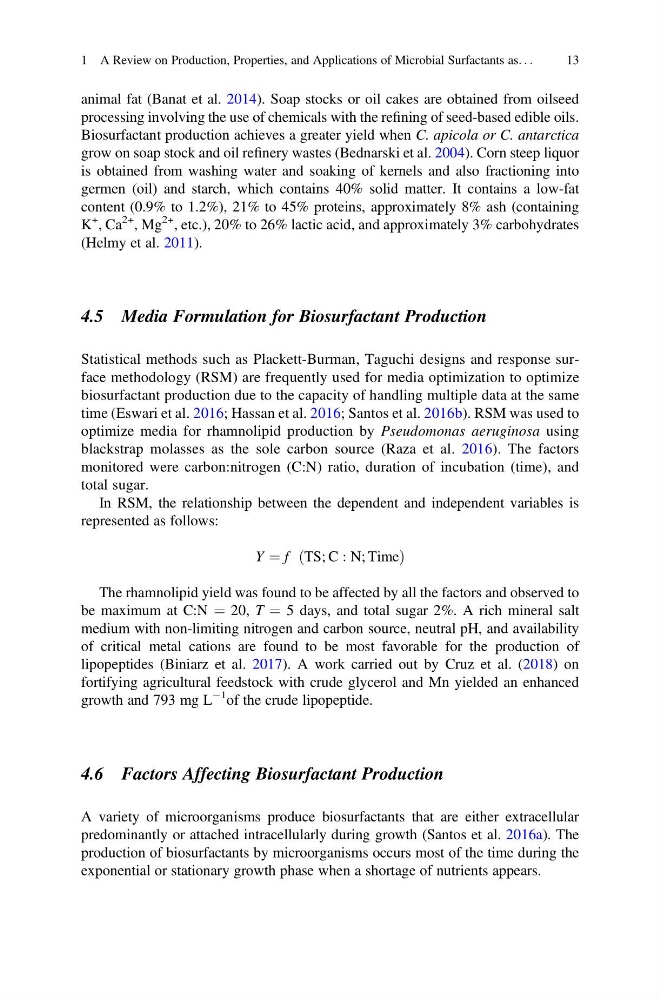
In RSM, the relationship between the dependent and independent variables is
represented as follows:
Y ¼ f TS; C : N; Time
ð
Þ
The rhamnolipid yield was found to be affected by all the factors and observed to
be maximum at C:N ¼ 20, T ¼ 5 days, and total sugar 2%. A rich mineral salt
medium with non-limiting nitrogen and carbon source, neutral pH, and availability
of critical metal cations are found to be most favorable for the production of
lipopeptides (Biniarz et al. 2017). A work carried out by Cruz et al. (2018) on
fortifying agricultural feedstock with crude glycerol and Mn yielded an enhanced
growth and 793 mg L
À1 of the crude lipopeptide.
4.6 Factors Affecting Biosurfactant Production
A variety of microorganisms produce biosurfactants that are either extracellular
predominantly or attached intracellularly during growth (Santos et al. 2016a). The
production of biosurfactants by microorganisms occurs most of the time during the
exponential or stationary growth phase when a shortage of nutrients appears.
1 A Review on Production, Properties, and Applications of Microbial Surfactants as. . .
13
processing involving the use of chemicals with the refining of seed-based edible oils.
Biosurfactant production achieves a greater yield when C. apicola or C. antarctica
grow on soap stock and oil refinery wastes (Bednarski et al. 2004). Corn steep liquor
is obtained from washing water and soaking of kernels and also fractioning into
germen (oil) and starch, which contains 40% solid matter. It contains a low-fat
content (0.9% to 1.2%), 21% to 45% proteins, approximately 8% ash (containing
K
+
, Ca
2+ , Mg
2+ , etc.), 20% to 26% lactic acid, and approximately 3% carbohydrates
(Helmy et al. 2011).
4.5 Media Formulation for Biosurfactant Production
Statistical methods such as Plackett-Burman, Taguchi designs and response surface methodology (RSM) are frequently used for media optimization to optimize
biosurfactant production due to the capacity of handling multiple data at the same
time (Eswari et al. 2016; Hassan et al. 2016; Santos et al. 2016b). RSM was used to
optimize media for rhamnolipid production by Pseudomonas aeruginosa using
blackstrap molasses as the sole carbon source (Raza et al. 2016). The factors
monitored were carbon:nitrogen (C:N) ratio, duration of incubation (time), and
total sugar.
In RSM, the relationship between the dependent and independent variables is
represented as follows:
Y ¼ f TS; C : N; Time
ð
Þ
The rhamnolipid yield was found to be affected by all the factors and observed to
be maximum at C:N ¼ 20, T ¼ 5 days, and total sugar 2%. A rich mineral salt
medium with non-limiting nitrogen and carbon source, neutral pH, and availability
of critical metal cations are found to be most favorable for the production of
lipopeptides (Biniarz et al. 2017). A work carried out by Cruz et al. (2018) on
fortifying agricultural feedstock with crude glycerol and Mn yielded an enhanced
growth and 793 mg L
À1 of the crude lipopeptide.
4.6 Factors Affecting Biosurfactant Production
A variety of microorganisms produce biosurfactants that are either extracellular
predominantly or attached intracellularly during growth (Santos et al. 2016a). The
production of biosurfactants by microorganisms occurs most of the time during the
exponential or stationary growth phase when a shortage of nutrients appears.
1 A Review on Production, Properties, and Applications of Microbial Surfactants as. . .
13