

4.3 Enzymes Involved in Pesticide Degradation
Enzymes produced by microorganisms in the soil in various metabolic processes are
the key to pesticide bioremediation. Enzymes play a major role in the biodegradation
of pesticides, at a significant rate, and can help in restoring the polluted environment
in the future (Rao et al. 2010). These enzymes also promote the degradation of
pesticides in target organisms, through inherent detoxification processes and developed metabolic resistance. The fungal enzymes oxidoreductase, laccase, and peroxidase are mainly used to remove polyaromatic hydrocarbon compounds from fresh
water, seawater, or terrestrial water (Balaji et al. 2014). Over the years,
organophosphorus-degrading enzymes have been studied in detail, and several
bacteria, fungi, and cyanobacteria that use organophosphorus compounds as carbon
and nutrient sources have also been isolated (Ghosal et al. 2016; Kandpal 2014).
5 Bioremediation Strategies and Its Application
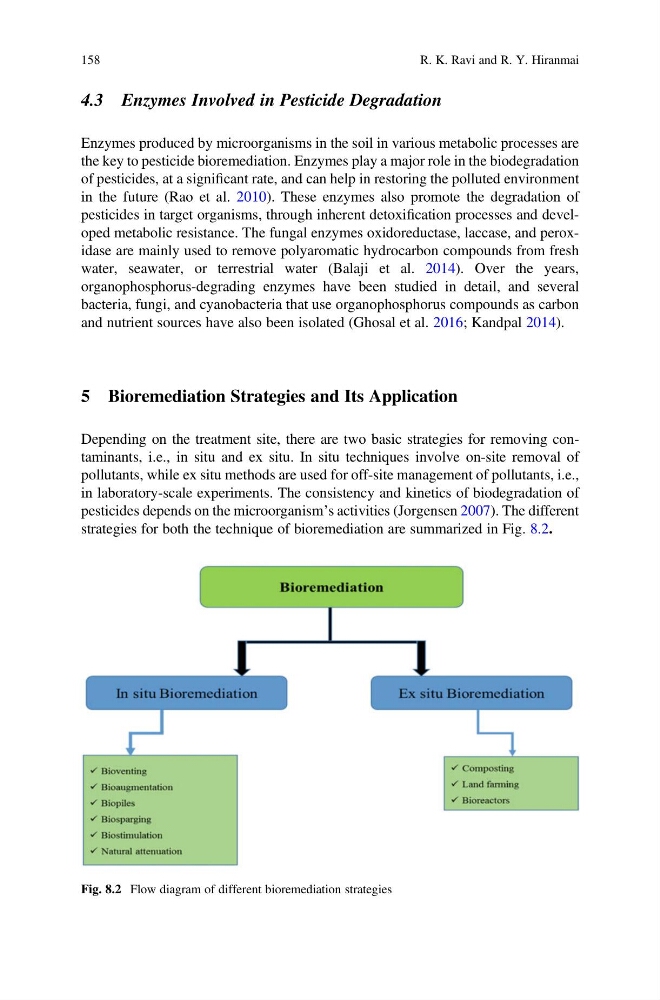
Depending on the treatment site, there are two basic strategies for removing contaminants, i.e., in situ and ex situ. In situ techniques involve on-site removal of
pollutants, while ex situ methods are used for off-site management of pollutants, i.e.,
in laboratory-scale experiments. The consistency and kinetics of biodegradation of
pesticides depends on the microorganism’s activities (Jorgensen 2007). The different
strategies for both the technique of bioremediation are summarized in Fig. 8.2.
Fig. 8.2 Flow diagram of different bioremediation strategies
158
R. K. Ravi and R. Y. Hiranmai
Enzymes produced by microorganisms in the soil in various metabolic processes are
the key to pesticide bioremediation. Enzymes play a major role in the biodegradation
of pesticides, at a significant rate, and can help in restoring the polluted environment
in the future (Rao et al. 2010). These enzymes also promote the degradation of
pesticides in target organisms, through inherent detoxification processes and developed metabolic resistance. The fungal enzymes oxidoreductase, laccase, and peroxidase are mainly used to remove polyaromatic hydrocarbon compounds from fresh
water, seawater, or terrestrial water (Balaji et al. 2014). Over the years,
organophosphorus-degrading enzymes have been studied in detail, and several
bacteria, fungi, and cyanobacteria that use organophosphorus compounds as carbon
and nutrient sources have also been isolated (Ghosal et al. 2016; Kandpal 2014).
5 Bioremediation Strategies and Its Application
Depending on the treatment site, there are two basic strategies for removing contaminants, i.e., in situ and ex situ. In situ techniques involve on-site removal of
pollutants, while ex situ methods are used for off-site management of pollutants, i.e.,
in laboratory-scale experiments. The consistency and kinetics of biodegradation of
pesticides depends on the microorganism’s activities (Jorgensen 2007). The different
strategies for both the technique of bioremediation are summarized in Fig. 8.2.
Fig. 8.2 Flow diagram of different bioremediation strategies
158
R. K. Ravi and R. Y. Hiranmai