

4 Microbial Diversity Involved in Degradation of Pesticides
Bioremediation is considered a natural and environmentally friendly technology that
can remove various toxic pollutants (Gupta et al. 2016). Microorganisms can
metabolize various chemical substances and their derived materials, such as organic
complexes, heavy metals, and chlorinated and non-chlorinated pesticides. Microorganisms, such as bacteria, fungi, or algae, can be used to remove organic or inorganic
chemicals from the soil environment (Megharaj and Naidu 2017). These potential
organisms can degrade toxic chemicals. They may be wild type or genetically
modified. Microbes can completely metabolize pollutants or change the chemical
structure, thereby promoting their degradation and effectively eliminating pollutants
from the environment (Abatenh et al. 2017; Rathour et al. 2018; Gupta et al. 2019).
Microorganisms use pesticides as carbon and nutrient sources through their own
multiple enzymatic mechanisms (Huang et al. 2018). Several bacteria that degrade
pesticides have been isolated, and the list is rapidly expanding (Bass and Field
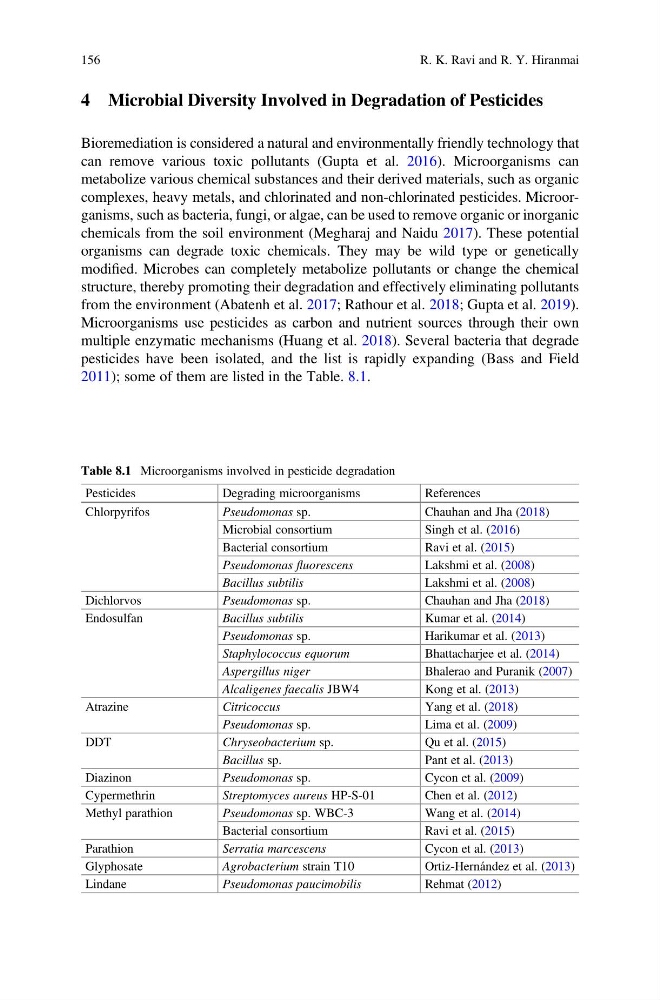
2011); some of them are listed in the Table. 8.1.
Table 8.1 Microorganisms involved in pesticide degradation
Pesticides
Degrading microorganisms
References
Chlorpyrifos
Pseudomonas sp.
Chauhan and Jha (2018)
Microbial consortium
Singh et al. (2016)
Bacterial consortium
Ravi et al. (2015)
Pseudomonas fluorescens
Lakshmi et al. (2008)
Bacillus subtilis
Lakshmi et al. (2008)
Dichlorvos
Pseudomonas sp.
Chauhan and Jha (2018)
Endosulfan
Bacillus subtilis
Kumar et al. (2014)
Pseudomonas sp.
Harikumar et al. (2013)
Staphylococcus equorum
Bhattacharjee et al. (2014)
Aspergillus niger
Bhalerao and Puranik (2007)
Alcaligenes faecalis JBW4
Kong et al. (2013)
Atrazine
Citricoccus
Yang et al. (2018)
Pseudomonas sp.
Lima et al. (2009)
DDT
Chryseobacterium sp.
Qu et al. (2015)
Bacillus sp.
Pant et al. (2013)
Diazinon
Pseudomonas sp.
Cycon et al. (2009)
Cypermethrin
Streptomyces aureus HP-S-01
Chen et al. (2012)
Methyl parathion
Pseudomonas sp. WBC-3
Wang et al. (2014)
Bacterial consortium
Ravi et al. (2015)
Parathion
Serratia marcescens
Cycon et al. (2013)
Glyphosate
Agrobacterium strain T10
Ortiz-Hernández et al. (2013)
Lindane
Pseudomonas paucimobilis
Rehmat (2012)
156
R. K. Ravi and R. Y. Hiranmai
Bioremediation is considered a natural and environmentally friendly technology that
can remove various toxic pollutants (Gupta et al. 2016). Microorganisms can
metabolize various chemical substances and their derived materials, such as organic
complexes, heavy metals, and chlorinated and non-chlorinated pesticides. Microorganisms, such as bacteria, fungi, or algae, can be used to remove organic or inorganic
chemicals from the soil environment (Megharaj and Naidu 2017). These potential
organisms can degrade toxic chemicals. They may be wild type or genetically
modified. Microbes can completely metabolize pollutants or change the chemical
structure, thereby promoting their degradation and effectively eliminating pollutants
from the environment (Abatenh et al. 2017; Rathour et al. 2018; Gupta et al. 2019).
Microorganisms use pesticides as carbon and nutrient sources through their own
multiple enzymatic mechanisms (Huang et al. 2018). Several bacteria that degrade
pesticides have been isolated, and the list is rapidly expanding (Bass and Field
2011); some of them are listed in the Table. 8.1.
Table 8.1 Microorganisms involved in pesticide degradation
Pesticides
Degrading microorganisms
References
Chlorpyrifos
Pseudomonas sp.
Chauhan and Jha (2018)
Microbial consortium
Singh et al. (2016)
Bacterial consortium
Ravi et al. (2015)
Pseudomonas fluorescens
Lakshmi et al. (2008)
Bacillus subtilis
Lakshmi et al. (2008)
Dichlorvos
Pseudomonas sp.
Chauhan and Jha (2018)
Endosulfan
Bacillus subtilis
Kumar et al. (2014)
Pseudomonas sp.
Harikumar et al. (2013)
Staphylococcus equorum
Bhattacharjee et al. (2014)
Aspergillus niger
Bhalerao and Puranik (2007)
Alcaligenes faecalis JBW4
Kong et al. (2013)
Atrazine
Citricoccus
Yang et al. (2018)
Pseudomonas sp.
Lima et al. (2009)
DDT
Chryseobacterium sp.
Qu et al. (2015)
Bacillus sp.
Pant et al. (2013)
Diazinon
Pseudomonas sp.
Cycon et al. (2009)
Cypermethrin
Streptomyces aureus HP-S-01
Chen et al. (2012)
Methyl parathion
Pseudomonas sp. WBC-3
Wang et al. (2014)
Bacterial consortium
Ravi et al. (2015)
Parathion
Serratia marcescens
Cycon et al. (2013)
Glyphosate
Agrobacterium strain T10
Ortiz-Hernández et al. (2013)
Lindane
Pseudomonas paucimobilis
Rehmat (2012)
156
R. K. Ravi and R. Y. Hiranmai