

span, the term biodegradation is often used in ecology, waste management, and
environmental remediation. The global annual use of pesticides is about 2 million
tons, of which 24% are used in the United States, 45% are used in Europe, and the
remaining 25% are used in other parts of the world. According to reports, India
consumes 3.8% of the world’s total pesticide production. The consumption of
agricultural pesticides in India, South Korea, and Japan is 0.5, 6.6, and 12.0 kg ha1, respectively (Gupta 2004). Earlier, the application of pesticides was relatively
helpful in reducing crop yield losses caused by pests, thus opening the way for
increasing crop productivity. However, the widespread use of pesticides has caused
pollution of the natural environment and has caused some long-term effects on
human society (Bhanti and Taneja 2007). Due to the persistence nature, lack of
selectivity, biomagnification, and accumulation under different nutrient levels, it is
reported that organochlorine is the cause of pest resistance development and harmful
effects on nontarget organisms (Carson 1962). The potential threat to all living
things caused by the abuse of pesticides has now become one of the most serious
environmental or health problems in the world. People mainly complain about the
availability of pesticides in drinking water, vegetables, mammalian blood, human
food, dairy products, fat samples, and other foods. The pesticide residues are present
in different environmental samples through the contaminated food chain, which
directly indicates the acute or chronic exposure of human beings to pesticides.
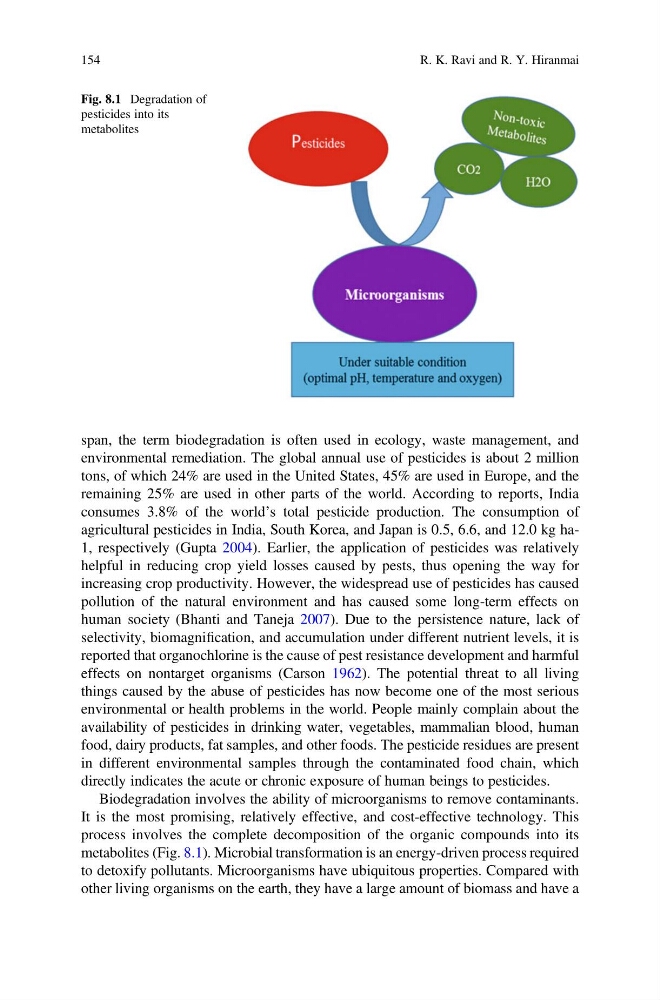
Biodegradation involves the ability of microorganisms to remove contaminants.
It is the most promising, relatively effective, and cost-effective technology. This
process involves the complete decomposition of the organic compounds into its
metabolites (Fig. 8.1). Microbial transformation is an energy-driven process required
to detoxify pollutants. Microorganisms have ubiquitous properties. Compared with
other living organisms on the earth, they have a large amount of biomass and have a
Fig. 8.1 Degradation of
pesticides into its
metabolites
154
R. K. Ravi and R. Y. Hiranmai
environmental remediation. The global annual use of pesticides is about 2 million
tons, of which 24% are used in the United States, 45% are used in Europe, and the
remaining 25% are used in other parts of the world. According to reports, India
consumes 3.8% of the world’s total pesticide production. The consumption of
agricultural pesticides in India, South Korea, and Japan is 0.5, 6.6, and 12.0 kg ha1, respectively (Gupta 2004). Earlier, the application of pesticides was relatively
helpful in reducing crop yield losses caused by pests, thus opening the way for
increasing crop productivity. However, the widespread use of pesticides has caused
pollution of the natural environment and has caused some long-term effects on
human society (Bhanti and Taneja 2007). Due to the persistence nature, lack of
selectivity, biomagnification, and accumulation under different nutrient levels, it is
reported that organochlorine is the cause of pest resistance development and harmful
effects on nontarget organisms (Carson 1962). The potential threat to all living
things caused by the abuse of pesticides has now become one of the most serious
environmental or health problems in the world. People mainly complain about the
availability of pesticides in drinking water, vegetables, mammalian blood, human
food, dairy products, fat samples, and other foods. The pesticide residues are present
in different environmental samples through the contaminated food chain, which
directly indicates the acute or chronic exposure of human beings to pesticides.
Biodegradation involves the ability of microorganisms to remove contaminants.
It is the most promising, relatively effective, and cost-effective technology. This
process involves the complete decomposition of the organic compounds into its
metabolites (Fig. 8.1). Microbial transformation is an energy-driven process required
to detoxify pollutants. Microorganisms have ubiquitous properties. Compared with
other living organisms on the earth, they have a large amount of biomass and have a
Fig. 8.1 Degradation of
pesticides into its
metabolites
154
R. K. Ravi and R. Y. Hiranmai