

2.10 Challenges and Prospects
Bacterial polymers have been deeply scrutinized for the sake of substituting the
current available chemical technologies with environmental remediation strategy,
and exploring its literature shows much promise due to its flexible and attractive
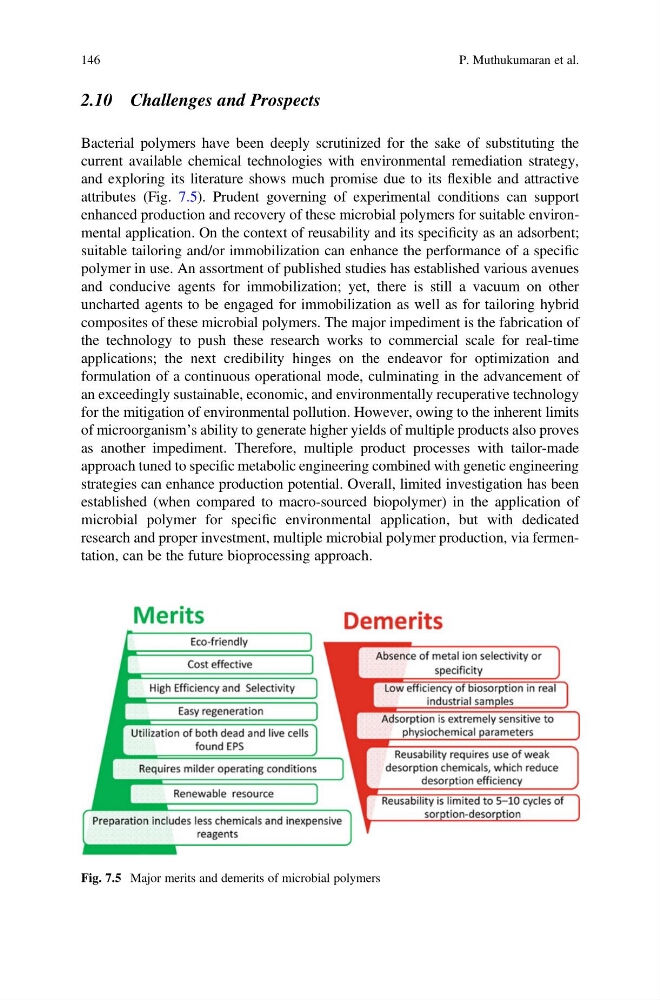
attributes (Fig. 7.5). Prudent governing of experimental conditions can support
enhanced production and recovery of these microbial polymers for suitable environmental application. On the context of reusability and its specificity as an adsorbent;
suitable tailoring and/or immobilization can enhance the performance of a specific
polymer in use. An assortment of published studies has established various avenues
and conducive agents for immobilization; yet, there is still a vacuum on other
uncharted agents to be engaged for immobilization as well as for tailoring hybrid
composites of these microbial polymers. The major impediment is the fabrication of
the technology to push these research works to commercial scale for real-time
applications; the next credibility hinges on the endeavor for optimization and
formulation of a continuous operational mode, culminating in the advancement of
an exceedingly sustainable, economic, and environmentally recuperative technology
for the mitigation of environmental pollution. However, owing to the inherent limits
of microorganism’s ability to generate higher yields of multiple products also proves
as another impediment. Therefore, multiple product processes with tailor-made
approach tuned to specific metabolic engineering combined with genetic engineering
strategies can enhance production potential. Overall, limited investigation has been
established (when compared to macro-sourced biopolymer) in the application of
microbial polymer for specific environmental application, but with dedicated
research and proper investment, multiple microbial polymer production, via fermentation, can be the future bioprocessing approach.
Fig. 7.5 Major merits and demerits of microbial polymers
146
P. Muthukumaran et al.
Bacterial polymers have been deeply scrutinized for the sake of substituting the
current available chemical technologies with environmental remediation strategy,
and exploring its literature shows much promise due to its flexible and attractive
attributes (Fig. 7.5). Prudent governing of experimental conditions can support
enhanced production and recovery of these microbial polymers for suitable environmental application. On the context of reusability and its specificity as an adsorbent;
suitable tailoring and/or immobilization can enhance the performance of a specific
polymer in use. An assortment of published studies has established various avenues
and conducive agents for immobilization; yet, there is still a vacuum on other
uncharted agents to be engaged for immobilization as well as for tailoring hybrid
composites of these microbial polymers. The major impediment is the fabrication of
the technology to push these research works to commercial scale for real-time
applications; the next credibility hinges on the endeavor for optimization and
formulation of a continuous operational mode, culminating in the advancement of
an exceedingly sustainable, economic, and environmentally recuperative technology
for the mitigation of environmental pollution. However, owing to the inherent limits
of microorganism’s ability to generate higher yields of multiple products also proves
as another impediment. Therefore, multiple product processes with tailor-made
approach tuned to specific metabolic engineering combined with genetic engineering
strategies can enhance production potential. Overall, limited investigation has been
established (when compared to macro-sourced biopolymer) in the application of
microbial polymer for specific environmental application, but with dedicated
research and proper investment, multiple microbial polymer production, via fermentation, can be the future bioprocessing approach.
Fig. 7.5 Major merits and demerits of microbial polymers
146
P. Muthukumaran et al.