

production cost. The current review emphasizes the overall view of biosurfactants,
their properties, classification, source, production, and characterization along with its
environmental applications.
Keywords Biosurfactants · Environmental applications · Sustainable · Properties ·
Screening · Characterization
1 Introduction
Surfactants or surface-active agents are amphipathic molecules and can form
micelles, as they are a group of molecular compounds with hydrophilic and hydrophobic moieties and have the potential to distribute themselves between two immiscible fluids. This property of surfactant tends to reduce surface tension or interfacial
tension (ST/IFT) and cause the solubility of nonpolar compounds in polar solvents
(Udoh and Vinogradov 2019). The nonpolar moiety is a hydrocarbon chain, whereas
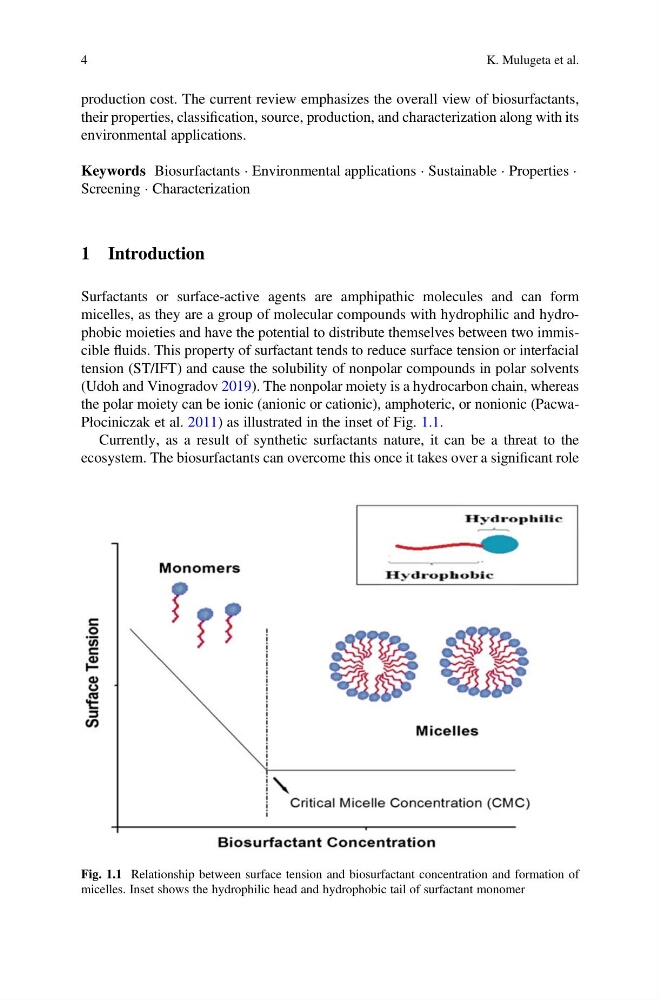
the polar moiety can be ionic (anionic or cationic), amphoteric, or nonionic (PacwaPłociniczak et al. 2011) as illustrated in the inset of Fig. 1.1.
Currently, as a result of synthetic surfactants nature, it can be a threat to the
ecosystem. The biosurfactants can overcome this once it takes over a significant role
Fig. 1.1 Relationship between surface tension and biosurfactant concentration and formation of
micelles. Inset shows the hydrophilic head and hydrophobic tail of surfactant monomer
4
K. Mulugeta et al.
their properties, classification, source, production, and characterization along with its
environmental applications.
Keywords Biosurfactants · Environmental applications · Sustainable · Properties ·
Screening · Characterization
1 Introduction
Surfactants or surface-active agents are amphipathic molecules and can form
micelles, as they are a group of molecular compounds with hydrophilic and hydrophobic moieties and have the potential to distribute themselves between two immiscible fluids. This property of surfactant tends to reduce surface tension or interfacial
tension (ST/IFT) and cause the solubility of nonpolar compounds in polar solvents
(Udoh and Vinogradov 2019). The nonpolar moiety is a hydrocarbon chain, whereas
the polar moiety can be ionic (anionic or cationic), amphoteric, or nonionic (PacwaPłociniczak et al. 2011) as illustrated in the inset of Fig. 1.1.
Currently, as a result of synthetic surfactants nature, it can be a threat to the
ecosystem. The biosurfactants can overcome this once it takes over a significant role
Fig. 1.1 Relationship between surface tension and biosurfactant concentration and formation of
micelles. Inset shows the hydrophilic head and hydrophobic tail of surfactant monomer
4
K. Mulugeta et al.