

56
Algae
triradiate, quadrate, and pentagonal variation of this symmetry, with a valve arranged in reference
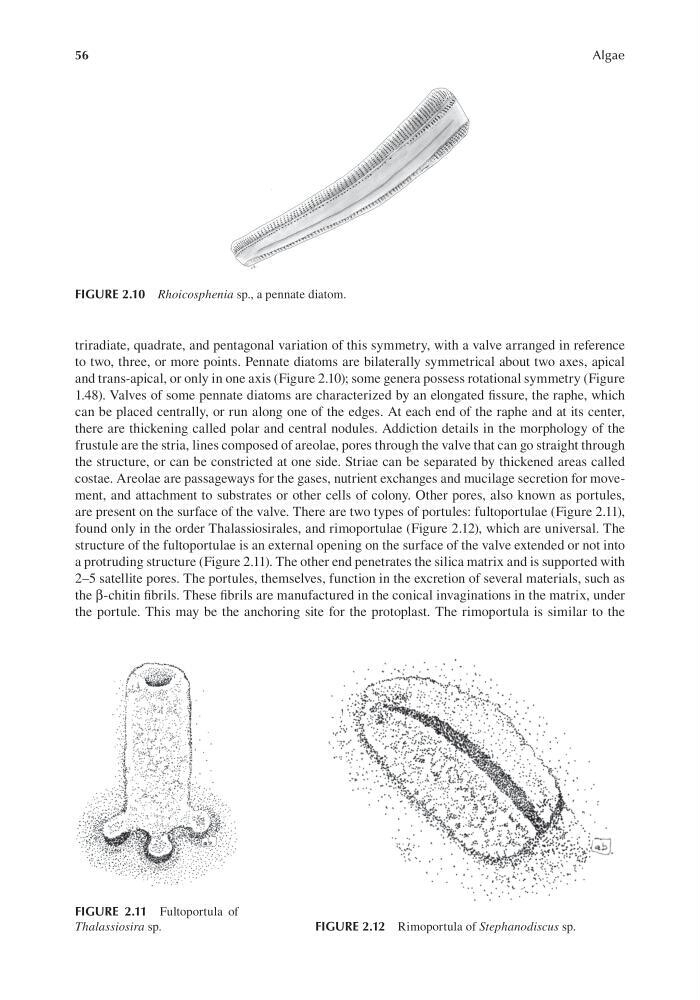
to two, three, or more points. Pennate diatoms are bilaterally symmetrical about two axes, apical
and trans-apical, or only in one axis (Figure 2.10); some genera possess rotational symmetry (Figure
1.48). Valves of some pennate diatoms are characterized by an elongated fissure, the raphe, which
can be placed centrally, or run along one of the edges. At each end of the raphe and at its center,
there are thickening called polar and central nodules. Addiction details in the morphology of the
frustule are the stria, lines composed of areolae, pores through the valve that can go straight through
the structure, or can be constricted at one side. Striae can be separated by thickened areas called
costae. Areolae are passageways for the gases, nutrient exchanges and mucilage secretion for movement, and attachment to substrates or other cells of colony. Other pores, also known as portules,
are present on the surface of the valve. There are two types of portules: fultoportulae (Figure 2.11),
found only in the order Thalassiosirales, and rimoportulae (Figure 2.12), which are universal. The
structure of the fultoportulae is an external opening on the surface of the valve extended or not into
a protruding structure (Figure 2.11). The other end penetrates the silica matrix and is supported with
2–5 satellite pores. The portules, themselves, function in the excretion of several materials, such as
the β-chitin fibrils. These fibrils are manufactured in the conical invaginations in the matrix, under
the portule. This may be the anchoring site for the protoplast. The rimoportula is similar to the
FIGURE 2.10 Rhoicosphenia sp., a pennate diatom.
FIGURE 2.11 Fultoportula of
Thalassiosira sp.
FIGURE 2.12 Rimoportula of Stephanodiscus sp.
Algae
triradiate, quadrate, and pentagonal variation of this symmetry, with a valve arranged in reference
to two, three, or more points. Pennate diatoms are bilaterally symmetrical about two axes, apical
and trans-apical, or only in one axis (Figure 2.10); some genera possess rotational symmetry (Figure
1.48). Valves of some pennate diatoms are characterized by an elongated fissure, the raphe, which
can be placed centrally, or run along one of the edges. At each end of the raphe and at its center,
there are thickening called polar and central nodules. Addiction details in the morphology of the
frustule are the stria, lines composed of areolae, pores through the valve that can go straight through
the structure, or can be constricted at one side. Striae can be separated by thickened areas called
costae. Areolae are passageways for the gases, nutrient exchanges and mucilage secretion for movement, and attachment to substrates or other cells of colony. Other pores, also known as portules,
are present on the surface of the valve. There are two types of portules: fultoportulae (Figure 2.11),
found only in the order Thalassiosirales, and rimoportulae (Figure 2.12), which are universal. The
structure of the fultoportulae is an external opening on the surface of the valve extended or not into
a protruding structure (Figure 2.11). The other end penetrates the silica matrix and is supported with
2–5 satellite pores. The portules, themselves, function in the excretion of several materials, such as
the β-chitin fibrils. These fibrils are manufactured in the conical invaginations in the matrix, under
the portule. This may be the anchoring site for the protoplast. The rimoportula is similar to the
FIGURE 2.10 Rhoicosphenia sp., a pennate diatom.
FIGURE 2.11 Fultoportula of
Thalassiosira sp.
FIGURE 2.12 Rimoportula of Stephanodiscus sp.