

33
General Overview
streptophytes; the only genus of Mesostigmatophyceae is Mesotigma with two species, M. viride
and M. grande. These isogamous algae are freshwater, scaly, asymmetrical, and unicellular
biflagellate, and unlike other charophytes, possess two multilayered structures and an eyespot.
Chlorokybophyceae (Figure 1.1z) consists of a sole representative, Chlorokybus atmophyticus,
occurring in moist terrestrial habitats where it forms sarcinoid packets of a few cells enveloped in
a common mucilaginous matrix, which reproduce asexually by asymmetrical motile spores possessing a single multilayered structure. Klebsormidiophyceae (Figure 1.1aa) represent the common
ancestor of the remaining streptophytes, in which multicellularity evolved in the form of unbranched
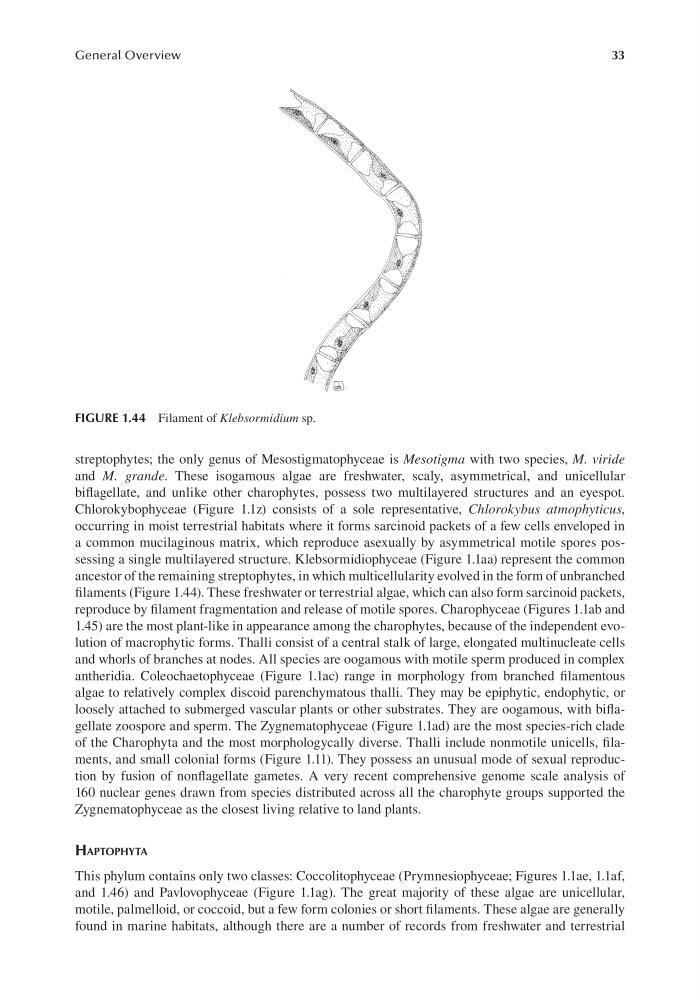
filaments (Figure 1.44). These freshwater or terrestrial algae, which can also form sarcinoid packets,
reproduce by filament fragmentation and release of motile spores. Charophyceae (Figures 1.1ab and
1.45) are the most plant-like in appearance among the charophytes, because of the independent evolution of macrophytic forms. Thalli consist of a central stalk of large, elongated multinucleate cells
and whorls of branches at nodes. All species are oogamous with motile sperm produced in complex
antheridia. Coleochaetophyceae (Figure 1.1ac) range in morphology from branched filamentous
algae to relatively complex discoid parenchymatous thalli. They may be epiphytic, endophytic, or
loosely attached to submerged vascular plants or other substrates. They are oogamous, with biflagellate zoospore and sperm. The Zygnematophyceae (Figure 1.1ad) are the most species-rich clade
of the Charophyta and the most morphologycally diverse. Thalli include nonmotile unicells, filaments, and small colonial forms (Figure 1.11). They possess an unusual mode of sexual reproduction by fusion of nonflagellate gametes. A very recent comprehensive genome scale analysis of
160 nuclear genes drawn from species distributed across all the charophyte groups supported the
Zygnematophyceae as the closest living relative to land plants.
hapTophyTa
This phylum contains only two classes: Coccolitophyceae (Prymnesiophyceae; Figures 1.1ae, 1.1af,
and 1.46) and Pavlovophyceae (Figure 1.1ag). The great majority of these algae are unicellular,
motile, palmelloid, or coccoid, but a few form colonies or short filaments. These algae are generally
found in marine habitats, although there are a number of records from freshwater and terrestrial
FIGURE 1.44 Filament of Klebsormidium sp.
General Overview
streptophytes; the only genus of Mesostigmatophyceae is Mesotigma with two species, M. viride
and M. grande. These isogamous algae are freshwater, scaly, asymmetrical, and unicellular
biflagellate, and unlike other charophytes, possess two multilayered structures and an eyespot.
Chlorokybophyceae (Figure 1.1z) consists of a sole representative, Chlorokybus atmophyticus,
occurring in moist terrestrial habitats where it forms sarcinoid packets of a few cells enveloped in
a common mucilaginous matrix, which reproduce asexually by asymmetrical motile spores possessing a single multilayered structure. Klebsormidiophyceae (Figure 1.1aa) represent the common
ancestor of the remaining streptophytes, in which multicellularity evolved in the form of unbranched
filaments (Figure 1.44). These freshwater or terrestrial algae, which can also form sarcinoid packets,
reproduce by filament fragmentation and release of motile spores. Charophyceae (Figures 1.1ab and
1.45) are the most plant-like in appearance among the charophytes, because of the independent evolution of macrophytic forms. Thalli consist of a central stalk of large, elongated multinucleate cells
and whorls of branches at nodes. All species are oogamous with motile sperm produced in complex
antheridia. Coleochaetophyceae (Figure 1.1ac) range in morphology from branched filamentous
algae to relatively complex discoid parenchymatous thalli. They may be epiphytic, endophytic, or
loosely attached to submerged vascular plants or other substrates. They are oogamous, with biflagellate zoospore and sperm. The Zygnematophyceae (Figure 1.1ad) are the most species-rich clade
of the Charophyta and the most morphologycally diverse. Thalli include nonmotile unicells, filaments, and small colonial forms (Figure 1.11). They possess an unusual mode of sexual reproduction by fusion of nonflagellate gametes. A very recent comprehensive genome scale analysis of
160 nuclear genes drawn from species distributed across all the charophyte groups supported the
Zygnematophyceae as the closest living relative to land plants.
hapTophyTa
This phylum contains only two classes: Coccolitophyceae (Prymnesiophyceae; Figures 1.1ae, 1.1af,
and 1.46) and Pavlovophyceae (Figure 1.1ag). The great majority of these algae are unicellular,
motile, palmelloid, or coccoid, but a few form colonies or short filaments. These algae are generally
found in marine habitats, although there are a number of records from freshwater and terrestrial
FIGURE 1.44 Filament of Klebsormidium sp.