

25
General Overview
soil samples also. They possess only chlorophyll a; accessory pigments such as phycoerythrocyanin, phycocyanin, and allophycocyanin are organized in phycobilisomes. Carotenoids such as
β-carotenes and xantophyll zeaxanthins are also present in their chloroplast. This unusual chloroplast lies in a special vacuole and presents a thin peptidoglycan wall located between the two plastid
outer membranes. Thylakoids are not stacked. The chloroplast DNA is concentrated at the center
of the chloroplast, where typical carboxysomes are present, which contain the RuBisCo enzyme.
Starch is the reserve polysaccharide, which is accumulated in granular form inside the cytoplasm,
but outside the chloroplast. Glaucophyceae live photoautotrophically with the aid of blue-green
plastids often referred to as cyanelles. Cyanelles are presumed to be phylogenetically derived from
endosymbiotic cyanobacterium. Sexual reproduction is unknown in this division.
rhodophyTa
This phylum is currently divided into two subphyla, Cyanidiophytina, with the single class of
Cyanidiophyceae, and Rhodophytina with the remaining six classes. Red algae consist mostly
of seaweed, but including genera of free-living unicellular microalgae. They inhabit prevalently
marine ecosystems, but are also present in freshwater and terrestrial environment. The lack of any
flagellate stages, the lack of centrioles, and the presence of accessory phycobiliproteins (allophycocyanin, phycocyanin, and phycoerythrin) organized in phycobilisomes (shared with Cyanobacteria,
Cryptophyta, and Glaucophyta) are unique features of these algae; chlorophyll a is the only chlorophyll. Chloroplasts are enclosed by a double-unit membrane; thylakoids do not stack at all, but
lie equidistant and singly within the chloroplast. One thylakoid is present around the periphery of
the chloroplast, running parallel to the chloroplast’s internal membrane. The chloroplastic DNA is
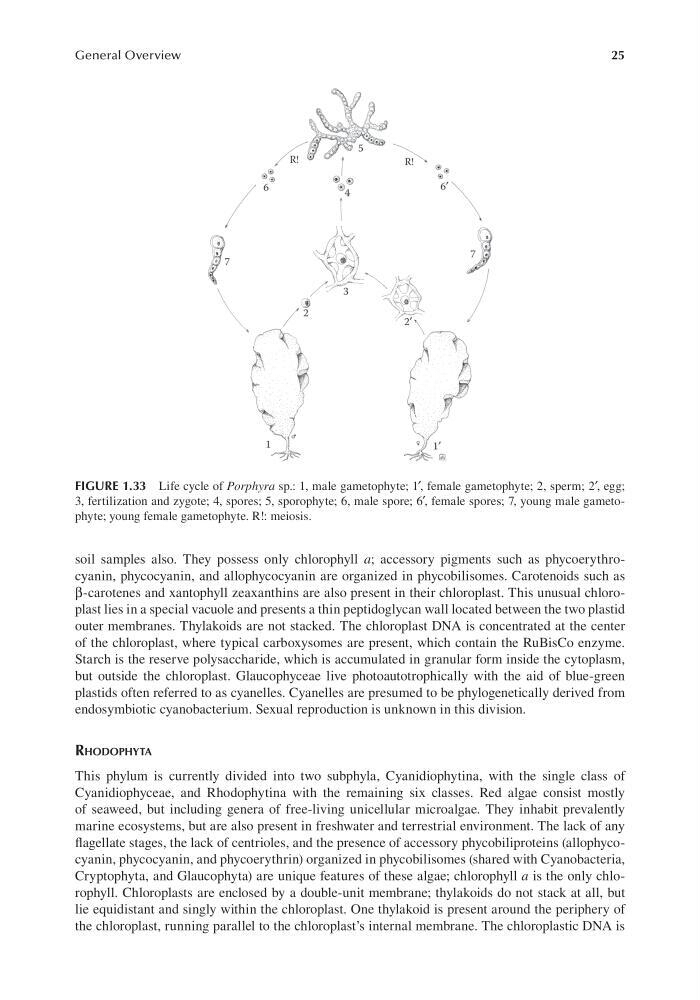
FIGURE 1.33 Life cycle of Porphyra sp.: 1, male gametophyte; 1′, female gametophyte; 2, sperm; 2′, egg;
3, fertilization and zygote; 4, spores; 5, sporophyte; 6, male spore; 6′, female spores; 7, young male gametophyte; young female gametophyte. R!: meiosis.
General Overview
soil samples also. They possess only chlorophyll a; accessory pigments such as phycoerythrocyanin, phycocyanin, and allophycocyanin are organized in phycobilisomes. Carotenoids such as
β-carotenes and xantophyll zeaxanthins are also present in their chloroplast. This unusual chloroplast lies in a special vacuole and presents a thin peptidoglycan wall located between the two plastid
outer membranes. Thylakoids are not stacked. The chloroplast DNA is concentrated at the center
of the chloroplast, where typical carboxysomes are present, which contain the RuBisCo enzyme.
Starch is the reserve polysaccharide, which is accumulated in granular form inside the cytoplasm,
but outside the chloroplast. Glaucophyceae live photoautotrophically with the aid of blue-green
plastids often referred to as cyanelles. Cyanelles are presumed to be phylogenetically derived from
endosymbiotic cyanobacterium. Sexual reproduction is unknown in this division.
rhodophyTa
This phylum is currently divided into two subphyla, Cyanidiophytina, with the single class of
Cyanidiophyceae, and Rhodophytina with the remaining six classes. Red algae consist mostly
of seaweed, but including genera of free-living unicellular microalgae. They inhabit prevalently
marine ecosystems, but are also present in freshwater and terrestrial environment. The lack of any
flagellate stages, the lack of centrioles, and the presence of accessory phycobiliproteins (allophycocyanin, phycocyanin, and phycoerythrin) organized in phycobilisomes (shared with Cyanobacteria,
Cryptophyta, and Glaucophyta) are unique features of these algae; chlorophyll a is the only chlorophyll. Chloroplasts are enclosed by a double-unit membrane; thylakoids do not stack at all, but
lie equidistant and singly within the chloroplast. One thylakoid is present around the periphery of
the chloroplast, running parallel to the chloroplast’s internal membrane. The chloroplastic DNA is
FIGURE 1.33 Life cycle of Porphyra sp.: 1, male gametophyte; 1′, female gametophyte; 2, sperm; 2′, egg;
3, fertilization and zygote; 4, spores; 5, sporophyte; 6, male spore; 6′, female spores; 7, young male gametophyte; young female gametophyte. R!: meiosis.